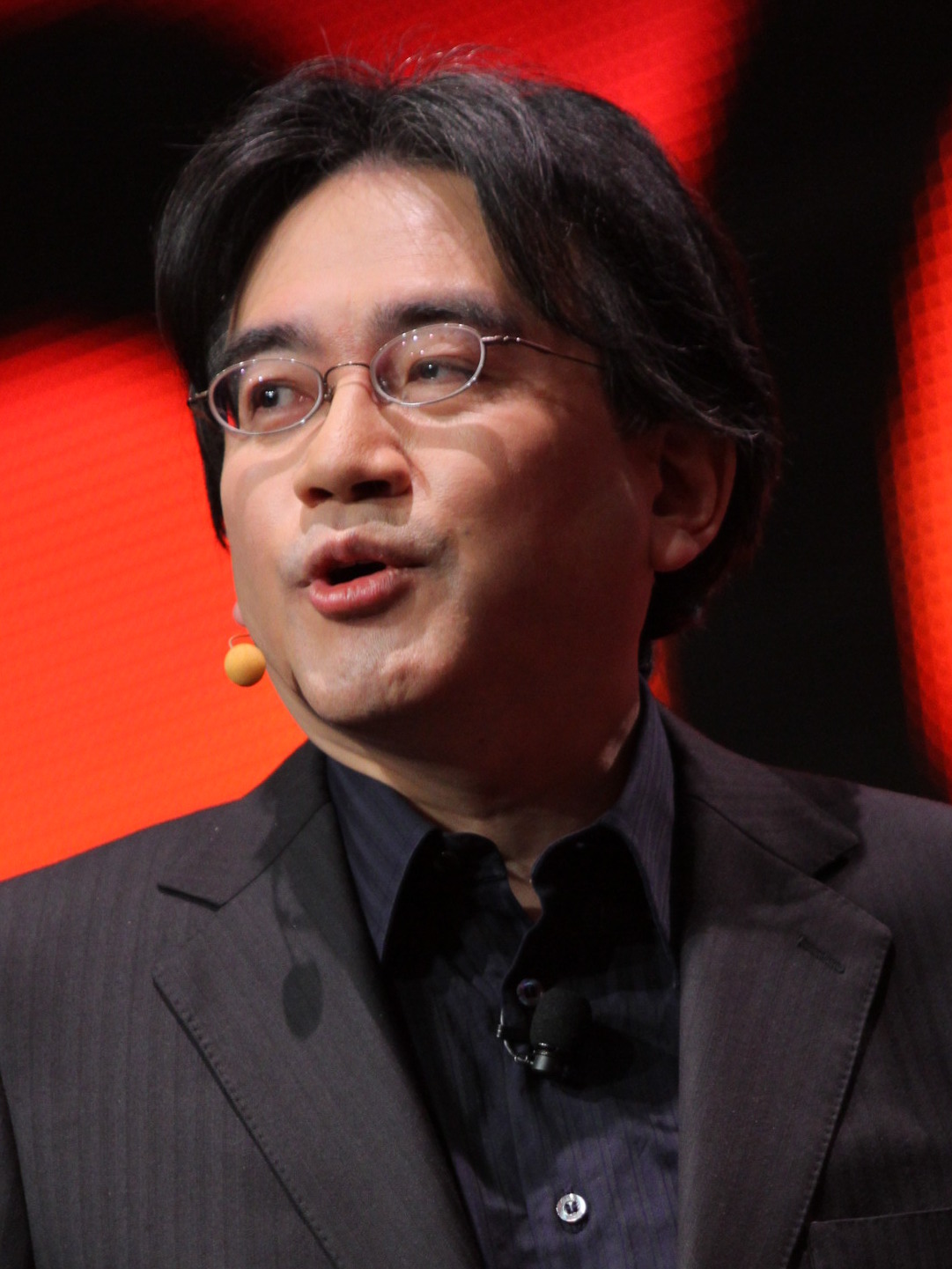

Photo: Official GDC (Game Developers Conference), 2011, CC BY 2.0 · Wikimedia Commons, 'Satoru Iwata GDC 2011 (cropped).jpg' -- a crop (by Commons user TheSilksongPikmin) of 'Satoru Iwata GDC 2011.jpg' (2832 x 4256 pixels), itself from the Official GDC Flickr stream photo 'GDC 2011 3/2 (day 2)' (photo 5492709996), taken 2 March 2011; CC BY 2.0 on the live Flickr page (checked 2026-10-24: licence CC BY 2.0, taken 2 March 2011, owner Official GDC) and on Commons, where the Flickr upload carries a human licence review (reviewer Jean-Frederic, 26 March 2011). The cropped file is 1081 x 1441 pixels (SHA-1 of the stored file 034a5112575750b3f7891bd724d4900c9387c89b); saved as downloaded, never upscaled. The Commons page also carries the generic personality-rights notice. Caveats: the individual photographer is not named (credit is to the conference's official Flickr account); the licence rests on the Flickr owner's CC BY 2.0 and the Commons review. · CC BY 2.0
executive · Contemporary
Satoru Iwata
1959–2015
Known For
Not yet included in personality matching — the documented evidence doesn't yet cover enough of the personality model. Everything else on this page is fully available.
Trait Constellation
Key Achievements
He started as a programmer at HAL Laboratory, became its president in 1993, joined Nintendo in 2000 and was named its president in 2002, the first person outside the founding Yamauchi family to hold the post, according to The Register.
Under his leadership Nintendo developed the DS and the Wii, which The Register calls the home console of choice for casual gamers; in 2006 he described Brain Training as a DS software line meant to reach players who did not already play games.
He kept programming as an executive. As HAL's president he rebuilt the Pokemon battle system for Pokemon Stadium on the N64 from the Game Boy source in about a week, which Game Freak programmer Shigeki Morimoto found astonishing.
Moments That Reveal Them
Game Freak programmer Shigeki Morimoto said that when he heard Iwata had ported his Pokemon battle program in about a week, working only from the source code, he thought: 'What kind of company president is this!?'
This is consistent with a deep, hands-on command of programming craft. Mastery Orientation
At the 2006 Game Developers Conference he gave every attendee a copy of Brain Age and had Will Wright and others play it on stage, after saying Nintendo had made Japanese retailers try the game before ordering it.
This is consistent with a preference for persuading by letting people try the product. Persuasiveness
Turning Points
After years in which Nintendo kept its games on its own hardware, the company announced a partnership with DeNA in May 2015 to bring games to smartphones and tablets, a move the Globe and Mail says reversed its earlier resistance.
This is consistent with a late shift in strategy after sustained pressure on the company. Adaptability
Similar People
People whose overall profiles resemble theirs.

Marcus Aurelius

Confucius

Malala Yousafzai

Charles Darwin

Niels Bohr
Opposite Profile
Not a rival — a different profile shape worth a look.
Toussaint Louverture
Sources
- Satoru Iwata (Q316013) -- verified live via the Wikidata API (2026-10-24): English label 'Satoru Iwata', description 'Japanese video game programmer and businessman (1959-2015)', Korean label '이와타 사토루', born 6 December 1959, died 11 July 2015, citizenship Japan, P18 'Satoru Iwata GDC 2011 (cropped).jpg'. Orientation only; not used as support for any row.
- Tokyo Tech News, 'In memory of Satoru Iwata, Tokyo Tech alumnus and Nintendo president', 8 September 2015 (read in full): the university's summary of his path (School of Engineering entry 1978, part-time work at HAL Laboratory, full-time at HAL in 1982 after graduating, president of HAL in 1993, joined Nintendo in 2000, the DS and Wii developed under his leadership) with recollections from three Tokyo Tech professors -- classmate Tomohiko Uyematsu (honed his programming day and night on a Commodore PET and wrote programs faster and more accurately than anyone), lab senior Motoshi Saeki (graduation research on recognising handwritten mathematical expressions on a tablet, which he later saw as a prototype of the DS) and part-time co-worker Satoshi Matsuoka (HAL's early years). CANONICAL SIGNIFICANCE SOURCE (with the Rolling Stone obituary). University tribute written after his death; admiring and retrospective, but by people who worked or studied with him; only the study and work behaviour is used, not the occasion.
- Daniel Kreps, 'Satoru Iwata, President and CEO of Nintendo, Dead at 55', Rolling Stone, 13 July 2015 (read in full): HAL work on EarthBound, Kirby's Adventure and Balloon Fight; assisting Nintendo on Pokemon titles; joining Nintendo's corporate planning in 2000 and succeeding Hiroshi Yamauchi two years later after the GameCube; steering resources to the DS and Wii; the 3DS's underperformance after which he voluntarily halved his own salary to take responsibility; a consultant's remark that he 'created a whole culture'. CANONICAL SIGNIFICANCE SOURCE (with the Tokyo Tech tribute). News obituary, mostly admiring but naming a failure; the cause-of-death and illness passages were not used.
- Mark Brown, '4 times Satoru Iwata was a programming badass', Pocket Gamer, 13 July 2015 (read in full): Iwata as the only Nintendo president with a game-development background who kept programming as boss; offering the EarthBound team a clean rewrite instead of a two-year fix and delivering rewritten code after about a month (his own 2013 account); rebuilding Pokemon's battle system for Pokemon Stadium on the N64 from the Game Boy source in about a week, with Game Freak programmer Shigeki Morimoto quoted as 'What kind of company president is this!?'; about three weeks as acting head of debugging on Super Smash Bros. Melee at HAL in 2001 (his own account to 4Gamer); the writer flags the Pokemon Gold/Silver compression story as hard to source. Enthusiast-press tribute: part self-account, part independent colleague quote.
- Shaun Nichols, 'Nintendo boss Satoru Iwata was MORE than a suit - he was a CODER', The Register, 13 July 2015 (read in full): programming credit he gave himself in a 1981 VIC-20 Galaxian game, HAL titles including EarthBound, Kirby and Pokemon; the Pokemon Stadium battle port in about a week from source alone with Morimoto's quote; president and representative director from 2002 and the first outside the Yamauchi family; the Wii for casual gamers and the DS; his role in the amiibo idea and the 2015 move toward smart-device software. Tech-press obituary; independent restatement of the Morimoto quote (so not a separate witness).
- The Globe and Mail staff, 'Nintendo CEO remembered by gamers, industry' (13 July 2015, read in full): HAL president from 1993 after Kirby's Dream Land, Nintendo president from May 2002; the DS, Wii and amiibo; the writers' note that Nintendo struggled to adapt and resisted smartphone games until a May 2015 DeNA partnership; his 'gamer at heart' style, Iwata Asks interviews with developers, and his statement that he wanted to improve 'the position of video games in society' (from an Iwata Asks interview). News report with the subject's own quoted motive and a critical note on mobile; social-media tribute passages not used.
- Toshi Nakamura, 'Smash Bros. Creator Remembers Satoru Iwata', Kotaku, 22 July 2015 (read in full): translation of Masahiro Sakurai's column in Weekly Famitsu -- Iwata had interviewed Sakurai when he applied to HAL; Sakurai's five descriptions (analysing and offering ideas rather than showing anger, quickly summarising what others meant, reading numerous management books and seeking advice, doing Iwata Asks and Nintendo Direct himself, emailing all employees and treating people as equals) and that his programmer years let him carry long projects to completion. Colleague's tribute through a translation, admiring; one voice; the passages on his health, a farewell dinner and Sakurai's own future are not used.
- Eurogamer staff, 'GDC: Satoru Iwata keynote text commentary', 23 March 2006 (live text report of the 'Disrupting Development' keynote, read in full): Iwata's account of the Brain Training task force and the nine-person team given a short schedule, Dr Kawashima's one-hour meeting, requiring retailers in Japan to try the game, Nintendo Wi-Fi Connection built around Mario Kart DS and Animal Crossing and aimed at a friendly rather than 'aggressive' online atmosphere, the design of the Revolution controller (Miyamoto's one-handed idea, nunchuk added after Metroid developers objected), his critique of $50-60 games dependent on sequels, and the 'new continent' metaphor. Live report of his own speech: primary account of his strategy as he described it in 2006, filtered by a reporter's jokes; not used as proof of results.
- NBC News, 'Game ender? Nintendo warns of third annual loss as Wii U sales flop', 17 January 2014 (read in full): Nintendo cutting its Wii U forecast by almost 70 percent to 2.8 million units and its 3DS forecast, a third annual loss, Iwata apologising to shareholders after a pledge to return to profit and saying there would be no major management shake-up, the contrast with the Wii success he architected in 2006, Nintendo's refusal to let its games run on rivals' machines or on mobile devices, and an asset-management chief saying the 'Wii U strategy' had failed. Business-news counter-voice on a contested stretch of his tenure.
- Wikimedia Commons file pages 'Satoru Iwata GDC 2011 (cropped).jpg' and 'Satoru Iwata GDC 2011.jpg', plus the Flickr photo page of the Official GDC account (live check 2026-10-24) -- checked for the portrait: photograph from the Official GDC Flickr stream, 2 March 2011 (second day of GDC 2011), CC BY 2.0 with a human licence review on Commons.