
Aung San Suu Kyi
93% Profile Match
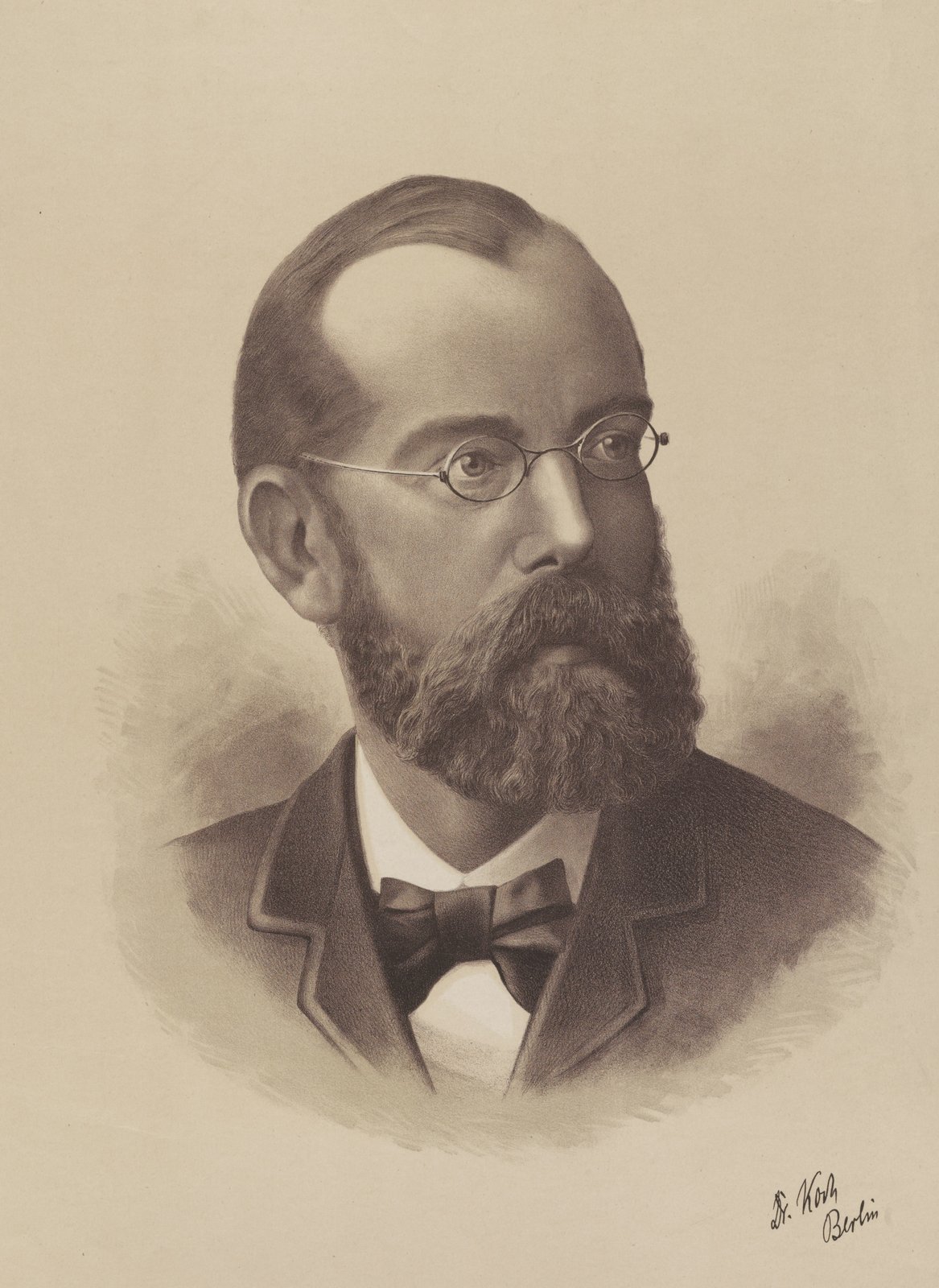
Compton Litho. Co., Dr. Robert Koch (Gallerie berühmter Männer), lithograph, 1887; Library of Congress, LC-USZ62-75478; public domain (US publication 1887). Cropped to the printed image area (title, imprint line and stamps removed) · Compton Litho. Co., St. Louis, 'Gallerie berühmter Männer. Dr. Robert Koch', lithographic print with facsimile signature 'Dr. Koch Berlin', copyright 1887 (imprint on the plate: 'Copyright 1887 and pub. by Compton Litho. Co. St. Louis'; distributed with the stamp 'Compliments of Parke, Davis & Co., Detroit'); Library of Congress Prints and Photographs Division, Popular Graphic Arts collection, LCCN 2003674738, digital ID pga.04671 (LC-USZ62-75478), copyright-deposit stamp; via Wikimedia Commons · Public domain
On 24 March 1882 Koch told the Physiological Society in Berlin that a bacillus was the cause of tuberculosis. He showed it with a new staining method, grew it on coagulated blood serum and produced the disease in laboratory animals with the cultures. The 1905 Nobel Prize in Physiology or Medicine was awarded to him for his work and discoveries on tuberculosis.
While working as a district physician in Wollstein, in the Prussian province of Posen, Koch studied anthrax in a laboratory he set up in part of his consulting room. His 1876 paper traced the anthrax bacillus through its growth and spore formation and passed the disease through long series of mice. His pupil Friedrich Loeffler later described the work in detail in his 1887 history of bacteriology.
In 1883-84 Koch led the German Cholera Commission to Egypt and India and, in Calcutta, isolated the comma-shaped bacillus in pure culture and found it in every cholera case examined. Writing on the 1892 Hamburg epidemic, he pointed to the boundary with neighbouring Altona, which filtered its river water, as evidence for careful sand filtration.
In his first official report from Alexandria, dated 17 September 1883, Koch wrote that the bacilli found in every fresh cholera case did not yet prove they were the cause, since the invasion might follow the disease rather than start it. He reported that feeding and inoculation experiments on mice brought from Berlin, monkeys, dogs and hens had all failed. A year later the British zoologist Ray Lankester, a hostile critic, accused him of declaring the cause without having reproduced the disease in animals.
Spelling out what his own findings did not yet show is consistent with the profile's analytical rigor score. Lankester's charge sits beside it as a reminder that the profile scores this trait only moderately, because Koch's later causal claims went further than his animal evidence. Analytical Rigour
At the international hygiene congress in Geneva in September 1882, Louis Pasteur's lecture criticised Koch's work on anthrax. By Koch's own account he made only a short protest in the hall and then published a full written reply. In it he accused Pasteur of keeping his vaccine methods secret and reporting only favourable trial results, while still acknowledging Pasteur's other scientific merits.
Choosing a detailed, sharply argued printed answer over a quick exchange offers one example of the profile's high conflict tolerance. The text is Koch's own side of a long, two-sided dispute, so it shows how he fought rather than who was right. Conflict Tolerance
In August 1890 Koch announced a substance that stopped tuberculosis in guinea pigs. In November he wrote that early cases of pulmonary tuberculosis could be cured with it, while declining to say how it was made. Within months, reports of patients who got worse or died had brought it into discredit, and he disclosed its general composition only under public and official pressure. He presented an improved tuberculin in 1897, and in his 1905 Nobel lecture he still recommended tuberculin treatment in sanatoria.
Keeping faith in tuberculin long after the early reverses sits alongside the profile's low belief updating score. The historian Christoph Gradmann reads the affair as self-deception rooted in commitment to his earlier explanation of tuberculosis, reinforced by rivalry with Pasteur's school and institutional and financial pressures; that is one scholarly reading, not a settled verdict on his motives. Belief Updating
People whose overall profiles resemble theirs.
Not a rival — a different profile shape worth a look.
