Mahatma Gandhi
94% Profile Match
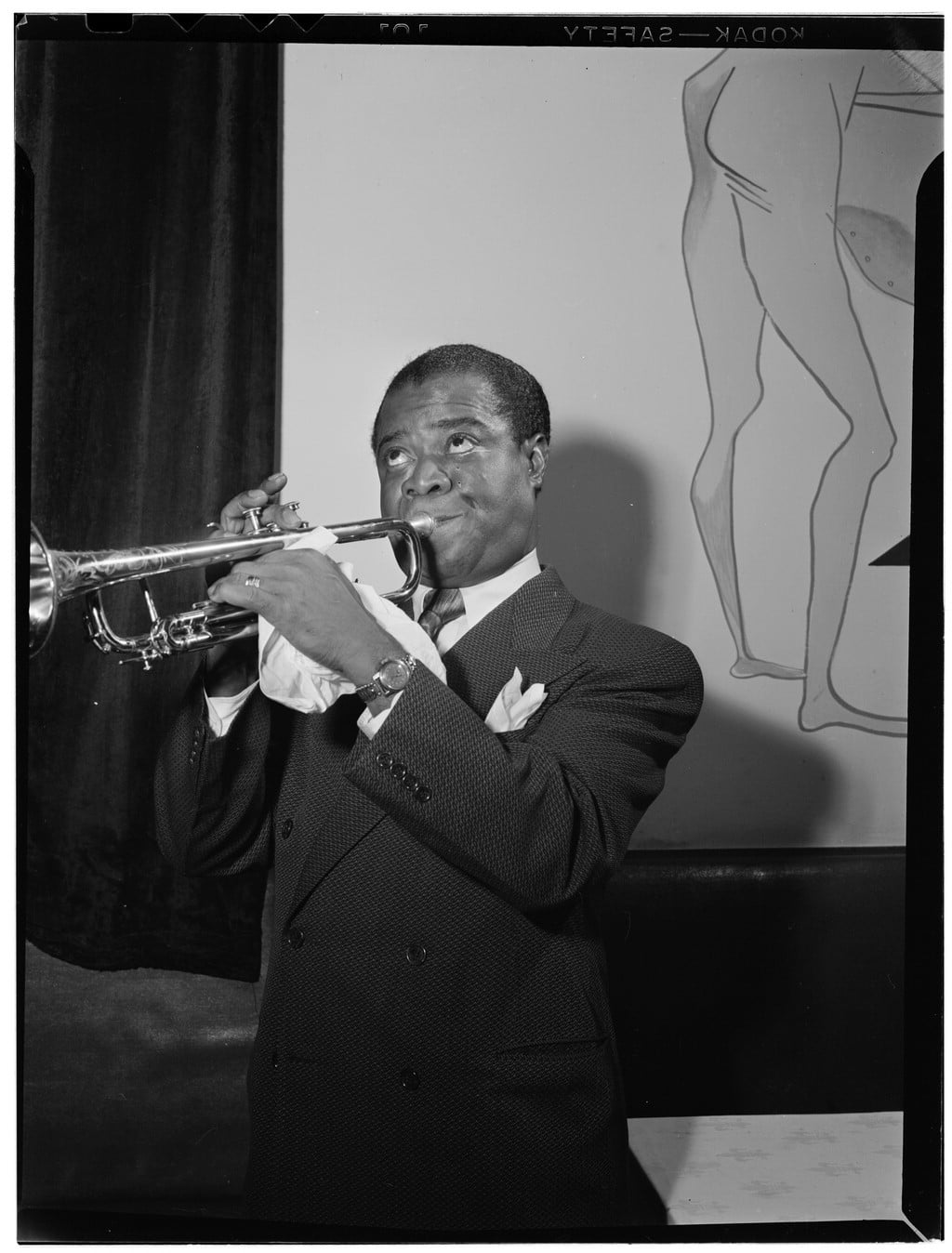
Photograph by William P. Gottlieb, between 1938 and 1948, Library of Congress, Public Domain · Wikimedia Commons (recompressed derivative) · Public Domain
1901 — Born in New Orleans.
1912–1914 — After an arrest, was sent to the Colored Waif's Home for Boys, where he learned cornet technique and rose to lead the Home's brass band.
1922–1925 — Moved to Chicago at his mentor King Oliver's invitation, briefly joined Fletcher Henderson's orchestra in New York, then returned to Chicago to build a career under his own name.
1925–1928 — Formed the Hot Five and Hot Seven; the improvised solo playing on these recordings helped shift jazz toward the individual soloist, and he helped popularize scat singing in the same period.
1950s–1965 — Toured internationally, including under US State Department sponsorship, becoming a widely recognized cultural figure nicknamed "Ambassador Satch."
1971 — Died.
Back in Chicago, he formed the Hot Five, and later the Hot Seven, under his own name — drawing several musicians directly from his former mentor's own band — and built a body of recordings that established him as a bandleader in his own right.
In the mid-to-late 1920s, his improvised solo playing on the records he made under his own name — the Hot Five and Hot Seven sessions — is credited with transforming jazz from a primarily ensemble-based music into a genre centered on the individual improvising soloist; his biographer Terry Teachout writes that he "essentially created the idea of the jazz man as soloist." In the same period he also helped develop and popularize scat singing, wordless vocal improvisation that became a lasting technique in jazz vocal performance.
Arrested for firing a pistol into the air on New Year's Eve 1912, the eleven-year-old Armstrong was sent to the Colored Waif's Home for Boys, where an instructor taught him proper cornet technique; he rose to lead the Home's own brass band before his release in 1914.
Departing sharply from his usual public reticence about politics, he condemned the federal government's handling of the 1957 Little Rock school-desegregation crisis directly to a reporter, calling the president "two-faced" with "no guts" — and when his own manager later suggested publicly that he was "sorry" about the remarks, Armstrong immediately contradicted that framing and reaffirmed his position.
A rare public departure from an otherwise carefully maintained persona, made and then defended rather than walked back, is consistent with the profile's risk_tolerance score. Risk Tolerance
He kept a self-driven practice of documenting his own life across five decades, entirely outside any publisher or ghostwriter — roughly 650 reel-to-reel tapes, 5,000 photographs, and 86 scrapbooks kept from 1926 onward, with hand-annotated mixtapes carrying his own collage artwork.
In 1924 he married pianist Lil Hardin, a trained musician who pushed him to leave his mentor Joe Oliver's shadow rather than remain a sideman indefinitely. He tried Fletcher Henderson's New York orchestra the next year, found the year unsatisfying, and returned to Chicago — the point at which he began building a career under his own name instead of someone else's.
Leaving an established, secure position for one built on his own name is one specific documented instance behind the profile's autonomy_need and proactive_agency scores. Need for Autonomy
People whose overall profiles resemble theirs.