Aung San Suu Kyi
93% Profile Match
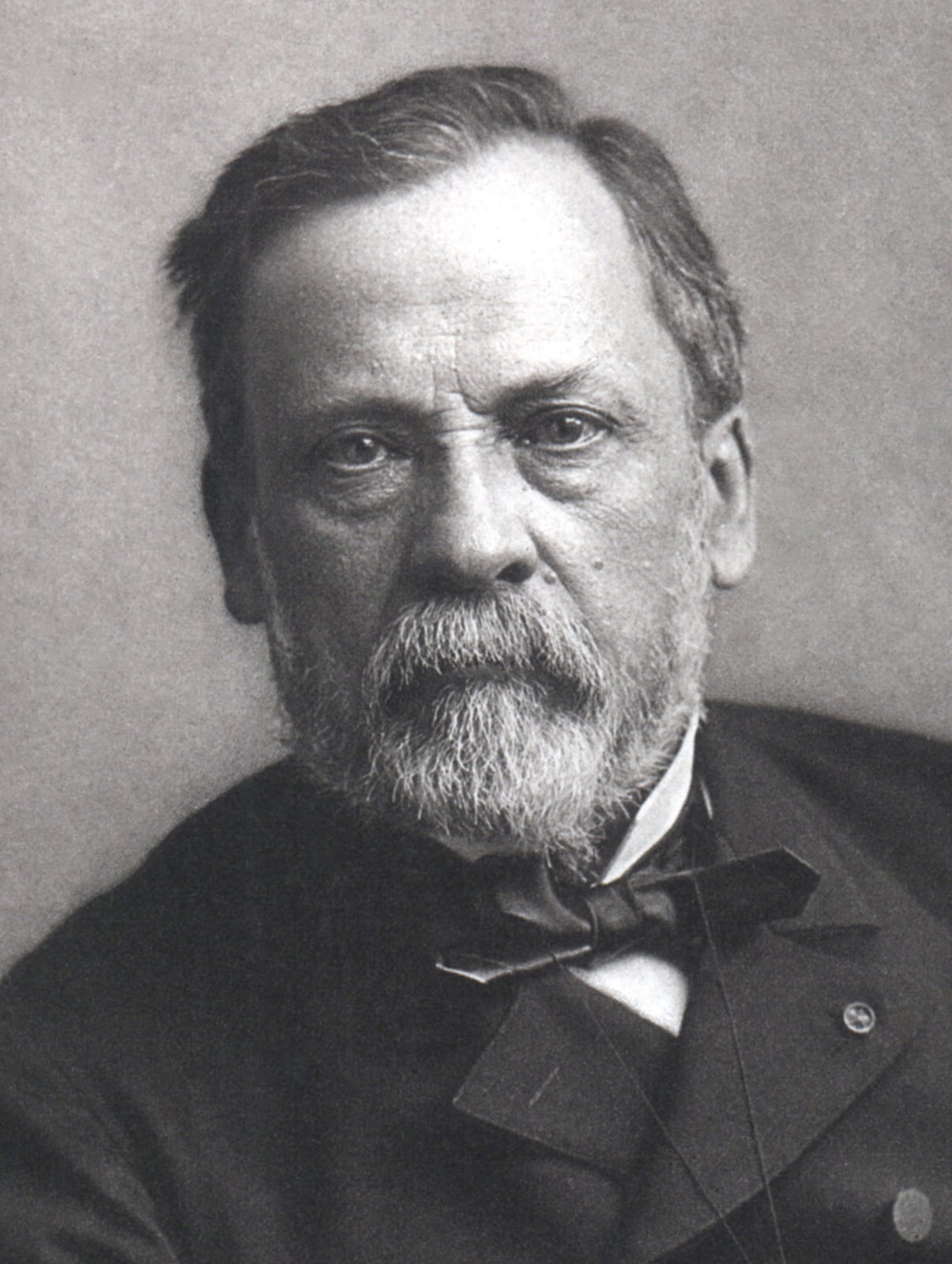
Paul Nadar, before 1895 — restored from a print held by the Smithsonian Institution · Wikimedia Commons (hosted locally by this app as a resized/compressed derivative; see licenseUrl for the full-resolution original) · Public Domain (photographer died 1939; also published before 1931)
1822 — Born.
1843–1848 — Studied chemistry at the École Normale Supérieure, and discovered molecular chirality by hand-separating mirror-image tartrate crystals.
1857–1864 — Demonstrated that fermentation is caused by living microorganisms, defending the finding in a public 1864 debate at the Académie des Sciences.
1868 — Had a stroke that permanently paralyzed part of his left arm and leg, after years of grief following the deaths of three of his children.
1881–1885 — Publicly demonstrated an anthrax vaccine at Pouilly-le-Fort, then administered an experimental rabies treatment to nine-year-old Joseph Meister, the first successful human rabies vaccination.
1887–1895 — The resulting demand led to the founding of the Institut Pasteur, which he directed for the rest of his life; died in 1895.
He founded the field of stereochemistry by hand-separating mirror-image forms of tartrate crystals under a microscope, sorting them one by one based on tiny asymmetric facets — a discovery built from unusually careful, repetitive manual observation rather than a single flash of insight.
Beginning in 1857, Pasteur demonstrated that fermentation was caused by living microorganisms rather than a purely chemical process — a minority scientific position he advanced against the dominant view of the time. He extended this into a direct public refutation of spontaneous generation, most decisively in an 1864 debate at the Académie des Sciences against Félix Pouchet, helping establish that microorganisms arise only from other microorganisms — a foundational premise of modern germ theory and microbiology.
In 1881, at a widely publicized public field trial at Pouilly-le-Fort, Pasteur demonstrated that vaccination could protect livestock against anthrax, convincing skeptical scientists and the wider agricultural public that vaccination worked against bacterial disease generally. Four years later, in July 1885, he administered an experimental rabies treatment to nine-year-old Joseph Meister — the first successful human rabies vaccination — and the resulting surge in demand for treatment directly led to the founding of the Institut Pasteur in 1887–88, which by 2014 had produced ten Nobel Prize laureates among its researchers.
At the 1881 public field trial of his anthrax vaccine at Pouilly-le-Fort, he deliberately built his most vocal skeptic — a veterinarian who rejected germ theory outright — into the trial's own oversight structure, letting him select the animals and supervise the exposure, then addressed the assembled politicians, journalists, and farmers in a plain, familiar tone that reportedly charmed the crowd.
Three of his five children died of typhoid fever within his lifetime, and the accumulated grief and overwork of this period is linked by multiple biographers to a stroke in 1868 that permanently paralyzed part of his left arm and leg. From that point he worked mainly through trusted assistants, directing the physical laboratory work rather than carrying it out himself.
Continuing to direct research while relying on others for the manual work is consistent with the profile's adaptability score — a real change in working method, not a change in ambition. Adaptability
Facing a boy considered near-certain to die of rabies without intervention, he personally decided — despite holding no medical license, a real legal risk — to administer an experimental treatment previously tested only in animals; his own words describe the decision as made "not without acute and harrowing anxiety." His most trusted collaborator initially refused to take part, believing it premature and unjust, and a second physician who did hold a license ultimately administered the injections.
Proceeding under this much uncertainty, hedged by his own collaborator's initial refusal and his own admitted anxiety, is one of the more fully documented instances behind the profile's risk_tolerance score — not an act of simple confidence. Risk Tolerance
At the French government's request, he spent five years investigating a silkworm disease in a field where he had essentially no prior background — a period historians describe as an "epistemological rupture" that converted him from a chemist into a biologist.
The vaccine actually administered at that public trial was not the method he had publicly implied — which had not reliably worked — but a chemically inactivated preparation developed by a rival he had publicly dismissed and refined by his own assistant. He ordered the substitution kept quiet, and it became known only when his private notebooks were published nearly a century later.
People whose overall profiles resemble theirs.