Marie Curie
96% Profile Match
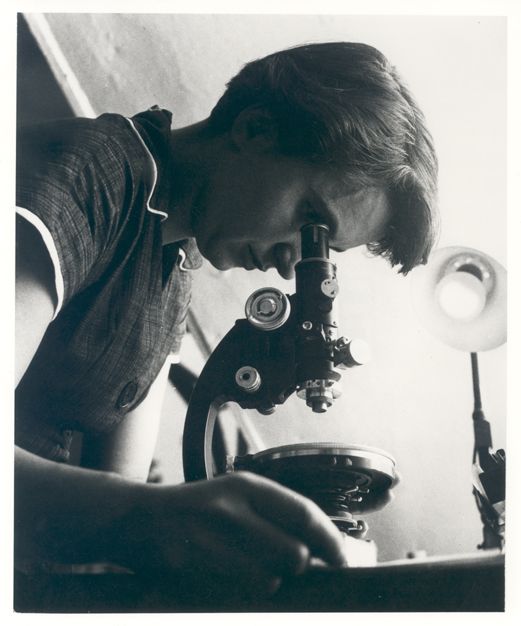
MRC Laboratory of Molecular Biology / Jennifer Glynn, 1955, CC BY-SA 4.0 · Wikimedia Commons (hosted locally by this app; byte-identical to the original — recompression saved a negligible amount here — see licenseUrl for the original) · CC BY-SA 4.0
1920 — Born in London.
1941–1945 — Completed a PhD in physical chemistry at Cambridge, researching the porosity of coal.
1947–1950 — Worked in Paris under Jacques Mering, becoming an expert X-ray crystallographer.
1951–1953 — Researched DNA structure at King's College London, producing Photograph 51.
1953–1958 — Led virus-structure research at Birkbeck College, including work on the tobacco mosaic virus and poliovirus.
1958 — Died of ovarian cancer in London, at age 37, with her poliovirus research unfinished.
At King's College London between 1951 and 1953, Franklin used X-ray diffraction to capture the sharpest images yet made of DNA fibers, including the image later known as Photograph 51, and was the first to establish that DNA existed in two distinct structural forms depending on humidity and that its phosphate backbone sat on the outside of the molecule. Colleague Maurice Wilkins showed Photograph 51 to James Watson without Franklin's permission, and Watson and Crick's April 1953 Nature paper announcing the double-helix model credited being "stimulated by a general knowledge of Franklin and Wilkins' unpublished contribution" in a single footnote; her own paper, presenting independently derived supporting evidence, was published alongside theirs in the same issue.
Her PhD research on the physical chemistry of coal at the British Coal Utilisation Research Association (1942–1945) established relationships between coal's microstructure and its density and permeability that became part of the standard science of coal and carbon materials; her subsequent postdoctoral work in Paris (1947–1950) under Jacques Mering made her an accomplished X-ray crystallographer and produced the terms "graphitizing" and "non-graphitizing" carbon still used in the field today.
At Birkbeck College from 1953 until her death in 1958, Franklin led X-ray studies of virus structure, establishing in 1955 that all tobacco mosaic virus particles were a uniform length — contradicting the prevailing view among virologists at the time — and secured the largest research grant Birkbeck had received to that point to study the structure of poliovirus, work left unfinished at her death.
After WWII, moved to Paris for several years specifically to learn X-ray diffraction crystallography, a technique not readily available to her in England at the time — an entirely self-directed piece of skill acquisition.
Read against the profile's proactive_agency score, this is a case of going abroad to acquire a specific technical capability, rather than working only with the tools already close at hand. Proactive Agency
At King's College, Franklin built and refined a specialized camera to precisely control the humidity of her DNA samples during X-ray exposure, reasoning that the fiber's structure changed measurably with moisture — a months-long technical refinement, not a single fortunate exposure, and what let her capture the unusually sharp Photograph 51.
In early 1953, after months of a difficult working relationship with colleague Maurice Wilkins at King's College — the two had been given conflicting understandings of her role, he expecting a supporting collaborator and she an independent researcher leading her own project — Franklin left DNA research and moved to Birkbeck College to lead an entirely new research program on virus structure.
Franklin's X-ray data was essential evidence in determining the structure of DNA, and her later work on virus structure is recognized as foundational to structural virology; she died four years before the 1962 Nobel Prize that recognized Watson, Crick, and Wilkins for the DNA discovery, a prize not normally awarded posthumously. Her contribution has since been widely re-examined and credited: the Royal Society's Rosalind Franklin Award, established in 2003, recognizes outstanding contributions to STEM by women, and the European Space Agency's ExoMars rover is named in her honor.
People whose overall profiles resemble theirs.



Not a rival — a different profile shape worth a look.