Alan Turing
94% Profile Match
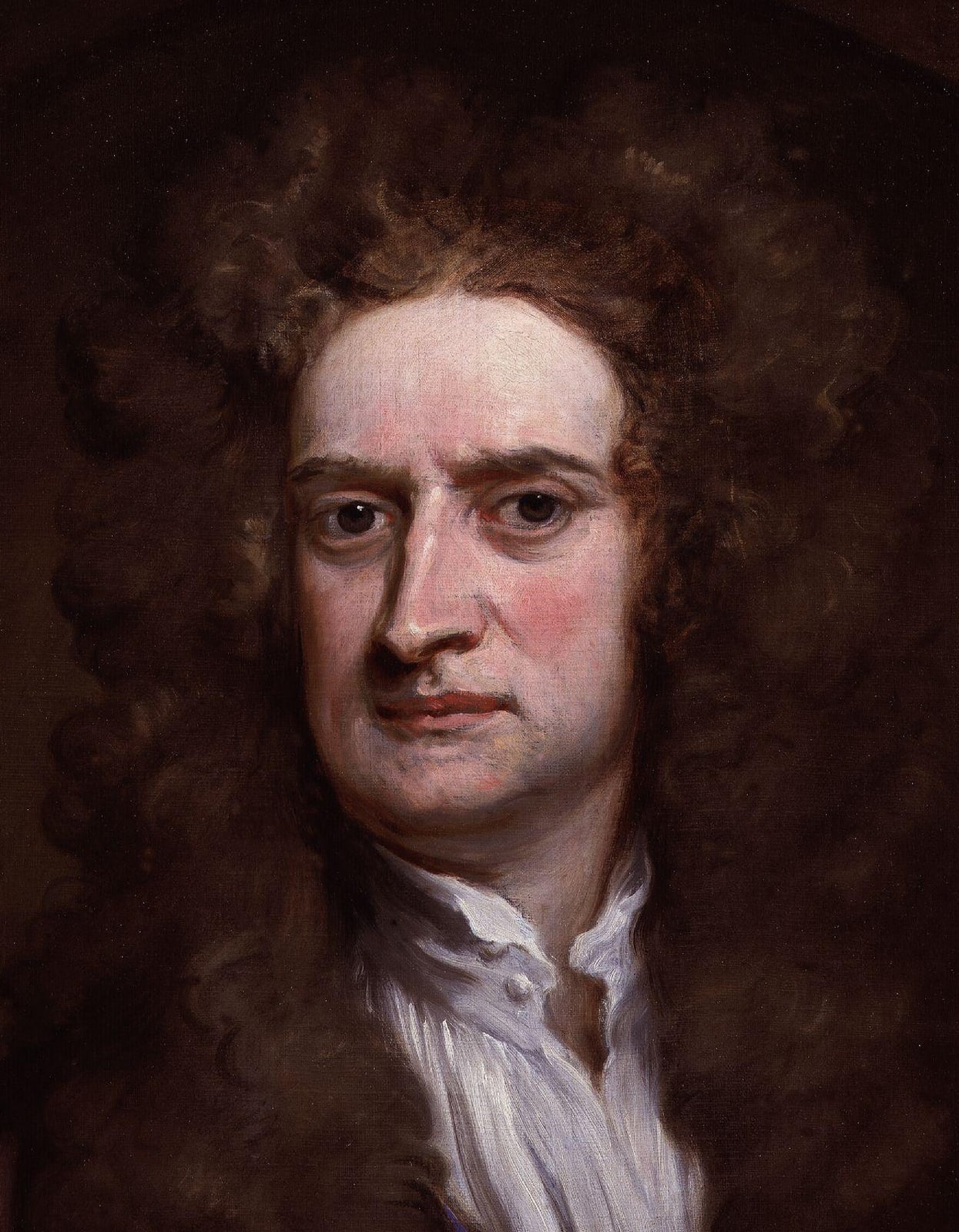
Godfrey Kneller, 1702 — National Portrait Gallery, London · Wikimedia Commons · Public Domain (artist died 1723)
1643 — Born.
1665–1667 — During plague closures, worked alone at home, laying the foundations of calculus, optics, and gravitational theory.
1687 — Published Principia Mathematica, unifying terrestrial and celestial motion under one law of gravitation.
Mid-1690s — Left Cambridge for London to lead the Royal Mint, an entirely different, publicly administrative role.
1703–1727 — Served as President of the Royal Society while continuing as Master of the Mint.
1727 — Died.
During the plague closures of 1665–1667, working alone at his family home in Woolsthorpe rather than at Cambridge, he laid the mathematical and experimental foundations of calculus, his theory of colors, and early gravitational theory — years before any of it reached print.
Principia Mathematica (1687) unified terrestrial and celestial motion under a single law of gravitation, built axiomatically from a small set of definitions and laws of motion up through their derived consequences.
Served as President of the Royal Society for 24 years (1703–1727) while also serving as Master of the Royal Mint — two sustained, demanding institutional leadership roles held simultaneously rather than in sequence.
To get around the chromatic-aberration problem that limited existing refracting telescopes, he designed and built his own reflecting telescope — a specific technical workaround rather than a wait for someone else to solve it.
This is consistent with the profile's resourcefulness score: solving an instrument-level problem himself rather than working within the limits of the equipment already available. Resourcefulness
When his priority dispute with Gottfried Leibniz over the invention of calculus reached the Royal Society, Newton anonymously chaired the Society's own committee investigating the claim — and it ruled in his favor.
This sits alongside the profile's very low collaboration score and high competitiveness score: settling a credit dispute by controlling the body meant to settle it impartially, rather than through open co-authorship or concession. Collaboration
In his mid-fifties, after roughly three decades as a reclusive Cambridge scholar, he accepted the Wardenship — and later Mastership — of the Royal Mint, moving to London to take on an administrative and law-enforcement role in an entirely different domain from his prior life, where by documented account he proved highly effective, personally investigating counterfeiters.
The Great Inside reads this alongside the profile's much lower belief_updating score, not against it: adjusting to a demanding new institutional role is a different kind of change from revising an established theoretical conviction, and this profile treats the two as separate rather than in tension. Adaptability
People whose overall profiles resemble theirs.

Not a rival — a different profile shape worth a look.