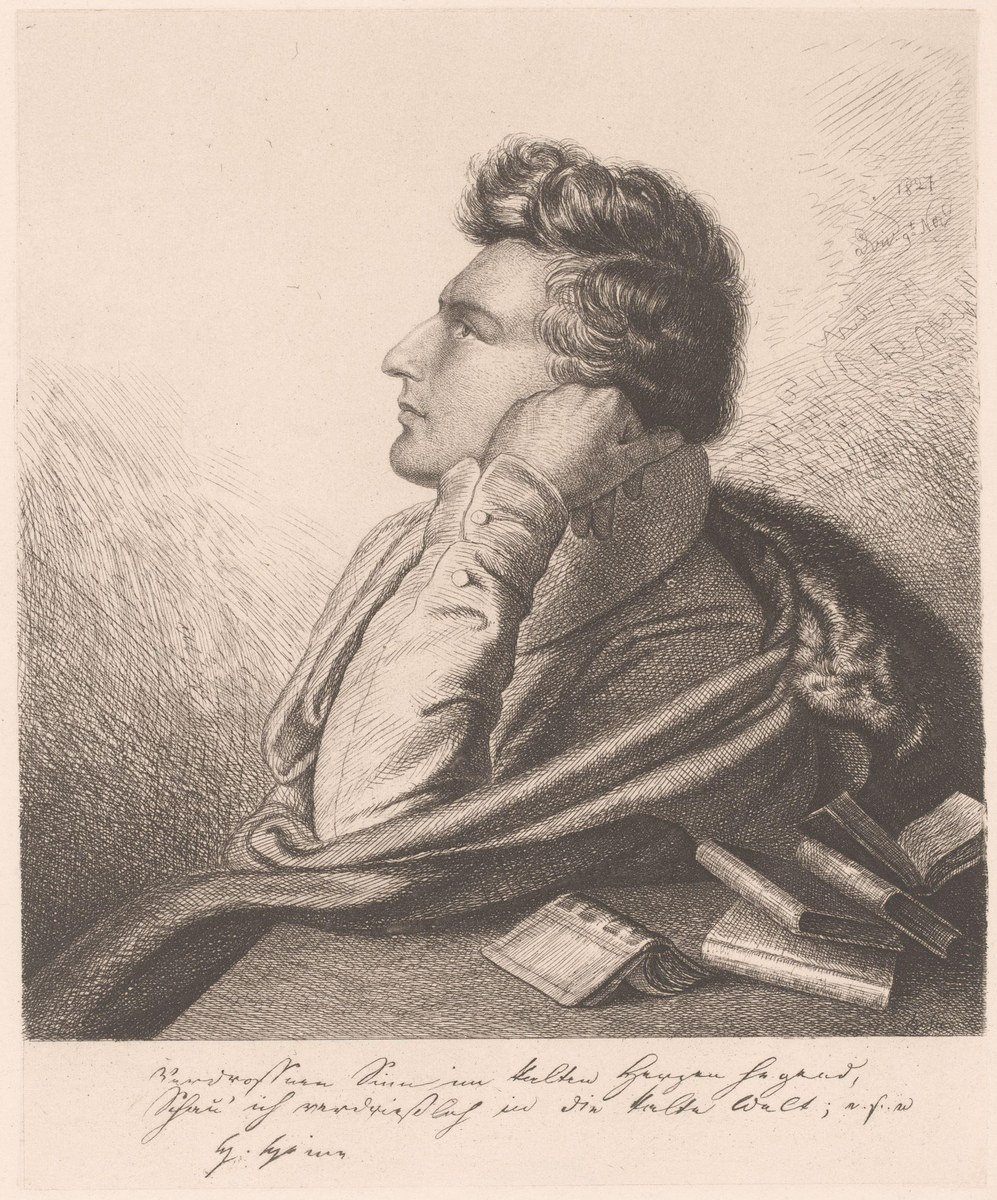

Ludwig Emil Grimm, 'Portret van Heinrich Heine', 1827, etching, Rijksmuseum, Amsterdam (RP-P-1974-50), public domain · Etching of Heinrich Heine by Ludwig Emil Grimm, dated 9 November 1827, with two handwritten lines of Heine's verse signed 'H. Heine' under the plate; Rijksmuseum, Amsterdam (RP-P-1974-50, purchased with the support of the F.G. Waller-Fonds). The museum scan (3852 x 4402 pixels) was cropped to the plate and handwritten caption and downscaled once to 997 x 1200 pixels; nothing was upscaled. · Public domain (Rijksmuseum Public Domain Mark; 1827 etching by an artist who died in 1863)
poet · 19th Century
Heinrich Heine
1797–1856
Known For
Not yet included in personality matching — the documented evidence doesn't yet cover enough of the personality model. Everything else on this page is fully available.
Trait Constellation
Key Achievements
His Buch der Lieder (1827) ironized and urbanized the conventions of Romantic verse, and, as Jeffrey Sammons notes, poems from it went out into the world in thousands of musical settings.
His Reisebilder (1826-31) blended prose, verse, fictionalized autobiography and social comment into what the Larousse encyclopedia calls a new kind of genre, and made his name.
From Paris from 1831 he wrote on German literature, religion and philosophy for French readers and published the Romanzero (1851), whose lyrics the Poetry Foundation counts among the finest he wrote.
Moments That Reveal Them
After quarrelling with Ludwig Borne, a fellow German writer in Paris, he fought a duel with one of Borne's friends in September 1841 and, soon after Borne's death, published a satirical book about him; the publisher's chronology records that the title he rejected was nevertheless used.
This episode is consistent with a readiness to carry a literary quarrel into print and even into a duel, at a cost to his reputation. Conflict Tolerance
In 1835 the German states banned his writings, and in that same year the second volume of his Salon, containing his essay on the history of religion and philosophy in Germany, appeared; he kept publishing from Paris for the rest of his life.
This is consistent with continuing to publish under a ban rather than stopping. Persistence
Turning Points
In 1831, after failing to build a career in Hamburg, he moved to Paris, where he lived for the rest of his life, became a correspondent for the Augsburg Allgemeine Zeitung and wrote for French periodicals such as the Revue des Deux Mondes.
This is consistent with changing country and readership when a first career route had closed. Adaptability
Similar People
People whose overall profiles resemble theirs.


Frida Kahlo

Hildegard of Bingen

Louis Pasteur

Wole Soyinka

Carl Jung
Opposite Profile
Not a rival — a different profile shape worth a look.
Martin Luther King Jr.
Sources
- Heinrich Heine (Q44403), verified live via the Wikidata API (2026-11-06): label 'Heinrich Heine', description 'German poet, writer and literary critic (1797-1856)', born 13 December 1797, died 17 February 1856, Korean label 하인리히 하이네. Orientation only; not used as support for any row.
- Jeffrey L. Sammons, 'Heine, Heinrich', in Encyclopedia of Modern Europe: Europe 1789-1914 (Gale), reproduced on Encyclopedia.com (entry read in full, about 1,100 words). CANONICAL SIGNIFICANCE SOURCE: by a leading Heine biographer; covers Buch der Lieder (1827), the Reisebilder (1826-31), the move to Paris in 1831, the essays on France and Germany, the Neue Gedichte and the satirical epics of 1844 and 1847, the late Romanzero (1851) and the reception history, including a frank statement that his career was a series of quarrels, some caused by his own poor judgment.
- Poetry Foundation, 'Heinrich Heine' poet biography (read in full, about 600 words). US poetry institution's account: studies, baptism for career reasons, Buch der Lieder, Reisebilder, the Paris years, the 1835 ban on his works in the German states and the Romanzero and last poems, which it counts among the finest he wrote.
- Larousse, 'Heinrich Heine ou Henri Heine', Encyclopedie (French-language entry read in full, about 3,000 words, quoting his letters of 1827-1833). Independent French account: early studies and patrons, the Reisebilder as a new mixed prose-and-verse genre, his break with Goethe's aesthetic, the Munich and Italian years, the move to Paris in May 1831, his French literary friendships and periodicals, his distancing from the Young Germany group, the quarrel with Ludwig Borne and the 1841 duel.
- Suhrkamp Verlag, 'Heinrich Heine' year-by-year chronology (PDF, about 1,200 words, read in full). German publisher's dated timeline: failed business 1818-19, university studies and a duel-related suspension, first book 1821, baptism and doctorate 1825, first meeting with the publisher Julius Campe 1826, the 1827 and 1835 bans, the failed Hamburg career and the move to Paris in 1831, the correspondent work for the Augsburg Allgemeine Zeitung, the 1840 and 1843 arrangements with Campe, the Platen attacks of 1829 and the pamphlet on Menzel.
- Harald Loch, 'Aus einem Dichterleben', Judische Allgemeine, 16 February 2006 (review essay on new Heine literature read in full, about 700 words). Independent critical press assessment on the 150th anniversary of his death: calls him full of contradictions, notes both his fight against censorship and his compromising concessions to it, his two duel challenges, his reputation as one of the inventors of the feuilleton, and the long dispute before the Dusseldorf university took his name in 1988.
- The Paris Review, 'Against Heine', Karl Kraus's 1910 essay 'Heine and the Consequences' in Jonathan Franzen's translation with Franzen's introduction (introduction and opening pages of the essay read, about 4,000 words). COUNTER-VOICE: Kraus's hostile polemic against Heine's style and influence, framed by Franzen, who also sets out Heine's fame, wit and Paris 'exile'; used as critical context and not scored as a trait.
- Heinrich Heine, 'Autobiographical Sketch' (letter written in Paris, 15 January 1835, first published in the Revue de Paris, translated for the Marxists Internet Archive; read in full, about 1,200 words). SELF-REPORT: his own account of his schooling, studies, doctorate, early publications, his autumns by the North Sea, his omissions from the French edition and the range of genres he tried; used only for documented facts and never as sole support for a row.
- Rijksmuseum, Amsterdam, 'Portret van Heinrich Heine' by Ludwig Emil Grimm, etching dated 9 November 1827 (object RP-P-1974-50; collection page and linked-art record read in full, Public Domain Mark stated at item level). Holder record for the portrait.