Carl Jung
92% Profile Match
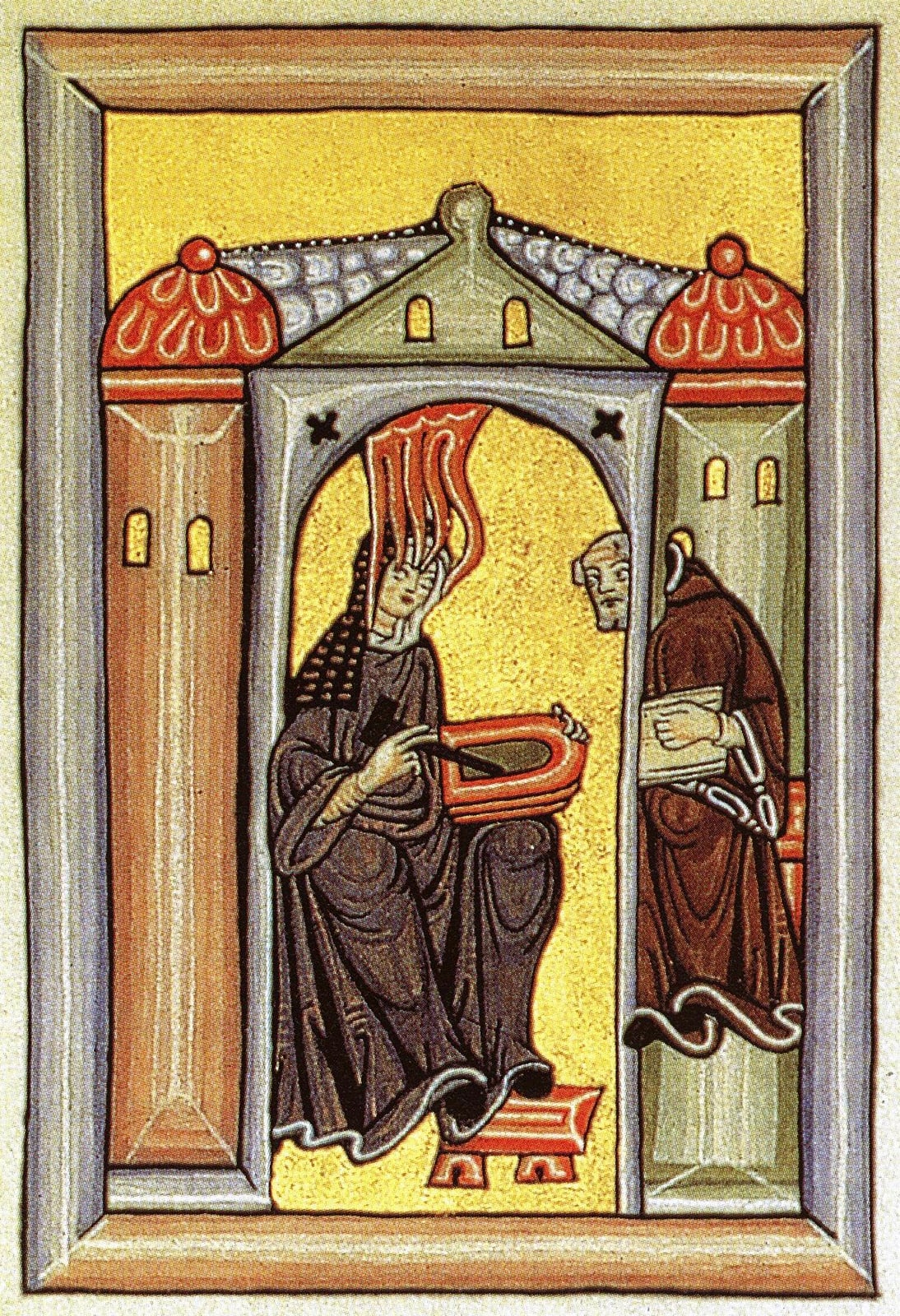
Illumination from the Rupertsberg Codex of the Liber Scivias, c. 1175 — a traditional depiction, not a lifetime likeness, showing Hildegard receiving a vision and dictating to her scribe Volmar, Public Domain · Wikimedia Commons (hosted locally by this app as a resized/compressed derivative; see licenseUrl for the full-resolution original) · Public Domain
1098 — Born.
1112 — Enclosed as a young nun with the anchoress Jutta, having been given to religious life some years earlier.
c. 1141 — Reported receiving a call from God to record the visions that became Scivias.
1150 — Founded the independent monastery of Rupertsberg, over her abbot's initial resistance.
1165 — Founded a second monastery, at Eibingen.
1179 — Died shortly after a church-imposed interdict on her community was lifted.
Hildegard authored Physica and Causae et Curae, systematic surviving texts cataloguing plants, animals, and minerals alongside their medicinal uses, with descriptions of human anatomy and reproduction that modern medieval scholars note as unusually direct and detailed for a 12th-century monastic author.
She composed Ordo Virtutum, an original liturgical musical drama unusual in form for its era, and wrote Scivias, a visionary theological work organizing reported religious experience into a structured account of cosmology, salvation history, and ethics — both survive as her own direct output, not works attributed to her secondhand.
She founded and led two monastic communities over her life, Rupertsberg and later Eibingen — sustained institutional leadership documented in the monastic records of the period.
Surviving letters show her sending unsolicited moral admonishment directly to Pope Eugenius III and to Emperor Frederick Barbarossa — she had also received a rare Church-sanctioned exception permitting her to preach publicly as a woman in the 12th century.
What matches the profile's independent_thinking score here is something more specific than general confidence: these were letters she initiated herself, addressed unprompted to the two most powerful offices of her world, not responses solicited from her. Independent Thinking
Founding the independent Rupertsberg monastery required first relocating her existing community, a move her own abbot initially resisted — a documented dispute she ultimately won, achieving the relocation against his resistance rather than deferring to it.
This sits well with the profile's autonomy_need score: the obstacle here was not a distant political power but her own monastic superior, which arguably makes the outcome a more direct test of the trait than the letters to popes and emperors. Need for Autonomy
Her surviving musical compositions are noted by musicologists for an unusually wide vocal range and a distinctive melodic style for the period, evidence of a deliberate aesthetic approach rather than formulaic liturgical composition.
Late in her life, Hildegard's monastery was placed under a severe ecclesiastical penalty, an interdict, after she refused a church authority's demand to exhume and remove the body of a man buried in the community's cemetery whom the authority considered excommunicated. She refused to comply and directly petitioned church officials until the interdict — which barred her community from performing the liturgy and music central to its life — was lifted only shortly before her death.
Both the profile's conflict_tolerance and risk_tolerance scores are live in this one episode, and worth separating: staying in the dispute rather than backing down is one thing, and accepting the real institutional exposure of defying an active interdict is a related but distinct one. Conflict Tolerance
People whose overall profiles resemble theirs.