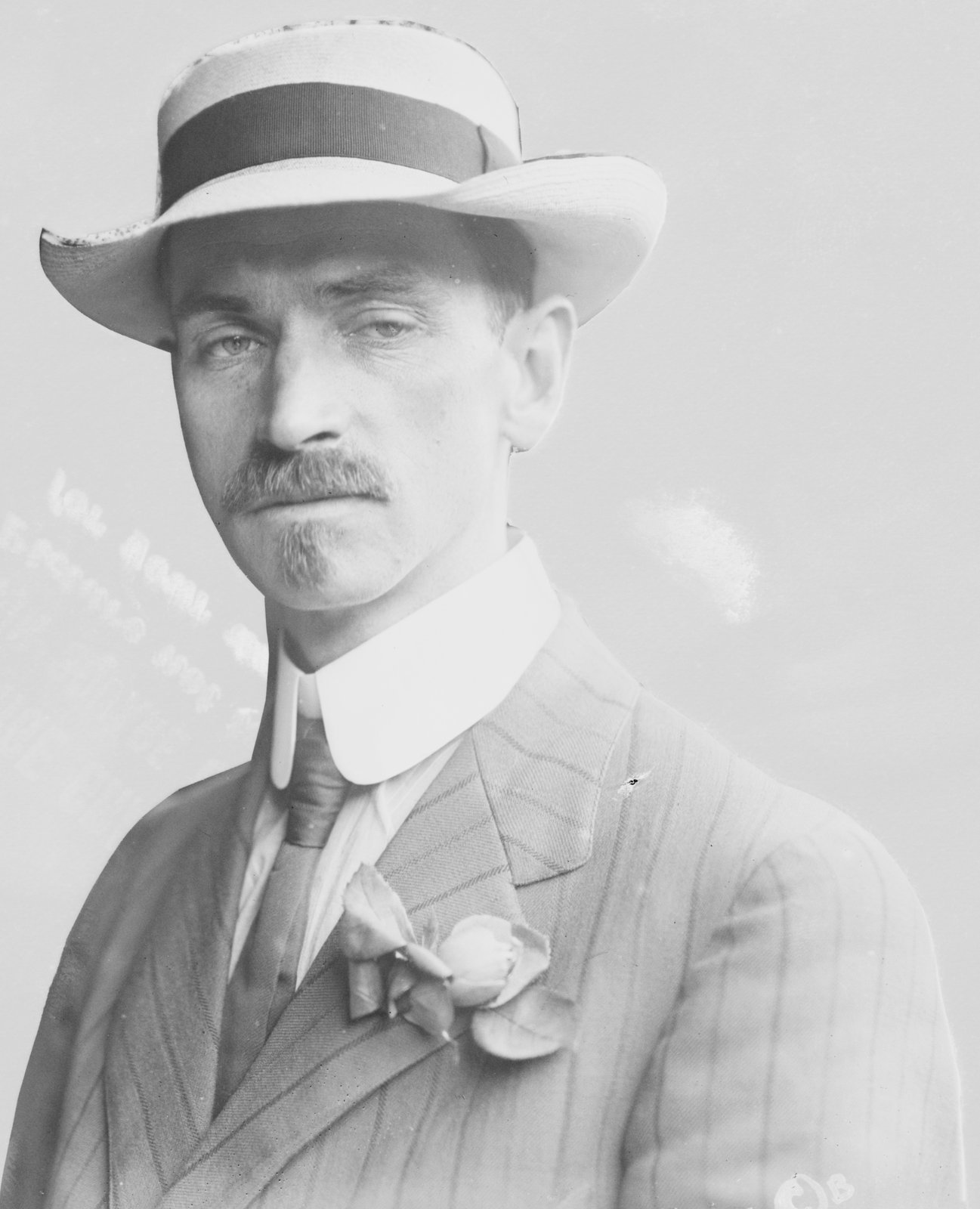

Bain News Service (George Grantham Bain), 1909 (date created or published later by Bain); Library of Congress Prints and Photographs Division, LC-DIG-ggbain-04102; record rights field: 'No known restrictions on publication' · Library of Congress Prints and Photographs Division, George Grantham Bain Collection, 'Glenn Curtis' (title misspelled in the source; LC-B2- 852-5 [P&P], LC-DIG-ggbain-04102, control number 2014684096; hdl.loc.gov/loc.pnp/ggbain.04102), glass negative; also on Wikimedia Commons as 'Glenn Curtiss - 1909 (cropped).jpg' · Public domain
Trait Constellation
Key Achievements
On 4 July 1908 Curtiss flew the Aerial Experiment Association's June Bug about a mile at Hammondsport, New York, winning the Scientific American Trophy for the first public flight of a kilometre by an American aeroplane. At the Reims meeting in August 1909 he won the Gordon Bennett Cup for speed, covering the 20 kilometres in 15 minutes 50 3/5 seconds, about six seconds ahead of Louis Blériot. On 29 May 1910 he flew from Albany to New York City, roughly 150 miles with two stops, and won the New York World's $10,000 prize.
In January 1911 Curtiss opened a flying school and test station on North Island at San Diego, where Army and Navy officers trained under him, and by late January his float-equipped biplane had risen from and alighted on San Diego Bay. The Navy later asked him for a hydroaeroplane able to leave and land on either land or water, and Lieutenant Ellyson records that it was delivered on time. Curtiss aeroplanes flown by Eugene Ely also made the first take-off from a warship (14 November 1910) and the first landing on one (18 January 1911), and Britannica credits Curtiss with pioneering flying boats in the United States.
By the First World War Curtiss's firm was a leading American aircraft maker, and Britannica records it as a major supplier of flying boats to the United States and allied governments and a leading builder of aircraft engines, notably the OX-5. Its JN-4 'Jenny' became a standard American military training and general-purpose aircraft, and a multi-engine Curtiss flying boat, the NC-4, made the first flight across the Atlantic in 1919.
Curtiss began building his own motorcycle engines around 1900. In January 1907 at Ormond Beach, Florida, he rode a mile at about 136 miles an hour on a motorcycle with an eight-cylinder engine, and Britannica calls him the fastest man on earth that day; by his own account it was not accepted as an official record because the engine was too large for a motorcycle. In 1904 the airship builder Thomas Baldwin bought a Curtiss engine for the California Arrow, which Britannica identifies as Curtiss's entry into aeronautics.
Moments That Reveal Them
Before the Albany-New York flight in May 1910, Curtiss travelled the Hudson, chose a refuelling field at Poughkeepsie and a fallback meadow at Inwood in upper Manhattan, and fitted pontoons in case he had to come down on the river. He says he rose at daybreak for three days and was called off by wind; Flight reports that he had been waiting on the weather for some days. On the flight he landed near Poughkeepsie for fuel and again beside the Harlem River, short of Governor's Island, when his oil ran low.
Scouting landing places and refuelling points in advance, and waiting several days for suitable weather, is consistent with planning orientation; the preparations come mainly from Curtiss's own account, while Flight independently confirms the waiting, the stops and the landing near Spuyten Duyvil. Planning Orientation
In August 1909 the Wright Brothers sued the Aeronautic Society of New York over the Curtiss machine, and on 3 January 1910 Judge Hazel granted them a preliminary injunction against Curtiss and the Herring-Curtiss Company. The Second Circuit reversed it on 14 June 1910 because the affidavits conflicted, but after a final hearing the district court ruled for the Wright Company on 21 February 1913, and the Second Circuit affirmed on 13 January 1914. Curtiss testified that his ailerons kept lateral balance 'without the use of any other element'; the courts found that his machine infringed the Wrights' patent.
Turning Points
In the autumn of 1910 Curtiss, by his own account, gave up public contest flying to work on flight from water. On 29 November 1910 he wrote to the Secretaries of War and Navy offering to train officers at his California station without charge; Lieutenant Ellyson says the Navy accepted at once and that this was the start of its practical interest in aviation. The training camp opened on North Island on 17 January 1911, and within weeks a Curtiss biplane on floats was rising from San Diego Bay.
Moving from contest flying to a new line of work and offering it to the Army and Navy before they had asked is consistent with opportunity sensing; the Navy's acceptance is confirmed independently of Curtiss by Ellyson, though Ellyson is a sympathetic participant. Opportunity Sensing
Similar People
People whose overall profiles resemble theirs.

Benjamin Franklin

Marie Curie

Ruth Bader Ginsburg

Rosalind Franklin

Confucius
Opposite Profile
Not a rival — a different profile shape worth a look.

Hildegard of Bingen
Sources
- Glenn Curtiss (Q454544) -- verified live via wbgetentities (2026-10-05): en label 'Glenn Curtiss', description 'American aviator and industrialist (1878-1930)', ko label '글렌 커티스', P569 21 May 1878, P570 23 July 1930, citizenship United States (Q30), instance of human, P18 'Glenn Curtiss - 1909 (cropped).jpg'. Orientation only; not used as support for any row.
- Glenn Curtiss -- English Wikipedia article (raw wikitext), read as orientation only; not used as support for any scored row. Its Smithsonian/Langley and Wright patent-settlement passages were not verified against primary sources here and are not used.
- Glenn H. Curtiss and Augustus Post, The Curtiss Aviation Book (New York: Frederick A. Stokes, 1912), Internet Archive full text (curtissaviationb00curtrich) -- SELF / CO-AUTHORED, promotional in tone (Post was an Aero Club of America official and friend; the book is dedicated to Mabel Bell). Read locally: Part I (boyhood, motorcycles, Baldwin dirigible work), Part II (Aerial Experiment Association, Red Wing, White Wing, June Bug, Loon, Mineola), Part III chapters on Reims, the Albany-New York flight and the beginning of the hydroaeroplane (to the January 1911 San Diego flights). It omits the Wright patent suit entirely. Used for sequence of events and for Curtiss's own account of his preparations; never as the sole perspective for a scored row.
- Lt. Theodore G. Ellyson, U.S. Navy, 'The Aeroplane for the Navy (with an account of the training camp at San Diego)', chapter in The Curtiss Aviation Book (1912), Internet Archive full text -- first-person account by the first naval officer detailed to learn to fly under Curtiss; a participant-observer inside a Curtiss-co-authored volume, so partly independent of Curtiss's own voice but sympathetic. Read in full: the November 1910 offer of instruction, the North Island camp from 17 January 1911, the fifty design changes, the Navy's 1911 delivery specification.
- Scientific American, 11 July 1908 (notice of the Aerial Experiment Association's three aeroplanes and the trophy trial) and 18 July 1908 ('The Winning Flight of the June Bug', report by the journal's aeronautical editor, who was present at Hammondsport on 4 July 1908), Internet Archive OCR text -- contemporary independent press and the trophy's own sponsor; the 18 July OCR is partly garbled in column order and was read for the dated facts used (a first attempt that settled in grass short of the finish, the tail-angle fault found, the second flight at 7 p.m. of about a mile in 1 min 42 2/5 s).
- Flight (London weekly aeronautical journal), issues of 28 August, 4 September and 11 September 1909, Internet Archive OCR text -- contemporary independent trade press on the Reims meeting (the Gordon Bennett Cup result, Curtiss's 5 per cent penalty, the Speed Prize) and on the Wright Brothers' suit against the Aeronautic Society over the Curtiss machine; the OCR is partly garbled and was read for the figures and statements used.
- Flight, 4 June 1910 (editorial on the Albany-New York flight and the news report 'Glenn Curtiss' Albany, New York Flight', plus the flight table dating the flight 29 May), Internet Archive OCR text -- contemporary independent trade press; the editorial praises the flight while questioning how much it advanced the science.
- Flight, issues of 28 January, 4 and 11 February 1911 (Ely's landing on the cruiser Pennsylvania; Curtiss rising from the water at San Diego), 3 February to 16 March 1912 (Curtiss hydroaeroplanes flown at Nice) and 31 July 1914 (the Curtiss flying boat America), Internet Archive OCR text -- contemporary independent trade press, read for the dated reports of these events.
- Charles C. Turner, The Romance of Aeronautics (London: Seeley, 1912), Internet Archive full text (romanceofaeronau00turn), passages on Curtiss (the Gordon Bennett win, his motorcycle work, the Baldwin and Bell associations, the Aerial Experiment Association) and the ship-deck demonstrations -- independent popular historian writing at the time; the account of Curtiss's early life is brief and secondary.
- Wright Co. v. Herring-Curtiss Co. and Glenn H. Curtiss, as printed in the Federal Reporter: 177 F. 257 (W.D.N.Y., 3 January 1910, preliminary injunction); 180 F. 110 and 112 (2d Cir., 14 June 1910, injunction reversed on conflicting affidavits); 204 F. 597 (W.D.N.Y., 21 February 1913, final hearing, decree for the Wright Company); 211 F. 654 (2d Cir., 13 January 1914, affirmed). Internet Archive scans of the Federal Reporter volumes 177, 180, 204 and 211 read locally -- neutral/adversarial court record that quotes Curtiss's own testimony. Used only for the dated course of the case and for what Curtiss said under oath; the courts' verdicts are not used as evidence of any trait.
- Encyclopaedia Britannica, 'Glenn Hammond Curtiss' (written by Tom D. Crouch, National Air and Space Museum), read in full -- institutional overview: the January 1907 motorcycle speed run, the Baldwin engine link, the Aerial Experiment Association and Scientific American Trophy, the Wright suit, flying boats, the November 1910 and January 1911 ship-deck flights, the OX-5 engine, the JN-4, the NC-4 and the 1917-1920 loss of corporate control.