
Tony Barnard, Los Angeles Times (Los Angeles Times Photographic Collection, UCLA Library), CC BY 4.0 · Los Angeles Times Photographic Collection, UCLA Library (photograph by Tony Barnard), via Wikimedia Commons · CC BY 4.0
Trait Constellation
Key Achievements
During the mid-1990s sessions for Outside, Bowie worked with Ty Roberts, who had made interactive CD-ROMs for him and Brian Eno, on the Verbasizer, a Mac program that split typed sentences into columns and randomly recombined their words into lyric fragments. Roberts says it automated the paper cut-up method he had seen Bowie use in the studio, and Bowie demonstrated the program on camera in the 1997 documentary Inspirations.
According to co-creator Ron Roy, Bowie approved the BowieNet project pitched by Robert Goodale and Roy in late 1996 and put money into it. The service was announced on 17 July 1998 and launched on 1 September 1998, combining dial-up internet access at $19.95 a month with a davidbowie.com email address, chat rooms and places for fans to post their own art. Roy says Bowie insisted it not be a promotional site and, having relied on his record label for his earlier website, asked for a web-design firm of his own.
In 1994 Bowie joined the editorial board of the art magazine Modern Painters. According to Sotheby's, he contributed interviews and reviews there, including an interview with the painter Balthus that he proposed to the editors, one with Damien Hirst, a review of the 1995 Johannesburg Biennale and a piece on Jean-Michel Basquiat. On 1 April 1998 he launched the art-book publisher 21 Publishing at Jeff Koons's studio, with William Boyd's book on the invented painter Nat Tate as its first title.
Moments That Reveal Them
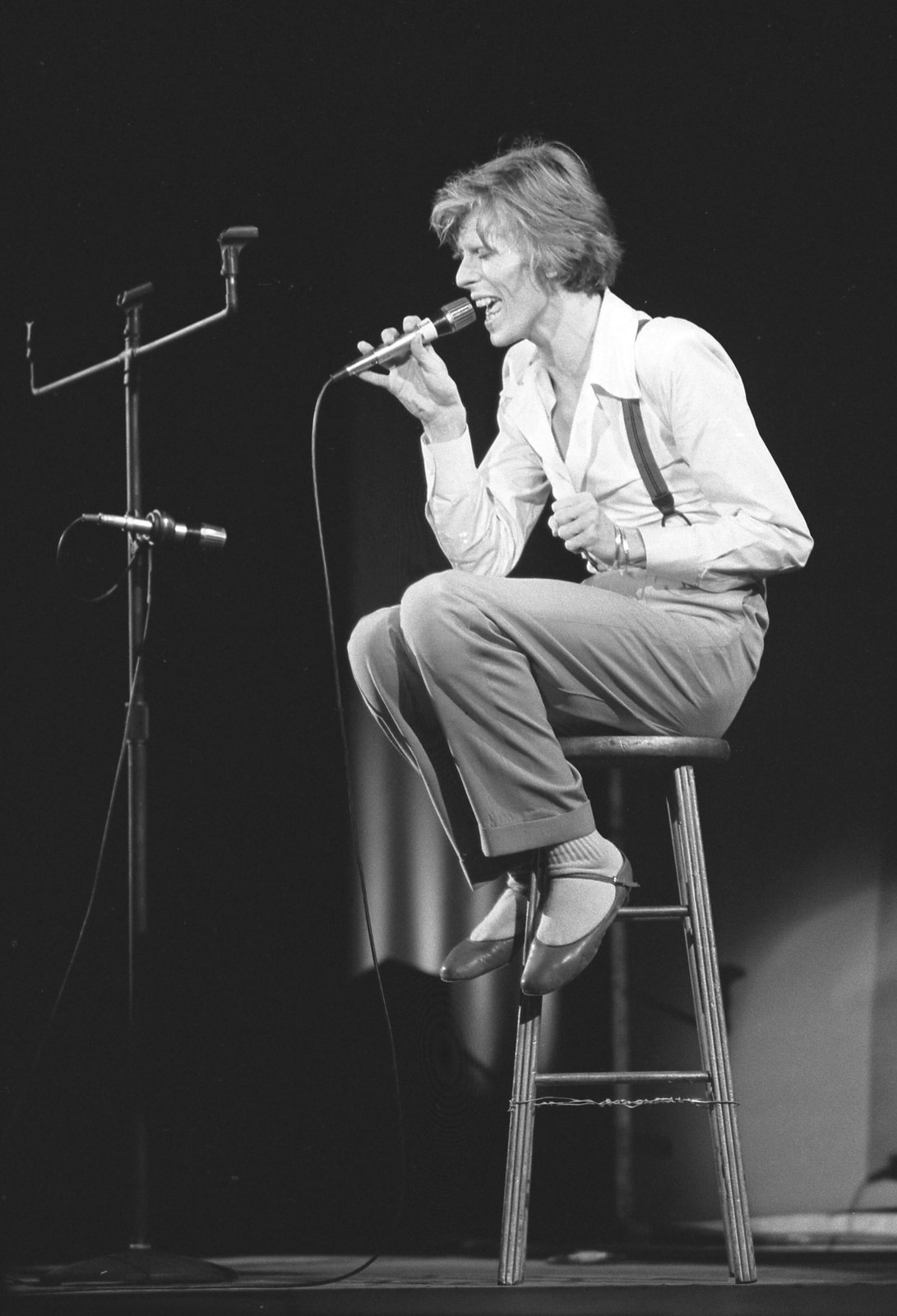
On 3 July 1973, on the last night of the Ziggy Stardust tour at London's Hammersmith Odeon, Bowie told the audience it was 'the last show we'll ever do'. According to Variety, guitarist Mick Ronson had been told beforehand, having been sworn to secrecy in exchange for a solo deal, while drummer Woody Woodmansey did not realize his future plans had been cancelled; Ultimate Classic Rock reports Suzi Ronson saying everyone knew except Woodmansey and bassist Trevor Bolder.
The announcement is consistent with a decisive willingness to end a persona that was still drawing large audiences. The accounts of bandmembers who were not told in advance also show a cost of that style, which is why this profile treats the trait as dual-edged. Decisiveness
In 1977 at Hansa Studios in Berlin, producer Tony Visconti says Bowie finished the lyrics for 'Heroes' while Visconti was away for a couple of hours, then sang the lead vocal, which Visconti says is 'probably take three', and the backing vocals. Visconti puts the whole sequence at about five hours, adds that this 'doesn't always happen', and says Bowie usually let lyric ideas germinate for a month or two beforehand. The account was given to Sound On Sound in 2004, decades after the session.
It illustrates fast execution once material had settled in his mind. Visconti presents the speed as unusual and describes a longer incubation beforehand, so this is one example rather than a general rule about Bowie's pace. Execution Speed
Turning Points
In 1982, according to Nile Rodgers, Bowie told him 'I want you to make hits', and Rolling Stone reports that Bowie told his usual producer Tony Visconti he wanted a change for the project. The resulting album Let's Dance, co-produced by Bowie and Rodgers, was cut in about 17 days at New York's Power Station with a band Rodgers assembled and the then little-known guitarist Stevie Ray Vaughan, whom Bowie had seen at the Montreux Jazz Festival.
The change of producer, band and sound offers one example of his readiness to change collaborators in order to change the music. Rodgers's account is one participant's recollection, and how much of the finished sound came from Bowie and how much from Rodgers remains a matter on which the accounts differ. Adaptability
Similar People
People whose overall profiles resemble theirs.


Sor Juana Inés de la Cruz

C. V. Raman

T. E. Lawrence

Benjamin Banneker

Akio Morita
Opposite Profile
Not a rival — a different profile shape worth a look.
Florence Nightingale
Sources
- David Bowie (English Wikipedia) -- orientation only (birth name David Robert Jones, 8 January 1947 - 10 January 2016, English singer/songwriter/actor); not used as support for any scored row.
- David Bowie (Q5383) -- identity check via the live Wikidata API: en label 'David Bowie', description 'English musician and actor (1947-2016)', ko label, P569 1947-01-08, P570 2016-01-10, P27 Q145 (United Kingdom).
- Richard Buskin, "Classic Tracks: David Bowie 'Heroes'", Sound On Sound, October 2004 -- producer/engineer Tony Visconti's first-hand account of the 1977 Hansa Studios sessions: Bowie's loose-structure working method with his rhythm section, lyrics written in a couple of hours after weeks of germination, the vocal being 'probably take three', and Bowie's remark 'Once I've made up my mind, I don't want to change it'. Downloaded with curl; the whole article text was searched locally and the passages on the working method, the lyrics, the vocal take count and the 'made up my mind' remark were read in context.
- Jem Aswad, "Why David Bowie Killed Ziggy Stardust, 50 Years Ago Today", Variety, 3 July 2023 -- music-industry journalism on the 3 July 1973 Hammersmith Odeon retirement announcement: who knew in advance (Ronson) and who did not (Woodmansey), the Spiders' pay dispute, RCA engineer Mike Moran on Bowie's 1972 studio habits ('one or two takes of his vocal'), and the parenthetical that Bowie ultimately paid MainMan upward of $50 million to separate and obtain his recordings. Downloaded and read locally through the retirement-gig section (about the first 27,000 of ~36,000 characters); note that it quotes Bowie's own 2002 memoir in places (self-authored material, not relied on here).
- Dave Swanson, "Original Spider From Mars Talks About Split From Bowie", Ultimate Classic Rock, 25 June 2012 -- short news item re-reporting drummer Woody Woodmansey's BBC/Classic Rock remarks (the band's pay grievance) and Suzi Ronson's statement that Mick Ronson knew of the July 1973 break-up in advance while Woodmansey and Bolder did not. Secondary re-telling; read in full.
- Allison Rapp, "Inside David Bowie's Freewheeling Sessions for 'Aladdin Sane': Exclusive Interview" with pianist Mike Garson, Ultimate Classic Rock, 19 April 2023 -- first-hand collaborator interview: Bowie interviewing Garson about the New York jazz/avant-garde scene at post-show dinners in 1972-73, and Garson's account of the freedom Bowie gave him at the Aladdin Sane sessions. Downloaded and read in full.
- "Carlos Alomar on David Bowie: He Was A Transitional, Generational Artist", The Line of Best Fit -- exclusive extract of a (then new) book in which guitarist Carlos Alomar speaks in the first person about meeting Bowie in 1974, Bowie's questions about the Chitlin' Circuit and the Apollo Theater, the 'change the band' method used on Young Americans, and the writing credit he received on 'Fame'. Author of the extract is Alomar himself (a first-hand collaborator account); the page's own byline/date and the book title were not visible in the fetched text. Downloaded and read (first ~15,000 of ~19,000 characters); drug and marriage passages deliberately not used.
- "Let's Dance: How Nile Rodgers made David Bowie's demo a global smash hit", V&A (David Bowie Centre), published 9 September 2025 -- Nile Rodgers's first-hand account, interviewed by V&A curators, of the 1982 Let's Dance collaboration (the demo Bowie played him, the arrangement, the studio session). The V&A holds the Bowie Archive, so this is an institution with a stake in the subject; the informant, Rodgers, is an independent collaborator. Downloaded and read in full.
- "David Bowie and the making of Let's Dance: how Nile Rodgers turned an arty outsider into a global superstar", Louder (Future plc) -- long-form feature quoting Rodgers (Le Freak, Rolling Stone podcast), Stevie Ray Vaughan, Bowie's own interview remarks, and bassist Trevor Bolder on the speed of the 'Jean Genie' recording; covers Rodgers's account of not being invited on tour and rarely credited. Byline/date not visible in the fetched text. Downloaded and read (about 20,000 of ~24,000 characters).
- Kory Grow, "How David Bowie, Nile Rodgers Made 'Let's Dance' a Hit", Rolling Stone, 14 April 2016 -- short retrospective: Bowie telling Rodgers 'I really want you to make hits', telling his usual producer Tony Visconti he wanted a change, and the album cut in 17 days at the Power Station. Downloaded and read in full.
- "David Bowie's 'Let's Dance' at 40: Nile Rodgers Looks Back", Variety, 14 April 2023 -- producer/engineer interview piece (Rodgers and Bob Clearmountain): the 17-day recording ('like four songs a day'), and the context that Bowie had struck an EMI Manhattan licensing deal while retaining ownership of his masters. Downloaded and read for the recording and EMI-licensing passages (byline not visible in the fetched text).
- Louder (Future plc) long-form feature on the Berlin era ('Low', 'Heroes', The Idiot) -- covers RCA's reaction to Low (the 'Young Americans II ... mansion in Philadelphia' remark recounted by Visconti), the abandoned Man Who Fell To Earth soundtrack, and Bowie's cut-up / randomised composition methods and Eno's Oblique Strategies cards. Byline/date not visible in the fetched text. Downloaded and read for the 1975-77 sections (about 9,000 of ~26,000 characters).
- Clyde Smith, "Ty Roberts: From Working With David Bowie To Co-Founding Gracenote", Hypebot, 8 March 2013 -- interview with Ty Roberts, who observed Bowie's cut-up lyric method in the studio with Eno during the Outside sessions and built the Verbasizer lyric-randomizer program for him. First-hand observer account. Downloaded and read in full.
- "The Verbasizer was David Bowie's 1995 Lyric-Writing Mac App", VICE / Motherboard (January 2016, published the week of Bowie's death; byline not captured) -- describes Bowie demonstrating the Verbasizer on camera in the 1997 documentary 'Inspirations' and cites biographer David Buckley on his randomness/juxtaposition methods; relies partly on the Hypebot interview above (same underlying perspective for the Roberts material). Downloaded and read in full.
- Ted Asregadoo, "35 Years Ago: David Bowie Launches the Tin Machine Era", Ultimate Classic Rock, 22 May 2015 -- retrospective on the 1988-91 Tin Machine band of equals (quoting Reeves Gabrels on the all-play-live recording method), EMI's negative reaction and the label parting with Bowie by 1990. Secondary, draws on Christopher Sanford's biography. Downloaded and read (about the first 9,000 of ~12,000 characters, through the Tin Machine II section).
- Richard MacManus, "BowieNet: The Inside Story of Its Creation", Cybercultural, 10 January 2023 -- based on a March 2020 interview with BowieNet co-creator Ron Roy: the 1996 pitch meeting with Bowie, his go-ahead and investment, his decision to hire his own web-design firm rather than rely on the record label, his 'not brochureware' insistence, and his promotional chats. Roy is a first-hand, non-self witness. Downloaded and read through the launch section (about 17,000 of ~21,000 characters).
- Sotheby's, "Bowie/Collector", 2 November 2016 -- auction-house feature for the sale of Bowie's art collection, with Bono's appreciation and a selection of Bowie's Modern Painters writing (1994 editorial-board invitation, his Balthus interview after proposing it to the editors, Hirst, Basquiat). As an auction house selling the estate collection it is an interested party; used only as one strand of corroboration. Downloaded and read (first ~6,500 of ~10,000 characters).
- "Quick study: David Bowie and art", Two Coats of Paint (art blog), January 2016 -- roundup noting Bowie's Modern Painters editorial-board role and interviews, the 21 art-publishing business, and his 1998 New York Times interview with Michael Kimmelman. Secondary link-roundup; read in full.
- Anthony Haden-Guest, "How 'Nat Tate' Hoaxed The Artworld, With Help From David Bowie", The Daily Beast, 15 August 2015 -- first-hand attendee account of the 1 April 1998 launch of Bowie's 21 Publishing at Jeff Koons's studio, with William Boyd's Nat Tate book as its first title and Bowie reading from it. Downloaded and read (nearly all of it).