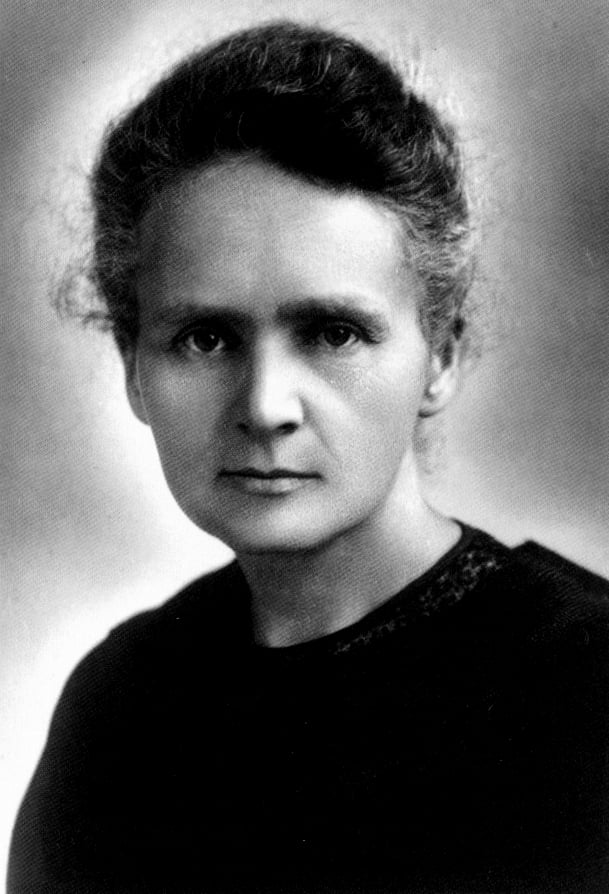
Marie Curie
94% Profile Match

A woodcut published on the cover of Banneker's own 1795 almanac (John Fisher, Stationer, Baltimore), in his lifetime, and traditionally associated with him; it is not confirmed to be an authentic likeness — no confirmed portrait of Banneker survives. · Wikimedia Commons (recompressed derivative; see licenseUrl for the original) · Public Domain (published 1795, well before 1931)
1731 — Born.
c. 1753 — Built a functioning wooden striking clock, self-taught, after studying a borrowed pocket watch.
Feb–Apr 1791 — Assisted Andrew Ellicott's survey of the future District of Columbia's boundary, for about three months.
August 1791 — Sent Thomas Jefferson a letter challenging the contradiction between his Enlightenment ideals and his ownership of enslaved people.
1792 — Began publishing an annual almanac series with his own astronomical calculations.
1806 — Died.
Beginning in 1792, Banneker calculated and published a series of annual almanacs containing his own original astronomical ephemerides — the tables of projected sun, moon, and planet positions used for practical purposes such as tide prediction — entirely self-taught, with no formal schooling in astronomy or advanced mathematics, according to Bedini's biography.
Around 1753, having studied the mechanism of a borrowed pocket watch, Banneker carved and built a functioning striking clock almost entirely from wood — a documented technical achievement, per Bedini, produced with no prior training in clockmaking or access to formal instruction.
In August 1791, Banneker sent Thomas Jefferson, then Secretary of State, a letter directly challenging the contradiction between Jefferson's stated Enlightenment ideals and his ownership of enslaved people, enclosing a manuscript copy of his forthcoming almanac as evidence of Black intellectual capability. Jefferson's reply, which survives alongside Banneker's letter, thanked him and noted he had forwarded the almanac to the Marquis de Condorcet in France — a polite acknowledgment that did not extend to any change in Jefferson's own practice of enslaving people.
Addressing a sitting cabinet secretary directly and personally on slavery was a real risk for a free Black man in 1791 Maryland — what this profile's risk tolerance score is actually drawn from here, not any claim about how the exchange was received. Risk Tolerance
People whose overall profiles resemble theirs.