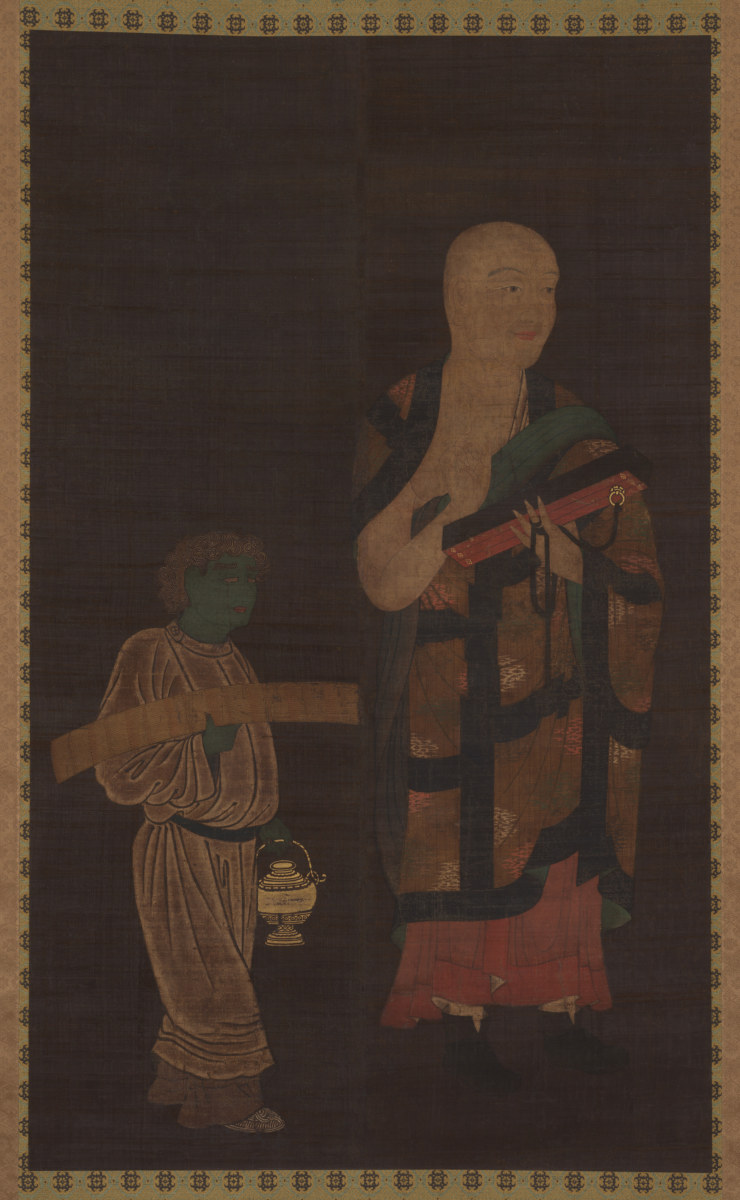
Attributed to Kasuga Motomitsu, Portrait of Xuanzang (Genjo) with Attendant, 14th century, The Metropolitan Museum of Art, H. O. Havemeyer Collection, Gift of Horace Havemeyer, 1929 · Portrait of Xuanzang with an attendant, hanging scroll in ink and color on silk, attributed to Kasuga Motomitsu, 14th century (Kamakura period), The Metropolitan Museum of Art, object 45372, H. O. Havemeyer Collection, Gift of Horace Havemeyer, 1929. The work is about seven hundred years old, and the museum's open-access record marks the image as public domain. A devotional painting made centuries after the monk's death, so shown as a later depiction and not a likeness. Original museum image 2468 x 4000 pixels, downscaled to 740 x 1200 with no cropping and no upscaling. · Public domain (artwork by age; museum open-access image)
scholar · Medieval
Xuanzang
602–664
Tang Dynasty, China
Known For
Not yet included in personality matching — the documented evidence doesn't yet cover enough of the personality model. Everything else on this page is fully available.
Trait Constellation
Key Achievements
A Tang-dynasty Buddhist monk, he travelled to India against an imperial travel ban (reported as 627 or 629), studied at Nalanda and in 645 returned to China with Buddhist texts, reported as 657 works.
In Chang'an he directed a state-funded translation project whose team translated 1,338 chapters in eighteen years, with at least 75 works translated by him personally.
His Great Tang Records on the Western Regions remains one of the best historical sources for Central and South Asia in his period, and his journey became the basis of the Journey to the West legend.
Moments That Reveal Them
After his request to travel west was refused, he left China without official approval to reach the Buddhist homeland, and reports say he several times nearly died crossing Central Asia.
This is consistent with a high tolerance for personal risk in pursuit of a scholarly goal, as told by tradition-based sources. Risk Tolerance
Turning Points
In 645 he returned to Chang'an to a triumphal welcome and committed the rest of his life to translating the texts he had brought back.
This is consistent with a shift from travel and study to long-term organised translation work. Persistence
Similar People
People whose overall profiles resemble theirs.

T. E. Lawrence

Marcus Aurelius

Nelson Mandela

Malala Yousafzai

Elizabeth Blackwell
Opposite Profile
Not a rival — a different profile shape worth a look.
Hildegard of Bingen
Sources
- Xuanzang (Q42063), verified live via the Wikidata API (2026-10-28): label 'Xuanzang', description '7th-century Chinese Buddhist monk and scholar (602-664)', Korean label present, image 'Xuanzang w.jpg'. Orientation only; not used as support for any row.
- Encyclopedia of Religion, 'Xuanzang' (via Encyclopedia.com; read in full). CANONICAL SIGNIFICANCE SOURCE: a scholarly entry that says he left China in 627 without official approval, studied at Nalanda, returned in 645 with Buddhist texts and artifacts, wrote the Da Tang xiyu ji, directed a lavishly funded translation project, and later became the prototype of the Tripitaka figure in Journey to the West. It marks several episodes as reported ('we are told'), calls him a 'radical conservative' and says his school's influence in China faded quickly.
- World Eras entry 'Xuan Zang' (via Encyclopedia.com; read in full): journey from 629, arrival in India 633, study at Nalanda, return in 645 with 657 texts, and a translation project in which his team of 185 workers translated 1,338 chapters in eighteen years, he himself at least 75 works; the Records as one of the most valuable accounts of the regions. General history reference.
- Edward H. Kaplan, review of Sally Hovey Wriggins, 'Xuanzang: A Buddhist Pilgrim on the Silk Road', The Historian 60(3), 1998 (read in full via the National Taiwan University Buddhist library copy): treats Xuanzang as an explorer comparable to Zhang Qian, says the book synthesises scholarship, and describes the Records and a colleague's biography as still extant. Academic book review; the book itself was not opened.
- Tricycle (Buddhist magazine), review of Wriggins's 'Xuanzang: A Buddhist Pilgrim on the Silk Road' (read in full): says he went to India in 629 despite an imperial ban, nearly died of thirst and was attacked by robbers, returned in 645 with the largest collection of scriptures to reach China, and dictated his experiences to the monk Huili. A sympathetic Buddhist publication retelling the biography tradition.
- The Metropolitan Museum of Art collection record 45372, 'Portrait of Xuanzang (Genjo) with Attendant', attributed to Kasuga Motomitsu, 14th century (checked for the portrait only; not used for any scoring).