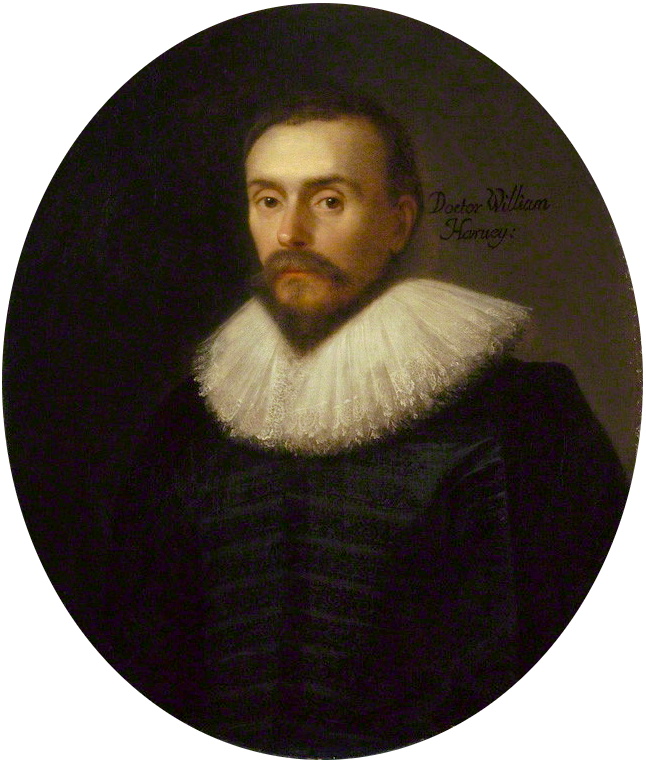

Attributed to Daniel Mytens (c. 1590-1647), William Harvey, c. 1627, oil on canvas, National Portrait Gallery, London (NPG 5115); photographic reproduction of a two-dimensional public-domain painting · Oval oil portrait inscribed 'Doctor William Harvey', c. 1627, attributed to Daniel Mytens (Daniel Mijtens the Elder), National Portrait Gallery, London, NPG 5115, via Wikimedia Commons (File:William Harvey 2.jpg; Wikidata Q28043529). Downloaded unmodified (646x762, no resizing). The NPG collection page is bot-walled (Cloudflare) and was not opened or bypassed, so the NPG attribution wording, acquisition history and any 'from life' statement were NOT verified at the holder. · Public domain (painting by an artist who died in 1647; Commons template PD-art-old-100-expired)
physician · Early Modern
William Harvey
1578–1657
Known For
Not yet included in personality matching — the documented evidence doesn't yet cover enough of the personality model. Everything else on this page is fully available.
Trait Constellation
Key Achievements
In 1628 Harvey published at Frankfurt the Exercitatio Anatomica de Motu Cordis et Sanguinis in Animalibus, a short quarto of 72 pages. Arguing from the structure of the heart and its valves, from experiments on living animals including ligatures on a snake, and from the amount of blood the heart sends out, he concluded that the blood travels in a continuous circuit, pumped from the right ventricle through the lungs and from the left ventricle round the body, and returns to the heart by the veins. He had first stated this in his lectures of April 1616.
Harvey was elected Lumleian lecturer in anatomy and surgery at the College of Physicians of London on 4 August 1615 and held the post until he resigned in 1656. His surviving notes for the lectures of 16-18 April 1616, the first public statement of the circulation, show that he had by then dissected more than eighty species of animals and used animal anatomy to explain the human body.
In 1651 Harvey's Exercitationes de Generatione Animalium appeared in London, after George Ent had taken the manuscript from him at Christmas 1650. The book describes the parts of the hen's egg and follows the growth of the chick inspection by inspection. Norman Moore judged that it shows great labour and careful observation, though the microscope was still needed to make much of it clear.
Moments That Reveal Them
In May 1636, travelling with the Earl of Arundel's embassy to the emperor, Harvey reached Nuremberg and offered to demonstrate the circulation to Caspar Hofmann, a professor who opposed it. He gave a demonstration there, which Keynes places at the University of Altdorf, but Hofmann remained unconvinced and the two exchanged letters afterwards. A later tradition adds that Harvey laid down his knife and left when the objections continued.
Offering a demonstration on the spot, rather than an argument by letter, fits persuasiveness, though the unconvinced Hofmann shows that it did not work on a determined opponent; the walk-out is tradition and is not relied on. Persuasiveness
John Aubrey, who first saw Harvey at Oxford in 1642, recalled that Harvey came several times to Trinity College to see George Bathurst, who kept a hen hatching eggs in his rooms. They opened one egg every day to follow the progress and way of generation.
Setting up a simple daily test and repeating it over several days is consistent with experimentation; the account rests on Aubrey's memory alone. Experimentation
Turning Points
After lecturing on the circulation at the College of Physicians every year since 1616, Harvey sent De Motu Cordis to press at Frankfurt in 1628, saying in the proem that some fellows reproached him for departing from all anatomists and that friends had urged him to publish. Opposition followed: James Primrose's reply appeared in 1630 and Parisanus's in 1635, and Aubrey reports Harvey saying that his practice fell off and that physicians were against him, though D'Arcy Power suggests the court's politics also played a part. Norman Moore concludes that before Harvey's death the doctrine was accepted throughout the medical world.
Publishing a doctrine he expected to draw hostility, then largely declining to answer the critics, is a mixed picture for conflict tolerance: he accepted open disagreement over the idea but avoided polemical exchange. Conflict Tolerance
Similar People
People whose overall profiles resemble theirs.

Benjamin Franklin

Carl Jung

Rosalind Franklin

Alan Turing

Sor Juana Inés de la Cruz
Opposite Profile
Not a rival — a different profile shape worth a look.

Susan B. Anthony
Sources
- William Harvey (Q93128) -- verified live via wbgetentities (2026-10-07): en label 'William Harvey', description 'English physician (1578-1657)', born 1 Apr 1578, died 3 Jun 1657, citizenship Kingdom of England, instance of human, ko label '윌리엄 하비', two P18 images. Orientation only; not used as support for any row.
- John Aubrey, 'William Harvey (1578-1657)', in 'Brief Lives', chiefly of contemporaries, set down between 1669 and 1696, ed. Andrew Clark, vol. 1 (Oxford: Clarendon Press, 1898), pp. 295-304, Internet Archive scan -- ACQUAINTANCE's memoir by a friend who knew Harvey personally from 1651 and had talked with him at Oxford; anecdotal, partly hearsay and, in Norman Moore's judgement and Willis's, not always accurate in detail; includes unflattering remarks (choleric, dagger, dismissive of his prescriptions). Read the whole entry including the editor's notes.
- Robert Willis, 'The Life of Harvey', in The Works of William Harvey, M.D., translated from the Latin (London: Sydenham Society, 1847), vol. 1, pp. xvii-lxiv, Internet Archive scan -- ADMIRING Victorian editor-translator's biography, built on Harvey's own text, Aubrey, hospital and College records; frequently adds editorial praise and conjecture (e.g. about Harvey's motives for leaving the king's service), which is not used as evidence. Read the life from the family background to the discussion of the opposition and of the claims of predecessors (Servetus, Columbus, Caesalpinus); the closing section on Harvey's person and writings beyond that point was not read.
- Norman Moore (physician and historian of the Royal College of Physicians), 'Harvey, William (1578-1657)', Dictionary of National Biography vol. 25 (1891), via Wikisource -- INDEPENDENT scholarly biography written from the College's own manuscript annals, the British Museum notes of Harvey's 1616 and 1627 lectures and St Bartholomew's Hospital records; it tells readers to treat Aubrey's remarks on Harvey 'with suspicion'. Read in full.
- D'Arcy Power (surgeon and medical historian, Bart's), 'William Harvey' (Masters of Medicine series, London: T. Fisher Unwin, 1897), Project Gutenberg ebook 46664 -- sympathetic but archival biography that quotes Bart's, College and State Papers records, and sets Aubrey's anecdotes against them (e.g. it is sceptical that Harvey's loss of practice was due to the book alone). Read the passages on the Lumleian lectures, the 1628 publication and its reception, the College offices, the foreign journeys including Nuremberg, the Merton wardenship and the closing comparison with John Hunter; the chapters on the anatomical works and on generation, and most of the Civil War chapter, were not read in full.
- William Harvey, Exercitatio Anatomica de Motu Cordis et Sanguinis in Animalibus (Frankfurt: Fitzer, 1628), in Robert Willis's English translation, 'An Anatomical Disquisition on the Motion of the Heart and Blood in Animals', Works of William Harvey (Sydenham Society, 1847), vol. 1 pp. 1-86 -- SELF source (primary). Read the dedication to the College of Physicians, the proem, chapter 1 (the author's motives), chapter 8 (the quantity of blood and the circular motion) and chapter 14 (conclusion); the remaining chapters were skimmed.
- William Harvey, 'First' and 'Second Anatomical Disquisition on the Circulation of the Blood, addressed to John Riolan' (Cambridge, 1649), in Willis's translation, Works of William Harvey (1847), vol. 1 pp. 89-142 -- SELF source (primary), Harvey's own reply to the Paris anatomist Riolan, who accepted part of the circulation and rejected the rest. Read the openings of both disquisitions.
- George Ent, 'Epistle Dedicatory' to Harvey's Exercitationes de Generatione Animalium (London, 1651), in Willis's translation, Works of William Harvey (1847), vol. 1 pp. 145-150 -- FRIEND and disciple's report of a Christmas 1650 conversation with Harvey, quoting his remarks on studying natural things; partisan (Ent had defended the circulation in print in 1641) but a contemporary eyewitness. Read the opening conversation.
- Sir Geoffrey Keynes, 'Notes for the Life of William Harvey', Journal of the Royal College of Physicians of London 12(5):433-436 (1978), PMC5366683 -- addenda by Harvey's principal modern biographer to his 'Life of William Harvey' (Oxford, 1966): new evidence on the Nuremberg demonstration to Hofmann, a 1638 report of a nearly finished generation treatise, Harvey's patients and his 1639 scurvy prescription. Read in full (4 pages). Keynes's main 1966 biography was NOT accessible in full text and was not read.
- Marjorie O'Rourke Boyle, 'Harvey, by Hercules! The Hero of the Blood's Circulation', Medical History 57(2) (2013), PMC3566748 -- modern scholarly, interpretive and partly revisionist reading of De Motu Cordis as a rhetorical act of self-defence against fellows of the College who accused him of breaking faith with Galenic medicine; argues Harvey's 'copia' of blood means a powerful supply rather than a measured quantity. Used only for the contested point about what the 'quantitative' argument meant and for the report that Harvey complained of the accusation in his own proem; its Herculean reading of his character is not used as evidence. Read the abstract and the opening sections on the oaths and the College setting.
- Royal Society of Medicine, Historical Section, 'Portraits of Dr. William Harvey' (Oxford: Humphrey Milford / OUP, 1913), Internet Archive scan -- institutional iconography with notes by D'Arcy Power and Geoffrey Keynes on twenty portraits, busts and the coffin; warns that many pictures labelled Harvey are spurious or doubtful. Read in full for the portrait provenance; its general remarks on his appearance and temperament are secondary and not used for any row.
- Wikimedia Commons file page 'File:William Harvey 2.jpg' (source link: National Portrait Gallery, London, NPG 5115; licence tag PD-art-old-100-expired) and Wikidata item Q28043529 (painting 'William Harvey', attributed to Daniel Mytens, 1627, collection National Portrait Gallery, inscribed). The NPG collection page itself sits behind a bot wall (Cloudflare 'Just a moment') and was not opened or bypassed. Portrait provenance only.