Marie Curie
91% Profile Match
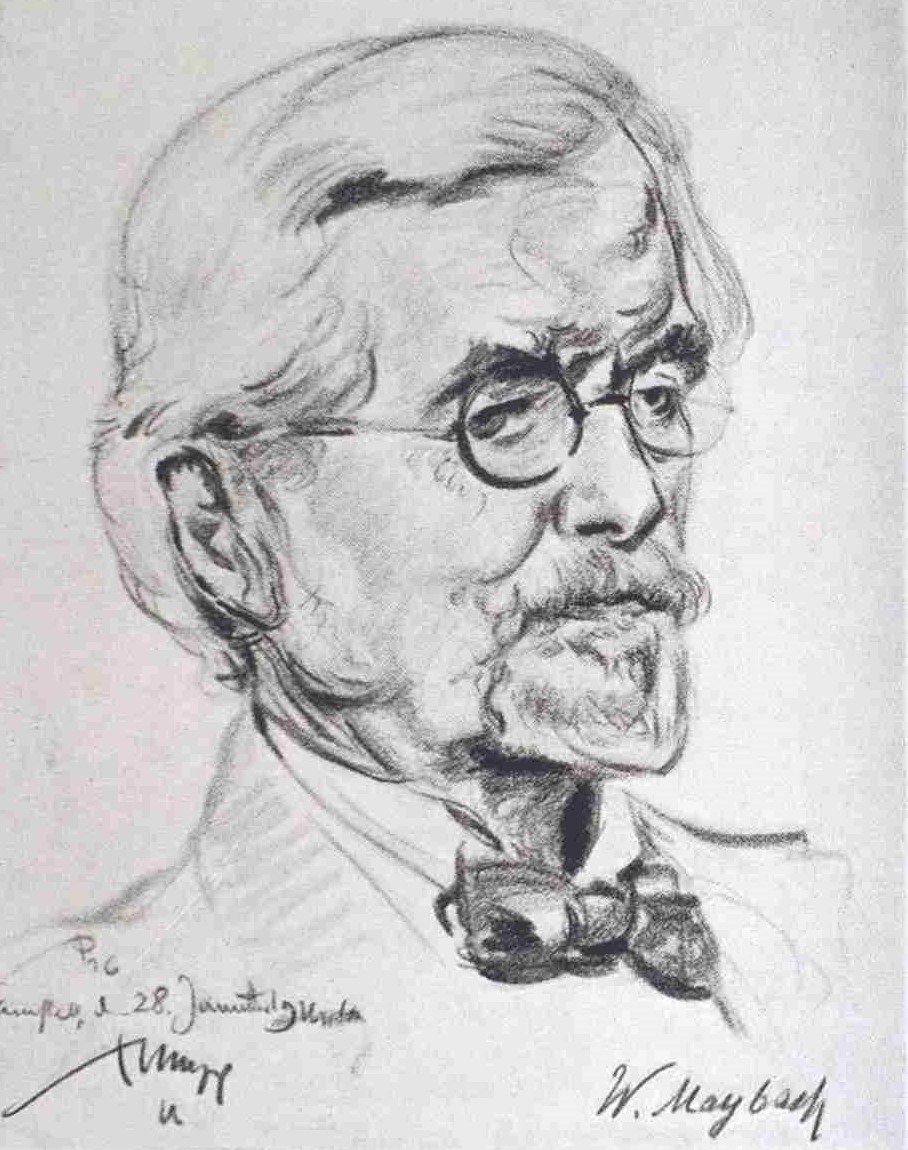
Emil Stumpp (1886-1941), 'Wilhelm Maybach', published in Koepfe in Schwaben, Stuttgarter Neues Tagblatt, 1926; Wikimedia Commons, Public domain · Emil Stumpp, 'Wilhelm Maybach', charcoal/crayon portrait drawing signed by the artist and by the sitter, published in 'Koepfe in Schwaben: Portraetskizzen von Emil Stumpp', Stuttgarter Neues Tagblatt, 1926 (Wikimedia Commons 'Emil Stumpp Wilhelm Maybach.jpg') · Public domain
engineer · 19th Century
1846–1929
Not yet included in personality matching — the documented evidence doesn't yet cover enough of the personality model. Everything else on this page is fully available.
At Daimler's workshop in Cannstatt, Maybach worked from 1882 on a light, high-revving petrol engine. The DPMA describes the vertical 'grandfather clock' engine of 1884 as light and small yet fast enough to drive vehicles, and NDB says he raised engine speed from about 110 to 900 rpm by redesigning connecting rod, crankshaft, bearings and valve gear. In 1885 it powered the wooden two-wheeler known as the Reitwagen, which reached about 12 km/h. The sources differ on how to share credit with Daimler, who filed the patents.
Working from a flat and then from the rented ballroom of the former Hotel Hermann in Cannstatt in 1891-95, Maybach developed the belt drive, the two-cylinder Phoenix engine and the spray-jet carburettor of 1893, which NDB says became widely used and the DPMA says was used for decades in the car industry. Weeks's 1904 reference book already credited his 'able assistance' and the carburettor to the Daimler works.
In 1900 Maybach's design office, including Ernst Moewes, Eugen Linck and Albert Heess, built a racing car with a 35 hp four-cylinder engine and two carburettors for the Austrian businessman Emil Jellinek, who ordered 36 cars and named the model after his daughter Mercedes. NDB lists the honeycomb radiator, light-metal parts and geared transmission, and the DPMA says the car set the basic layout of the modern automobile; it was shown at Nice Race Week in March 1901.
After leaving the DMG in 1907, Maybach wrote to Count Zeppelin in 1908 recommending an airship engine based on a design by his son Karl, and Luftfahrzeug-Motorenbau was founded at Bissingen on 23 March 1909. Karl designed the first engine himself (NDB), and the Zeppelin LZ 10 Schwaben flew with three of the company's engines in 1911; the firm later became Maybach-Motorenbau and presented its first car in 1921.
While researching for Daimler, Maybach found a patent by an Englishman named Watson that described an unregulated hot-tube ignition, which the Mercedes-Benz archive calls an important requirement for reaching higher engine speeds. A horizontal test engine followed in 1883, then the vertical 'grandfather clock'.
Searching existing patents and then testing the idea on a bench engine is consistent with experimentation; the account comes from the successor company's archive and the Watson patent itself was not checked. Experimentation
For the Paris World Exposition of 1889 Maybach built a four-wheeled 'steel-wheel car' with a bicycle-derived frame, solid rubber tyres, a geared transmission and a V-twin engine. NDB says that he and the French licensee Emile Levassor drove it on Paris streets, and the DPMA says he developed the vehicle around the engine instead of fitting an engine into a carriage.
Designing the transmission, frame, tyres and engine as one vehicle rather than adapting a carriage is consistent with systems thinking; both accounts are favourable to Maybach and credit is shared with Daimler's direction in other sources. Systems Thinking
In April 1907, after his position at the DMG had weakened since 1903 and supervisory board members wanted him out, Maybach left the company. NDB says Jellinek's support did not help. After the Zeppelin LZ 4 was destroyed at Echterdingen in August 1908, he offered Count Zeppelin an engine design by his son Karl, which led to the 1909 engine company that carried the Maybach name into airship, rail and car engines.
Turning a forced exit into an offer to a new customer within about a year is consistent with opportunity sensing; the engine design itself was his son's, and the account of the 1907 exit comes mainly from NDB and the DPMA. Opportunity Sensing
People whose overall profiles resemble theirs.


Not a rival — a different profile shape worth a look.