Rosalind Franklin
90% Profile Match
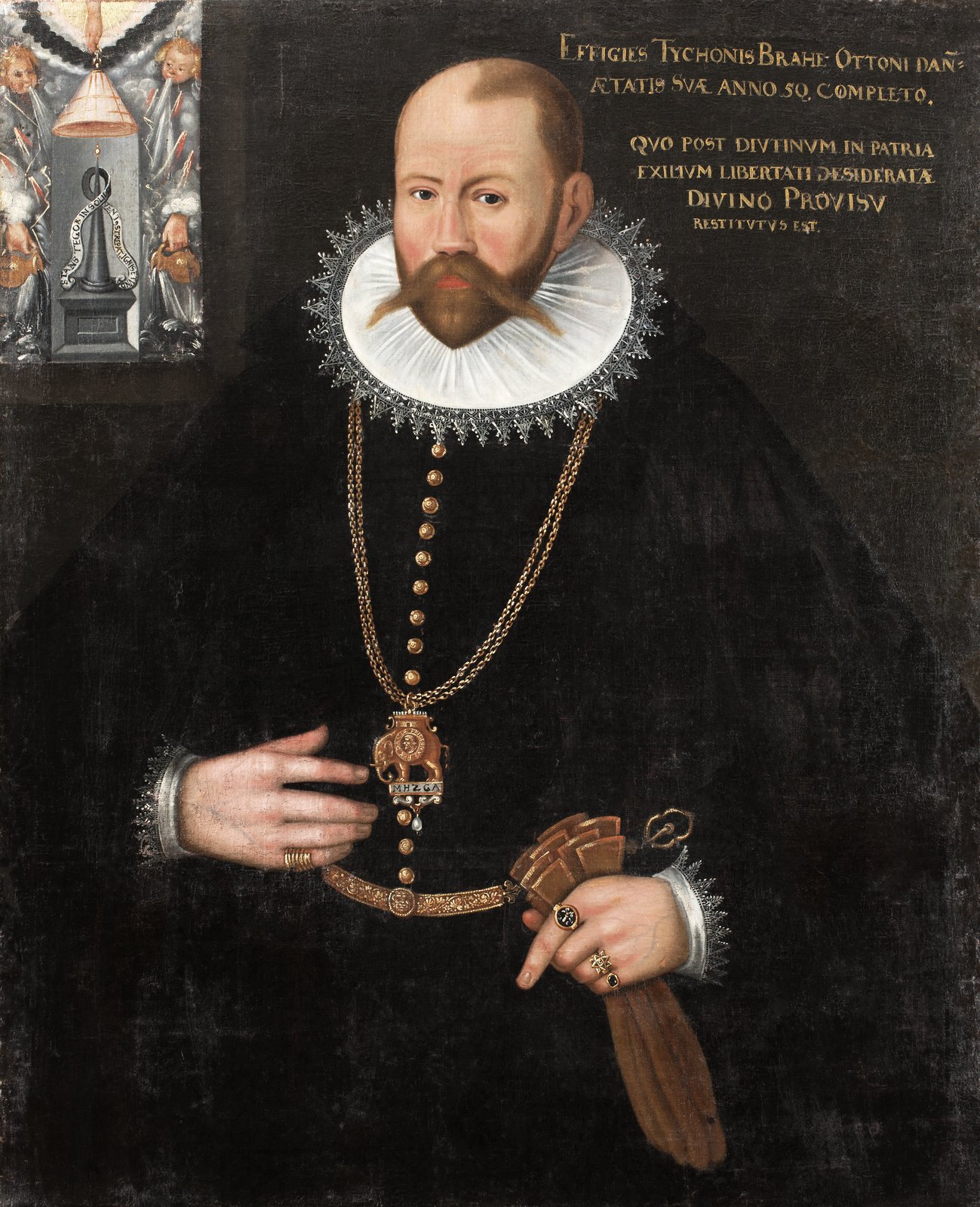
Portrait of Tycho Brahe, unknown artist, dated 1596, Skokloster Castle (SHM, SKO 11593); photograph Jens Mohr 2012/2013, Statens historiska museer, public domain · Skoklosters slott (Statens historiska museer), inventory SKO 11593, oil on canvas, inscribed as painted when Tycho was 50 (1596); via Wikimedia Commons file 'Portratt av Tycho Brahe - Skoklosters slott - 90153.tif' · Public domain (artist unknown; work more than 100 years old; Public Domain Mark per the museum)
astronomer · Early Modern
1546–1601
Not yet included in personality matching — the documented evidence doesn't yet cover enough of the personality model. Everything else on this page is fully available.
From 1576 Tycho observed from Uraniborg on the island of Hven, which Frederick II had offered him, and from 1584 also from Stjerneborg, a second observatory with underground crypts where the larger instruments stood fixed. With instruments he designed and kept rebuilding, and with sights and graduated arcs of his own devising, he ran a more frequent and more systematic observation programme than any earlier astronomer, according to Danish historian Kristian Peder Moesgaard, who says it raised the accuracy of positional astronomy about tenfold to roughly an arcminute, without a telescope; a later study of his planetary observations found errors mostly between 0.5 and 1 arcminute.
In November 1572 Tycho measured the position of a new star in Cassiopeia against the neighbouring stars and found no parallax, which put it far beyond the Moon and probably among the fixed stars; he published this in De nova stella in 1573. He did the same for the great comet first seen on 13 November 1577, and in De mundi aetherei recentioribus phaenomenis (printed on Hven in 1588) argued from his measurements that the comet moved among the planets, at least six times as far away as the Moon according to Dreyer. Moesgaard notes that these results struck at the Aristotelian picture of an unchanging heaven and of hard planetary spheres.
Tycho completed a catalogue of 1004 star positions in 1598 and circulated it in manuscript; the version he edited for print, with 777 stars, appeared in 1602 after his death in Astronomiae instauratae progymnasmata, and Kepler published the full list in the Rudolphine Tables in 1627. Moesgaard calls it the first real improvement in star catalogues since antiquity. A modern comparison with the Hipparcos Catalogue finds errors typically about 2 arcminutes wide, with some larger ones that mostly come from computation or copying; Dreyer judges that the stars added to reach about 1000 were observed in haste.
In 1588 Tycho published his own system of the world: the Earth fixed at the centre, the Sun and Moon circling it, and the five other planets circling the Sun. MacTutor, citing Janet Field, says most astronomers favoured it until at least the middle of the seventeenth century. In 1599 he became Imperial Mathematician in Prague, where Kepler joined him in 1600, first at the castle of Benatky nearby. Moesgaard writes that Kepler derived the elliptical orbits of the planets from Tycho's observations in Astronomia nova (1609) and in 1627 completed the Rudolphine Tables with them.
On the evening of 11 November 1572, coming back from his laboratory, Tycho saw a very bright star in Cassiopeia where none had been. According to Dreyer he asked his servants and then some peasants driving past whether they saw it too, and only then began measuring its distance from the nine main stars of the constellation with a new wooden sextant. He repeated the measurements through the night and even left the instrument clamped between readings to be sure nothing had shifted, and he tabulated the sextant's own error.
Checking his own eyes against other people's and checking the instrument against itself is consistent with detail orientation; the account comes from Dreyer's reading of Tycho's published description. Detail Orientation
In 1584 Tycho found that his own value for the tilt of the ecliptic differed from Copernicus's, and that the Copernican solar theory sometimes strayed from observed positions. To test the Copernican input he sent his assistant Elias Olsen with a sextant on a royal ship to Frauenburg, where Olsen spent from mid-May to early June measuring the latitude of Copernicus's observing place, and Tycho used the difference to explain part of the shortcomings of the solar theory. Dreyer adds that Tycho never named Copernicus without admiration, and a canon at Frauenburg sent him the triquetrum Copernicus had made.
Re-measuring a respected authority's basic data rather than assuming it is consistent with analytical rigor, though Tycho himself kept the solar parallax of 3 arcminutes on authority, as Moesgaard notes. Analytical Rigour
As a student at Copenhagen and then Leipzig, Tycho was meant to study law. A partial solar eclipse on 21 August 1560 that arrived at the predicted time first drew him to astronomy, and in August 1563 a conjunction of Saturn and Jupiter changed how he worked. The old Alphonsine tables were off by about a month and the Copernican-based Prutenic tables by a few days. Using a pair of ordinary compasses he began to record his own observations, and Dreyer and Moesgaard both say this convinced him that only a long, steady series of measurements could decide among the tables and the world systems behind them.
Letting a measured result outrank the printed tables, and acting on it against his guardians' plan for a legal career, is consistent with independent thinking. Independent Thinking
People whose overall profiles resemble theirs.
Not a rival — a different profile shape worth a look.