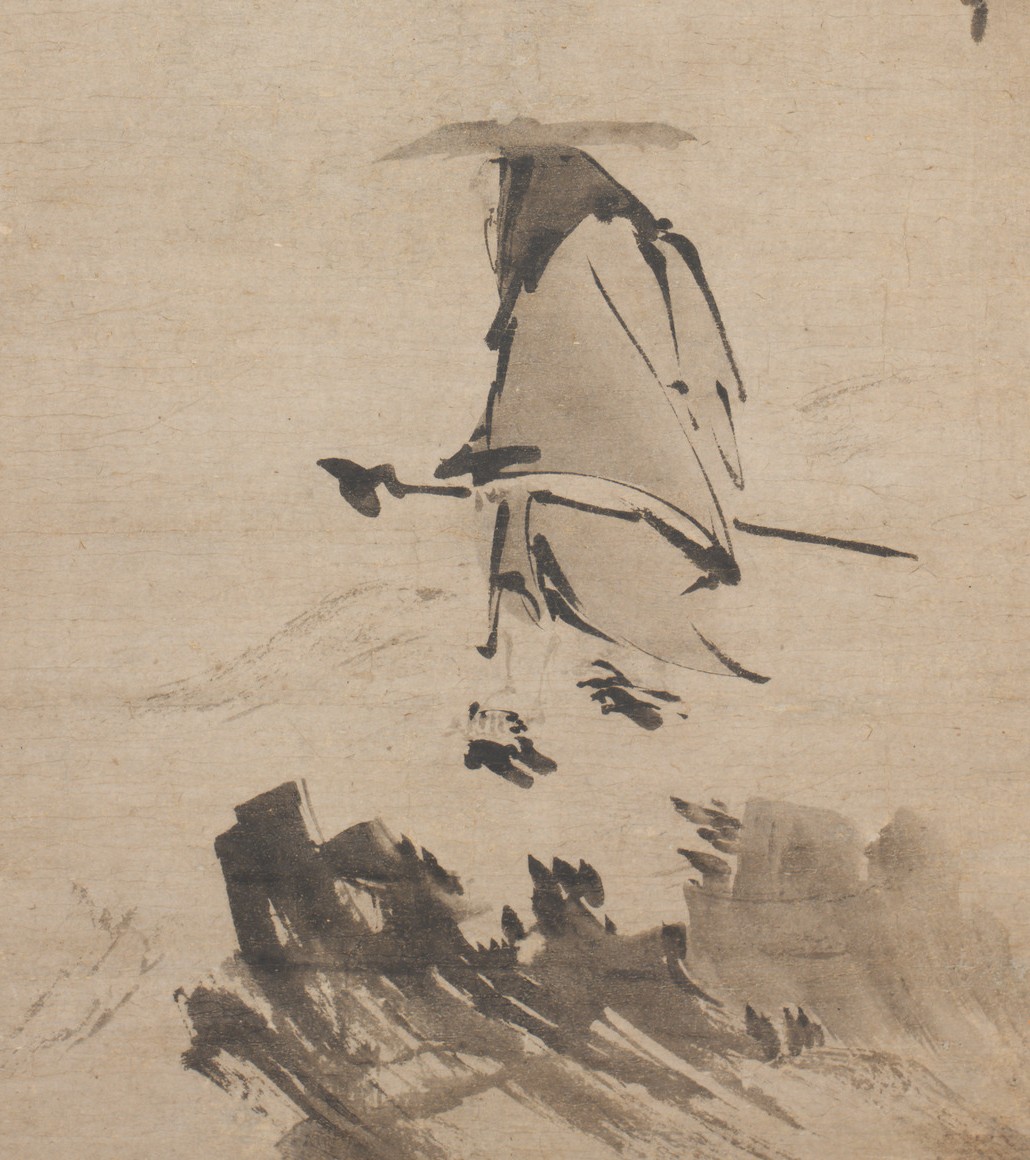

Unidentified Japanese painter, inscribed by Zuigan Ryusei and others, Su Shi (Dongpo) in a Bamboo Hat and Clogs, before 1460, The Metropolitan Museum of Art, Harry G. C. Packard Collection of Asian Art, 1975 (1975.268.39), public domain · The Metropolitan Museum of Art, 'Su Shi (Dongpo) in a Bamboo Hat and Clogs', hanging scroll, ink on paper, Japan, Muromachi period, made before 1460 (accession 1975.268.39), with inscriptions by several Zen monks including Zuigan Ryusei (1384-1460); the painter is not identified. A Japanese ink painting of the poet in the hat and clogs of a well-known episode, made about 350 years after his death, so it is a later depiction and not a likeness. The Met's collection record marks the work as public domain (open access). The file is a plain crop of the figure and rock from the original 1709 x 4000 pixel museum image, taken from the full image with the inscriptions and gold mounting cut away, at its original resolution and not enlarged. · Public domain (Metropolitan Museum of Art Open Access, CC0)
Trait Constellation
Key Achievements
One of the greatest Song dynasty poets and prose writers, counted among the eight great prose masters of the Tang and Song; his Former Ode on the Red Cliffs, written in exile, is regarded as the peak of his writing.
Ranked among the leading Song calligraphers, and called by one museum the fountainhead of the literati painting tradition, which came to dominate later Chinese art.
As prefect of Hangzhou he met drought, famine and epidemic with grain relief and hospitals, and dredged the silted West Lake, using the mud to build the causeway that still bears his name.
Moments That Reveal Them
When drought, famine and epidemic struck Hangzhou, he petitioned to cut the local rice tax, sold monks' ordination certificates to raise grain, and set up hospitals staffed by doctors.
This is consistent with a habit of finding practical means within the limits of his office. Resourcefulness
Exiled to Hainan, he was caught in the rain and borrowed a farmer's bamboo hat and clogs; a curator says he stayed calm, and the scene became a classic image of him.
This is consistent with an ability to keep working and keep his composure in changed and difficult circumstances. Adaptability
Turning Points
In 1079 censors charged him over phrases in his poems and he was imprisoned; he was spared execution and exiled to Huangzhou, where he farmed a plot called Dongpo and wrote the Red Cliff odes.
This is consistent with a pattern of reshaping his life and work around a forced change of circumstances. Adaptability
Similar People
People whose overall profiles resemble theirs.

Rabindranath Tagore

Benjamin Franklin

Leonardo da Vinci

Franz Kafka

Maya Angelou
Opposite Profile
Not a rival — a different profile shape worth a look.
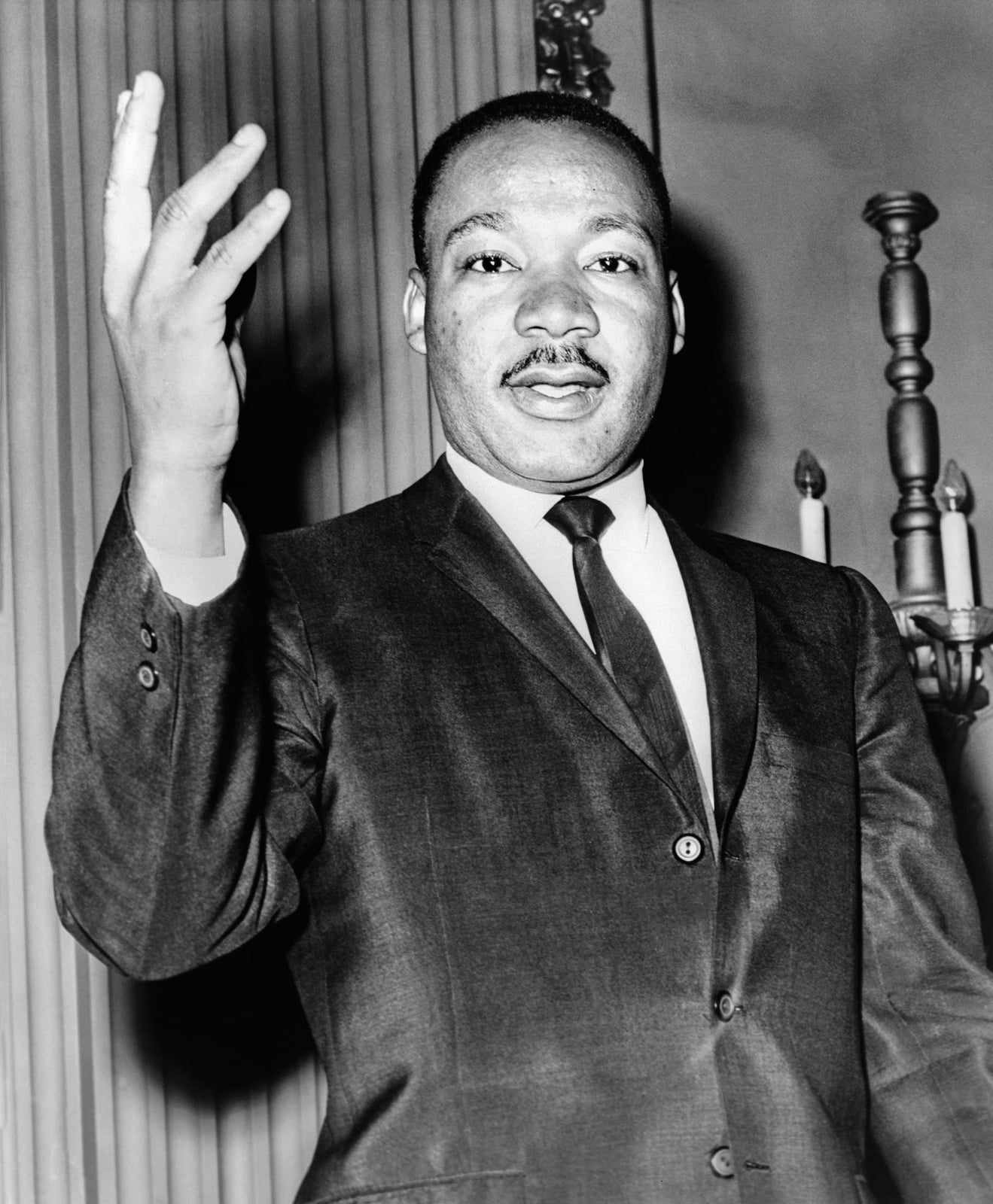
Martin Luther King Jr.
Sources
- Su Shi (Q36020), verified live via the Wikidata API (2026-10-31): label 'Su Shi', description 'Chinese writer and politician (1037-1101)', born 1037-01-08, died 1101-08-24, Korean label present. Orientation only; not used as support for any row.
- Wikipedia, 'Su Shi', fetched for orientation (dates, offices, the Four Masters of Song calligraphy, the poem-trial context). Orientation only; never counted as support for any row.
- Song Shi (the official history of the Song dynasty, compiled 1345), chapter 338, biography of Su Shi, read via the Chinese Wikisource text: the standard dynastic account of his offices (judge at Fengxiang, Hanlin academician, prefect of Hangzhou, Mizhou, Xuzhou and Huzhou), his 1079 arrest on charges drawn from his poems, exile to Huangzhou where he farmed the plot he called Dongpo, later exile to Hainan, and Hangzhou famine relief, the dredging of West Lake and the causeway. It also records his own remarks on writing and the compilers' closing judgment. CANONICAL SIGNIFICANCE SOURCE (with the Palace Museum curators' article). Compiled about 240 years after his death from earlier records, so the praise is retrospective, but it is the standard official biography. Read in an English summary produced by the fetch tool; the Chinese quotations were checked against the returned text.
- Wang Kaihao, 'A mind of the times', China Daily (22 September 2020), read in full: report on the Palace Museum, Beijing, exhibition on Su Shi's paintings and calligraphy that quotes curator Yu Wentao and deputy director Ren Wanping. It calls him one of the eight great prose masters of the Tang and Song, a leading Song calligrapher and a pioneer of poetry genres, with the Former Ode on the Red Cliffs as the peak of his writing, and says he broke with rigid copying of models. CANONICAL SIGNIFICANCE SOURCE (museum curators' view). Newspaper report of an exhibition: admiring and partly promotional.
- Santa Barbara Museum of Art, 'Bamboo, Rocks, and Old Trees: Chinese Calligraphy and Literati Painting' (exhibition page, 2019), read in full: describes Su Shi as a statesman, scholar, poet, writer, calligrapher and painter and as the fountainhead of the literati painting tradition, and calls 'Old Tree, Rock, and Bamboo' widely regarded as his only surviving painting. Museum framing with no independent sourcing on the page.
- Chiu-Ti Jansen, 'Su Dongpo's Friendship on the West Lake', Sotheby's (3 September 2013), read in full: sale-preview essay on a Su letter to Guo Xiangzheng written in Hangzhou around 1071-1072; says he asked for a Hangzhou post in 1071 to avoid the reformers' pressure, oversaw dredging of West Lake with the 1089 mud used for the causeway, was known for speaking his mind and suffered exile and sometimes imprisonment even when his own side held power. Auction-house marketing text: favourable and commercial, but independent of the museums.
- China Online Museum, 'Su Shi' (calligraphy masters section; unsigned), read in full: biography with the jinshi degree of 1057, posts from 1060, the Hangzhou causeway, the 1078 memorial from Xuzhou, the two exiles, and the calligraphy 'Cold Food Observance' and the Red Cliff odes written at Huangzhou; says his poems targeted Wang Anshi's reforms rather than the emperor and that after his death his work was collected and shrines built. Unsigned popular site that largely repeats standard accounts; used only for the outline and dates.
- Chen Xi, 'Beijing's Palace Museum explores life of the great Northern Song poet Su Shi', Global Times (2 September 2020), read in full: exhibition report with the reporter's summary of his calligraphy rank, his poems in Chinese school textbooks and the bamboo-hat-and-clogs episode in Hainan that an exhibited painting depicts. State-affiliated newspaper report; popular and admiring, used only to corroborate the Hainan episode and his reception.