Leonardo da Vinci
93% Profile Match
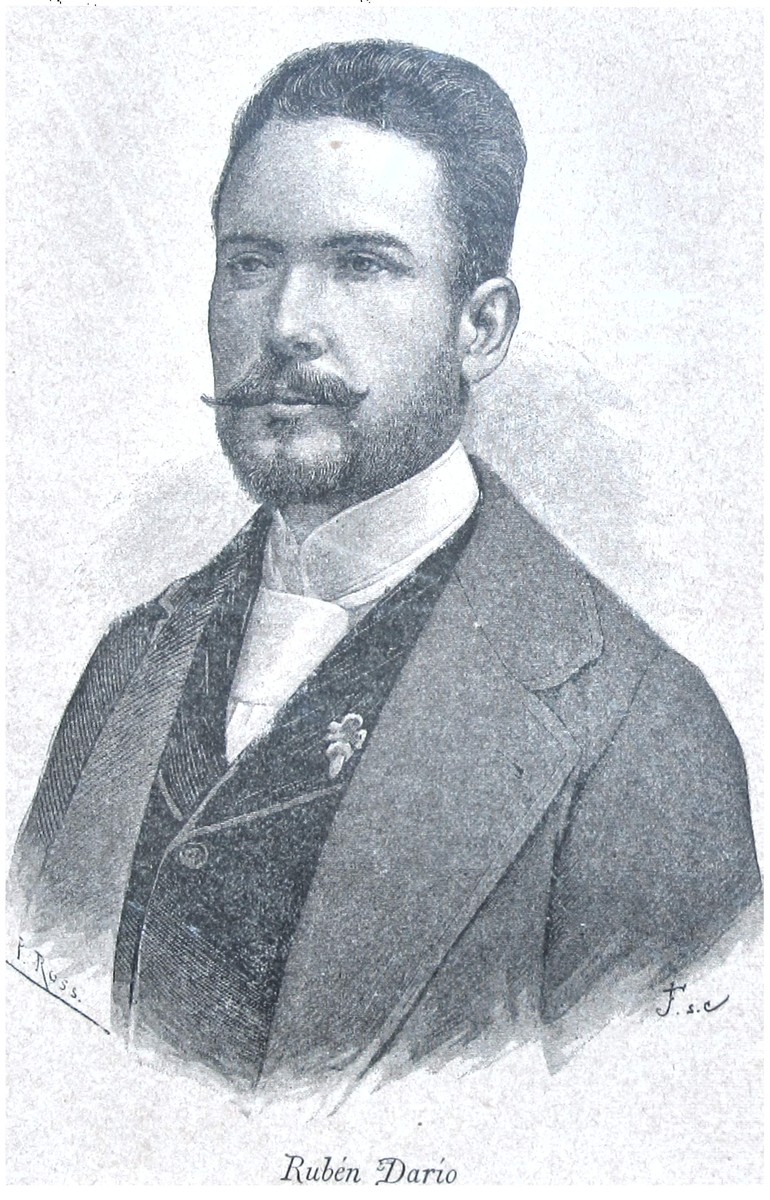
Portrait signed P. Russ, frontispiece of Los raros (Barcelona: Maucci, 1905), Academia Argentina de Letras collection via Wikimedia Argentina · Printed portrait of Rubén Darío, captioned 'Rubén Darío' and signed by its artist (read as P. Russ), used as the frontispiece of Los raros, second edition (Barcelona: Maucci, 1905); scan of the Academia Argentina de Letras copy shared on Wikimedia Commons through Wikimedia Argentina. The page margins were trimmed and the image downscaled from 2360 x 3680 to 770 x 1200 with no upscaling. · Public domain: an illustration printed in a book published in Barcelona in 1905 (before 1931), public domain in the United States by publication date
poet · 19th Century
1867–1916
Not yet included in personality matching — the documented evidence doesn't yet cover enough of the personality model. Everything else on this page is fully available.
He led Spanish-American modernismo: Azul (1888), written in Chile, broke with ornate Romantic style and is generally seen as the movement's starting point, and Prosas profanas (1896) consolidated it across Spanish America.
His Cantos de vida y esperanza (1905) is described as his most mature collection, and Lorca, Neruda, Borges and Paz regarded him as foundational, while young Spanish poets such as Juan Ramon Jimenez and the Machado brothers were drawn to his verse.
He wrote steadily as a journalist, for La Epoca in Chile and for La Nacion of Buenos Aires, which sent him to Spain in 1898, and in Los raros (1896) he wrote essays on writers he admired.
When the critic Clarin dismissed him as a derivative versifier in 1893, Dario answered in La Nacion with 'Pro domo mea', saying he was no head of a school and did not ask to be imitated.
This is consistent with answering a public attack in print rather than letting it pass. Conflict Tolerance
In Prosas profanas (1896) he experimented with rhythm, meter and sound, and over the years he revised earlier work, so that the 1905 edition of Azul is called its definitive version.
This is consistent with treating form as something to try out and refine. Experimentation
In Chile he published Azul (1888), which broke with ornate Romantic style, and Juan Valera's prologues to later editions brought him fame in both the Americas and Europe.
This is consistent with a new poetic voice that changed the direction of his career. Creative Originality
People whose overall profiles resemble theirs.