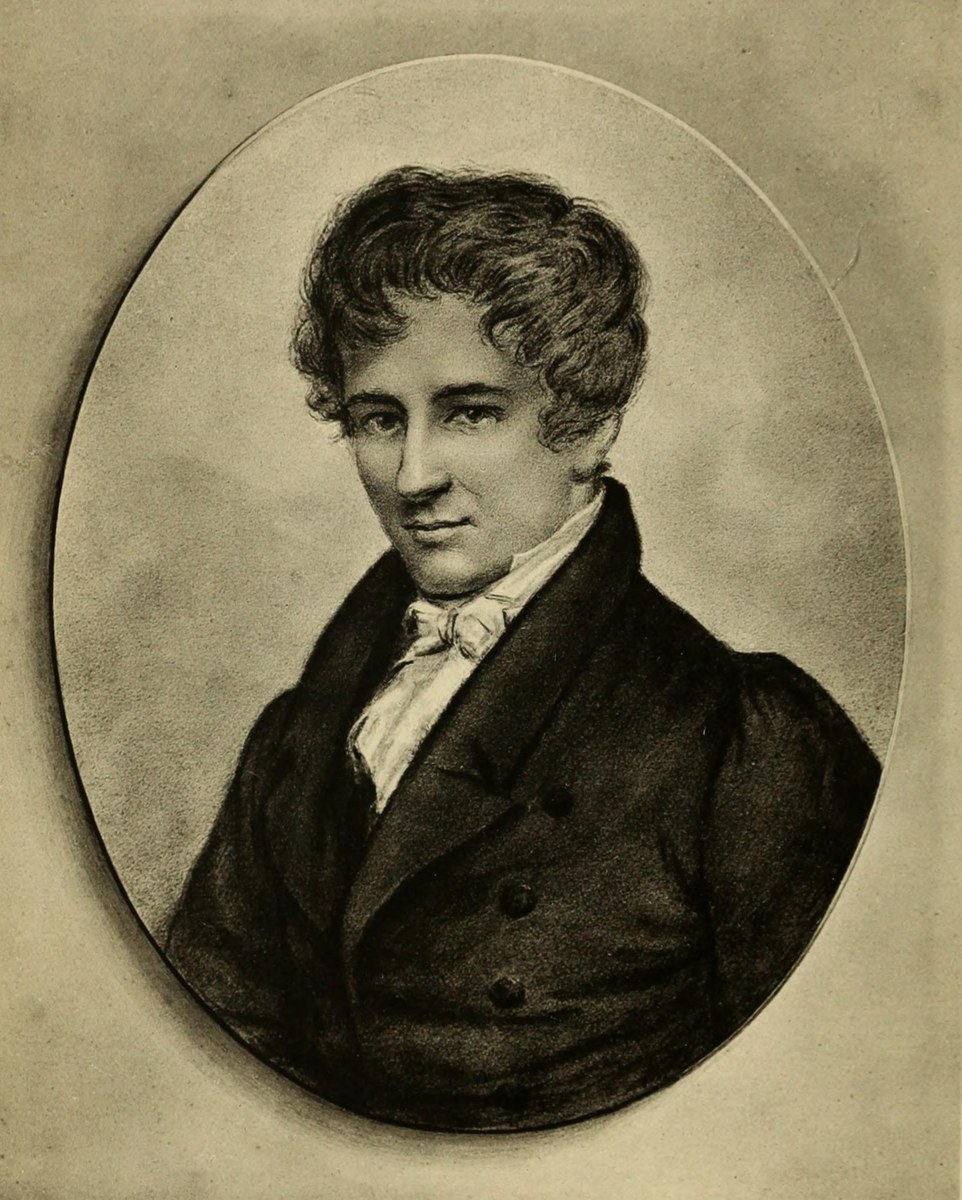

Photomechanical print (J. Jaeger, Stockholm) after Johan Gorbitz's 1826 drawing, in C.-A. Bjerknes, Niels-Henrik Abel (Paris, 1885), public domain · Frontispiece portrait of Niels Henrik Abel in C.-A. Bjerknes, 'Niels-Henrik Abel: tableau de sa vie et de son action scientifique' (Paris: Gauthier-Villars, 1885), a photomechanical print credited 'Ljustryck af J. Jaeger, Stockholm', reproducing the drawing Johan Gorbitz made of Abel in Paris in 1826 (the original charcoal and chalk drawing, 21.5 x 17 cm, is in Norwegian collections; the Norsk portrettarkiv record names Gorbitz and 1826). Internet Archive copy digitised from the University of Toronto (page image 2756 x 4390), cropped to the portrait and downscaled to 962 x 1200 with no upscaling. · Public domain: published in Paris in 1885 (before 1931); the original drawing is by an artist who died in 1853
mathematician · 19th Century
Niels Henrik Abel
1802–1829
Known For
Not yet included in personality matching — the documented evidence doesn't yet cover enough of the personality model. Everything else on this page is fully available.
Trait Constellation
Key Achievements
In 1824 he proved that the general equation of the fifth degree cannot be solved algebraically by radicals, a result Britannica calls the first valid proof of this impossibility.
He turned the theory of elliptic integrals into the theory of elliptic functions and proved Abel's theorem on sums of integrals of algebraic functions in a Paris memoir that was lost for years and printed only in 1841.
He brought rigour to infinite series and analysis, publishing most of his work in Crelle's Journal, and died at 26; the Abel Prize, established by the Norwegian government in 2002, is named for him.
Moments That Reveal Them
Asked by Degen for a numerical example of his supposed solution of the quintic, he found the mistake in his own paper; a few years later he published the proof that no such solution exists.
This is consistent with revising a position when his own checking contradicted it. Belief Updating
When his Paris memoir seemed to have been lost, he wrote its main theorem down again in a two-page paper he called only 'A theorem', and kept sending Crelle new treatises although he had no post.
This is consistent with continuing his work after being ignored. Persistence
Turning Points
In 1825, after printing his quintic proof at his own expense, he wrote a personal letter to the king asking to travel abroad at once; the journey brought him to Berlin, where he met Crelle and published much of his best work in Crelle's new journal.
This is consistent with taking the initiative to open his own route into the European mathematical world. Proactive Agency
Similar People
People whose overall profiles resemble theirs.

Benito Juarez

Florence Nightingale

Thomas Aquinas

Emmy Noether

Alan Turing
Sources
- Niels Henrik Abel (Q124115), verified live via the Wikidata API (2026-11-04): description 'Norwegian mathematician (1802-1829)', Korean label 닐스 헨리크 아벨, birth 5 August 1802 (a second 25 August value is also stored) and death 6 April 1829, image the Gorbitz portrait. Orientation only; not used as support for any row.
- Encyclopaedia Britannica, 'Niels Henrik Abel' (article body read from the public page). CANONICAL SIGNIFICANCE SOURCE: Norwegian mathematician (1802-1829) and pioneer in several branches of modern mathematics; his first papers in 1823 addressed functional equations and integrals, and he was the first to formulate and solve an integral equation; in 1824 he published the first valid proof that the general equation of the fifth degree cannot be solved by radicals; Abel's theorem is the foundation of the theory of Abelian integrals and Abelian functions; his theory of elliptic functions; his work paved the way for Galois's group theory; the Abel Prize was established by the Norwegian government on 1 January 2002. Scholarly reference; its praise is retrospective.
- MacTutor History of Mathematics (University of St Andrews), 'Niels Henrik Abel' by J. J. O'Connor and E. F. Robertson (full biography read, including the quoted letters to Holmboe and others and the passages citing Ore and Ayoub). Covers the 1821 belief that he had solved the quintic and the mistake found while preparing a numerical example, Degen's advice to study elliptic integrals, the 1824 pamphlet printed at his own expense, the stay in Berlin with Crelle and the founding volumes of Crelle's Journal, the Paris memoir on the addition theorem that Cauchy 'scarcely deigned to glance at' (Abel's own letter), the competition with Jacobi in 1828, Gauss never opening his quintic paper, and the later finding of the lost memoir. Scholarly history site drawing on Ore and other secondary works; includes Abel's own letters, which are self-report.
- Norsk biografisk leksikon, 'Niels Henrik Abel' (Norwegian national biographical dictionary, Arild Stubhaug's entry; read in Norwegian in full for the career sections). Gives the school and university years, the unreadable six-page 1824 quintic proof printed privately, the personal letter to King Karl Johan in 1825 asking to travel at once, the Berlin months with Crelle and the seven contributions to the first volume of Crelle's Journal, Paris 1826 and the neglected memoir, the unsuccessful grant requests after his return, the 1828 priority dispute with Jacobi, the stringent proof method (binomial series), and his later reputation as a national hero. Independent Norwegian scholarly biography; its closing assessment is admiring and national in tone.
- Store norske leksikon, 'Niels Henrik Abel' (Norwegian encyclopedia, read in Norwegian). Short independent summary: Holmboe discovered his talent at school, the privately printed 1824 quintic proof, the foreign scholarship and Berlin with Crelle, the Paris memoir treated 'very indifferently' by the committee so that the manuscript disappeared and was printed only in 1841, the competition with Jacobi that mathematicians watched closely, the efforts of Crelle and French academicians to obtain a post for him, and his death on 6 April 1829.
- Niels Abel's letter to August Crelle, Christiania, 25 September 1828 (handwritten German original, English translation on the MacTutor site, read in full). SELF-REPORT: he asks to be told promptly whether the Berlin appointment will succeed, comments on Jacobi's and Legendre's remarks on his elliptic-function work, asks Crelle to print his elliptic-function paper first, and says the equations paper will need much more effort. Primary document, used only for his own stated plans and for how he writes about Jacobi.
- C.-A. Bjerknes, 'Niels-Henrik Abel: tableau de sa vie et de son action scientifique' (Paris: Gauthier-Villars, 1885; French translation, Internet Archive scan from the University of Toronto; only the title page, the frontispiece plate and the passage on the Paris portrait by Gorbitz were read, so the 392-page text was not used for any trait row). Used for the portrait: the title page announces 'orne d'un portrait d'Abel' and the text calls the portrait by Gorbitz in Paris an excellent likeness. Pre-1931 publication.