Rosalind Franklin
94% Profile Match
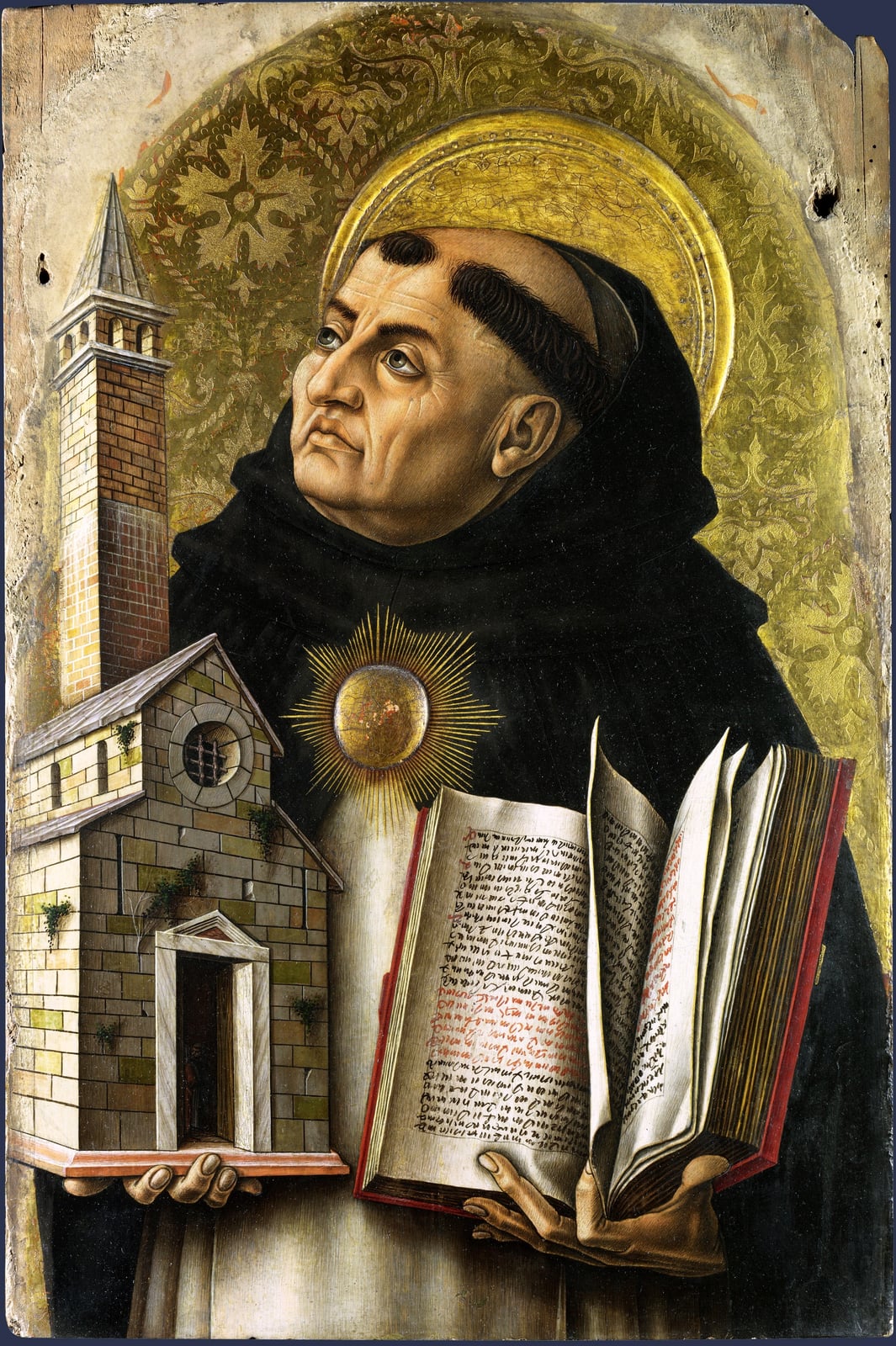
Carlo Crivelli, Saint Thomas Aquinas, 1476, National Gallery, London (NG788.9) — a later idealized/devotional depiction, painted approximately two centuries after Aquinas's death, not a lifetime likeness · Wikimedia Commons (resized derivative) · Public Domain
c. 1225 — Born; the exact year is not settled among historians.
c. 1244 — Resolved to join the Dominican Order at nineteen; his family had him seized and held for nearly a year to change his mind.
1248 — Followed his teacher Albert the Great to Cologne to continue his studies.
1250s–1273 — Taught and wrote across Paris, Rome, and Naples, dictating to multiple secretaries at once, including the Summa Theologica.
6 December 1273 — After a mystical experience during Mass, reportedly stopped writing, telling his secretary his work now seemed like straw to him.
1274 — Died at Fossanova Abbey, three months later, leaving the Summa unfinished.
The Summa Theologica organizes the whole of Christian theology and Aristotelian philosophy into one coherent structural framework, applying a consistent question-objection-response method across thousands of individual articles — directly observable in the surviving text's own organization.
Produced this extraordinary documented volume of work within a working life of roughly two decades, while also teaching and traveling, using a documented method of dictating to multiple secretaries on different works simultaneously.
Integrated newly translated, controversial "pagan" Aristotelian philosophy into Christian theology despite resistance from some Church authorities; several Thomistic propositions were formally condemned by the Bishop of Paris in 1277, a few years after his death.
The profile's independent_thinking score is worth reading through what it cost him — formal posthumous condemnation, not merely a private disagreement never voiced publicly. Independent Thinking
A widely repeated account describes him becoming so absorbed in thought at a royal dinner that he struck the table, oblivious to the company, having just resolved a theological problem — a specific, often-cited anecdote rather than one of several independently corroborated episodes.
He was widely known among fellow students by the nickname "the Dumb Ox" for his quiet, reserved manner — reportedly defended at the time by his teacher, Albert the Great, who predicted his eventual renown.
A widely documented account holds that following a mystical experience during Mass on 6 December 1273, he stopped writing, reportedly telling his secretary that everything he had written now seemed like straw to him next to what he had witnessed. He never resumed the Summa, which remained unfinished at his death roughly three months later.
This complicates rather than confirms the profile's high mastery_orientation score: by his own reported account, the work didn't stop because it was finished, but because the whole undertaking had come to seem beside the point. Mastery Orientation
People whose overall profiles resemble theirs.

Not a rival — a different profile shape worth a look.