Yayoi Kusama
93% Profile Match
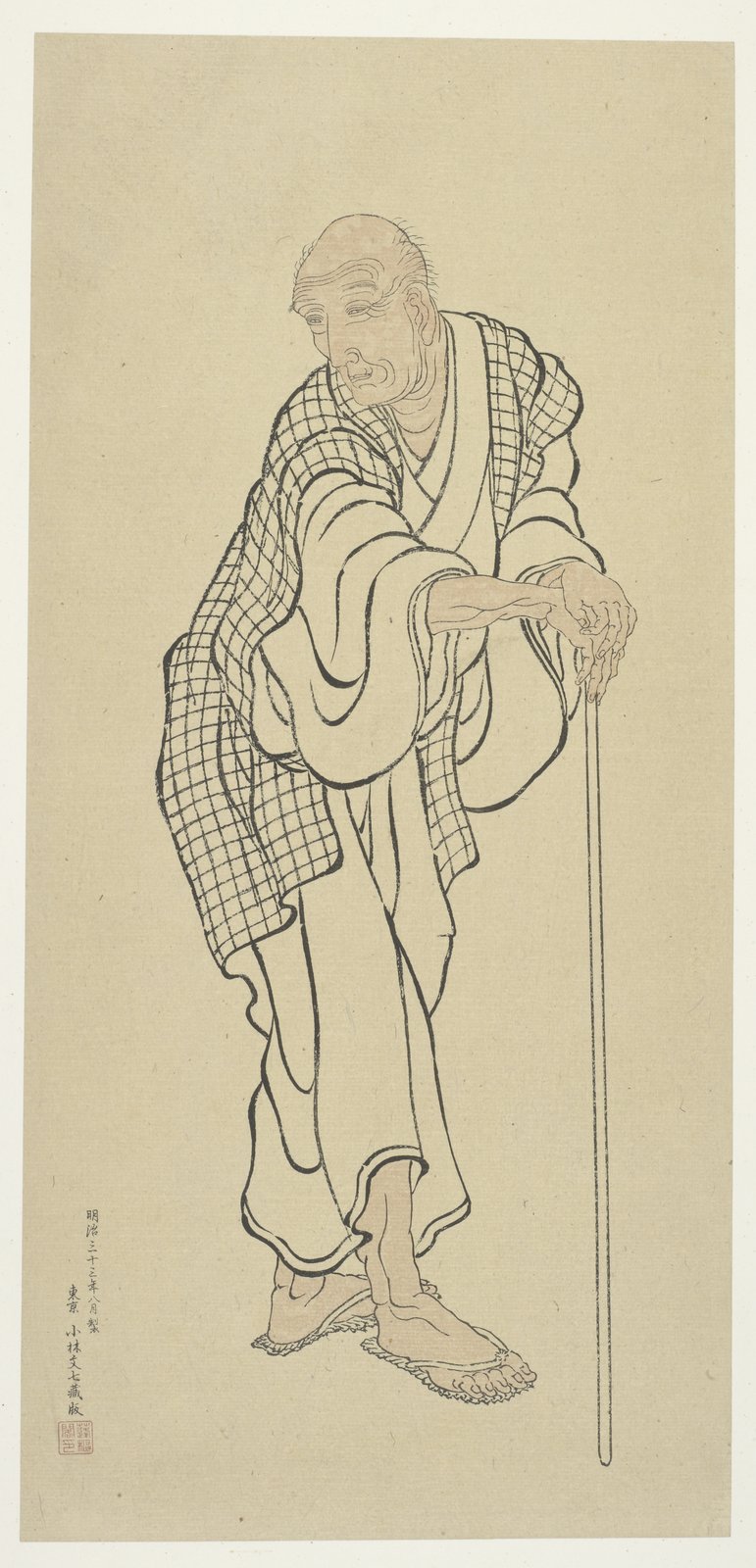
Woodblock print depicting Hokusai as an old man, printed in Tokyo in August 1900 (Meiji 33, per the colophon; blocks held by Kobayashi Bunshichi), 51 years after his death; maker of the earlier image not stated by the museum. National Museum of Asian Art, Smithsonian Institution, F1904.282, CC0. · Smithsonian National Museum of Asian Art (Freer Gallery of Art), F1904.282 'Hokusai as an old man', woodblock print, gift of Charles Lang Freer; copy via Wikimedia Commons · CC0 1.0 Universal (Public Domain Dedication)
Around 1830-32 Hokusai designed the colour woodblock series Thirty-six Views of Mount Fuji, which grew to forty-six prints and includes The Great Wave off Kanagawa and Fine Wind, Clear Morning. The views set the mountain among travellers, workers and weather. The British Museum's Tim Clark estimates that as many as 5,000 to 8,000 impressions were printed from the Great Wave's original block, and that a single sheet cost little more than a double helping of noodles.
From 1814 Hokusai published the Manga, a long series of woodblock sketchbooks crowded with small drawings of people, animals, plants, landscapes, trades and legends. Clark counts ten books of about thirty spreads each issued between 1814 and 1819, and the series eventually reached fifteen volumes, the last compiled from his leftover sketches after his death. Strange called it an encyclopaedia of Japanese life.
Japanese prints reached Paris in great numbers in the later nineteenth century, and Hokusai was among the names that travelled with them. Clark places him at the vanguard of the Japonisme movement and notes that Vincent van Gogh was one of the first in Europe to write a perceptive appreciation of the Great Wave. He calls Edmond de Goncourt's 1896 study of Hokusai the first serious biography in Europe.
Michel Revon's 1896 study, drawing on the recollection of a man named Tozaki who witnessed the scene, says the lord of Tsugaru invited Hokusai to paint a screen and, when messages went unanswered, sent an envoy who came twice offering five gold pieces as a welcome gift. Hokusai refused both times, and the envoy threatened to kill him; Hokusai said he would simply return the gold. Months later he turned up at the lord's house unasked and painted a group of wild horses on the screen, which was kept in the Tsugaru castle.
This episode illustrates, in a single reported instance, a strong need to take on work at his own initiative rather than on a patron's summons. It rests on one late witness account. Need for Autonomy
Japanese artists' compendia, as relayed by Revon and by Henri Focillon, say that in 1811 the novelist Bakin insisted Hokusai draw a clog between a character's teeth in their illustrated novel, and Hokusai refused, telling Bakin to try it himself first. Their collaboration, already marked by quarrels since 1807, ended there. Revon doubts that the clog alone explains the break.
Held alongside his other refusals of editors and patrons, this is consistent with a readiness to sustain open disagreement. Both Revon and Focillon describe Bakin as pedantic and domineering, so the quarrel does not show Hokusai alone as the difficult party. Conflict Tolerance
By about 1788 Hokusai, who had been expelled from his master's workshop and kept changing styles and names, was so poor that he sold red pepper and calendars in the street. A commission to paint the demon-queller Shoki on a banner for the Boys' Festival paid two gold ryo. In Revon's account of what Hokusai later told a bookseller, he then resolved to give his whole life to art, drawing from dawn until dark and studying for hours more. In 1789 he illustrated many books.
The resolution is known only from Hokusai's own later telling, so it is best read as how he understood his turning point; it is consistent with the profile's strong mastery drive. Mastery Orientation
People whose overall profiles resemble theirs.
Not a rival — a different profile shape worth a look.