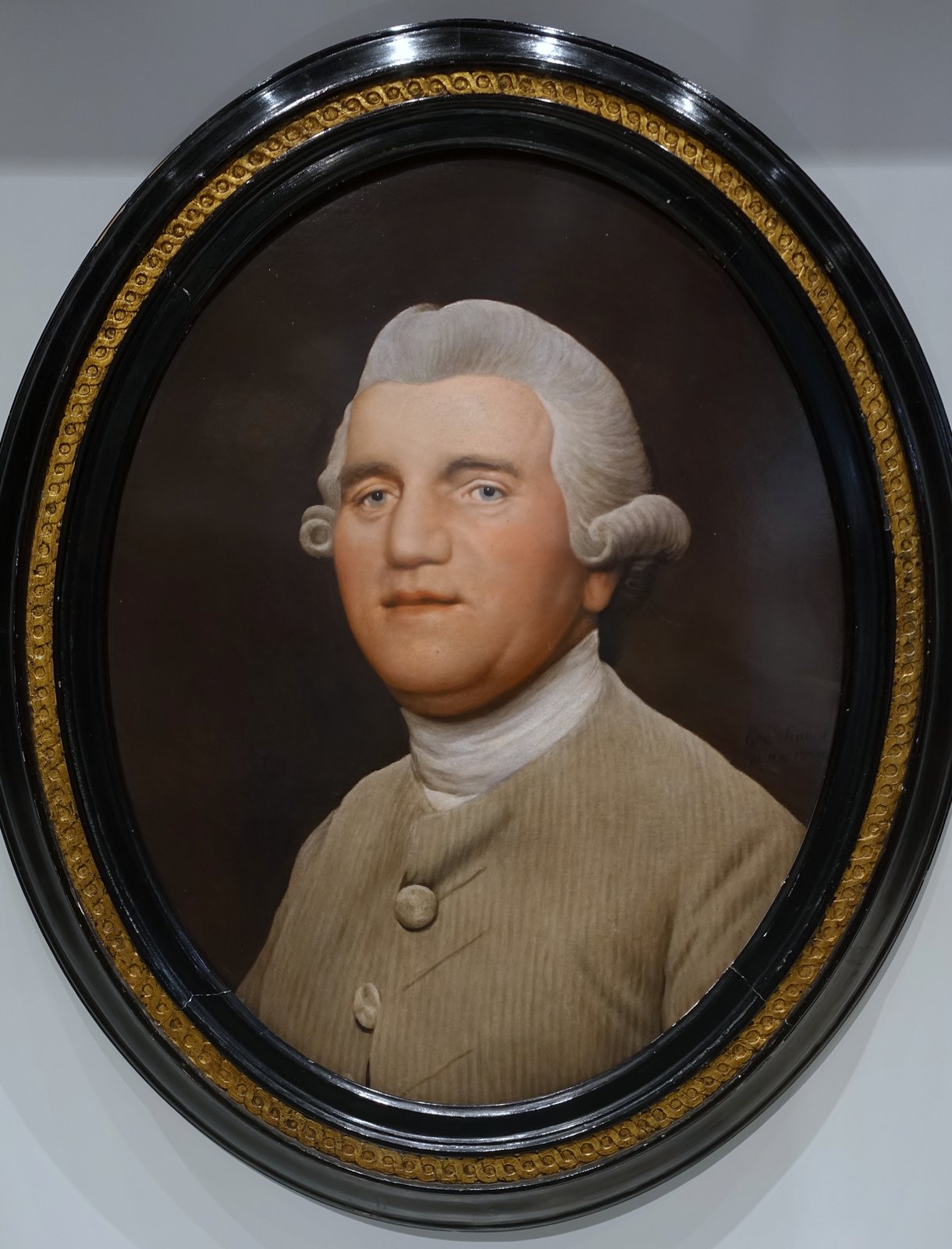

George Stubbs, 'Josiah Wedgwood I', enamel on a Wedgwood ceramic plaque, 1780 (V&A Wedgwood Collection, WE.7522-2014); photograph by Daderot, released under CC0 · Wikimedia Commons photograph (Daderot, 2016, CC0) of George Stubbs's 1780 enamel portrait of Josiah Wedgwood on a Wedgwood ceramic plaque, V&A Wedgwood Collection (WE.7522-2014), displayed at the Wedgwood Museum, Barlaston · Public domain
entrepreneur · Early Modern
Josiah Wedgwood
1730–1795
Known For
Not yet included in personality matching — the documented evidence doesn't yet cover enough of the personality model. Everything else on this page is fully available.
Trait Constellation
Key Achievements
In the 1760s Wedgwood improved the body and glaze of Staffordshire cream-coloured earthenware, building on earlier local potters' work. After he supplied Queen Charlotte, the ware was sold as 'Queen's Ware' and he was styled the Queen's potter; it became the staple of his business.
After trials with barium minerals from 1773, Wedgwood had by 1775 developed jasper, a fine unglazed stoneware that could be coloured right through with metal oxides. It was used for cameos, portrait medallions, plaques and vases with white reliefs on blue, green, lilac or black grounds. Church gives an approximate formula in which barium sulphate makes up more than half of the body.
In 1773-74 Wedgwood and his partner Thomas Bentley made a cream-ware dinner service for Empress Catherine II of Russia; according to Williamson it ran to more than 800 pieces, each carrying a green frog emblem and a painted view of a British building or landscape. Before it was shipped, the service was displayed in the firm's new show-rooms in Greek Street, London, in 1774.
Moments That Reveal Them
In July 1774 Wedgwood wrote to Bentley that his new white body kept coming out differently, sometimes white, sometimes cinnamon-coloured, sometimes melted to glass. Testing each lump of the mineral separately, he found the samples varied, and he turned to a material whose pieces all behaved alike. The account comes from his own letters, printed by Meteyard; the chemist A. H. Church separately describes his difficulty with these minerals.
Isolating one variable at a time, and then choosing a material for its consistency, is consistent with the profile's high analytical rigor score. Analytical Rigour
William Burton, who worked as a chemist at the Wedgwood factory, records that Wedgwood had his throwers weigh each ball of clay against a table of standard weights, had the scraps weighed daily to check waste, and had finished plates weighed in batches. Earlier, from 1759, his experiment books recorded each trial's ingredients by code number and the part of the oven where it was fired.
These routines sit alongside the profile's high detail orientation score; Church, a more critical writer, suggests the same push for exactness made the ornamental wares less lively. Detail Orientation
Turning Points
In 1759, at the end of his partnership with the Fenton potter Thomas Whieldon, Wedgwood leased the small Ivy House works in Burslem for 10 pounds a year and began working on his own account. According to Church, he had kept the right to keep his own improvements secret when the partnership began, and at first he made the models and mixed the clays himself.
Agreeing in advance to keep his discoveries his own offers one example of the forward planning reflected in the profile's planning orientation score, though his savings and the end of the partnership's term also shaped the timing. Planning Orientation
Similar People
People whose overall profiles resemble theirs.

John D. Rockefeller

Rosalind Franklin

Galileo Galilei

Marie Curie

Leonardo da Vinci
Sources
- Josiah Wedgwood (Q319331) -- verified live via wbgetentities (2026-10-02): en label 'Josiah Wedgwood', description 'English potter and founder of the Wedgwood company (1730–1795)', P569 12 Jul 1730, P570 3 Jan 1795, citizenship Kingdom of Great Britain (Q161885), instance of human, ko label '조사이아 웨지우드', kowiki sitelink '조사이아 웨지우드'. Orientation only; not used as support for any row.
- Samuel Smiles, Josiah Wedgwood, F.R.S.: His Personal History (London: John Murray / New York: Harper, 1894; Harper 1895 printing), Internet Archive full text (josiahwedgwoodfr00smiluoft) -- Victorian self-help biographer (non-self, ADMIRING/moralising tone; draws on the Wedgwood manuscripts and quotes many letters to Bentley, Banks's and Playfair's letters to Wedgwood). Read locally: Ch. IV 'Partnerships with Harrison and Whieldon' (pp. 33-41, incl. the 1759 preface to the experiment books quoted verbatim), Ch. V 'Wedgwood Begins Business for Himself' (pp. 42-56), Ch. VI 'Improvement of Ware -- Friendship with Bentley' (pp. 57-67), Ch. XI 'Improvement of Models -- Chemistry' (pp. 111-124), Ch. XVIII 'Wedgwood at Work Again -- Death of Bentley' (pp. 247-263) and Ch. XIX 'Wedgwood's Pyrometer' (pp. 264-270). Smiles's evaluative language ('indomitable', 'infinite patience') is not used as evidence; only dated actions and quoted documents.
- A. H. Church, F.R.S. (Professor of Chemistry, Royal Academy of Arts), Josiah Wedgwood, Master-Potter (Portfolio Monographs; new revised edition, London: Seeley, 1903), Internet Archive full text (josiahwedgwoodma00chur_0) -- SCHOLAR / connoisseur and chemist (non-self), more measured than Smiles and openly critical in places (e.g. 'Finish versus Vitality': the loss of individuality under Wedgwood's division of labour). Read locally: Ch. I (precursors, pp. 7-10), Ch. II 'His Early Years' (pp. 11-13), Ch. III 'As Master-Potter' (pp. 14-17), Ch. IV opening on cream-ware experiments (pp. 18-19) and Ch. 'His Invention of the Jasper Body' (pp. 26-29, barytes trials from 1773, Derbyshire search 1774).
- George C. Williamson (art historian, editor of Bryan's Dictionary of Painters), The Imperial Russian Dinner Service: A Story of a Famous Work by Josiah Wedgwood (London: George Bell, 1909), Internet Archive full text (imperialrussiand00will) -- SCHOLAR (non-self) monograph that prints Wedgwood's letters to Bentley and Boulton (1768-1774), the Mayer-collection wage lists and suppliers' bills, and the Etruria cost accounts. Read locally: Preface; Ch. I 'The Preparation of the Service' (letters of 19 Mar 1768, 23, 27 and 29 Mar, 5 and 9 Apr, 30 Jul and Aug 1773, bills of 1774); the Greek Street exhibition section (letters of Feb-31 May 1774); and the chapter 'The Cost of the Service' (Etruria/Mayer cost manuscripts, profit discussion). Williamson's own admiring framing is not used as evidence.
- William Burton, M.A., F.C.S., Josiah Wedgwood and His Pottery (London: Cassell, 1922), Internet Archive full text (josiahwedgwoodhi00burt) -- practising ceramic chemist and potter (non-self; formerly chemist at Josiah Wedgwood & Sons, Etruria, for five years -- a firm-adjacent technical perspective, not family). Read locally: Preface; Ch. III 'The Improvement of Manufacturing Conditions in Staffordshire' (pp. 19-31: lathes, weighing of clay and scraps, kilns) and Ch. VII 'The Invention of the Jasper Body' (pp. 67-76: barytes trials 1773, Derbyshire expedition 1774, Pegasus vase letter of 24 Jun 1786).
- Eliza Meteyard, The Life of Josiah Wedgwood, from his Private Correspondence and Family Papers, vol. II (London: Hurst and Blackett, 1866), Internet Archive full text (lifeofjosiahwedg00mete, Wellesley College copy of vol. II) -- SYMPATHETIC biographer (non-self) writing from the Mayer and Wedgwood/Darwin family papers; reprints Wedgwood's letters to Bentley with dates. Read locally: Ch. I (canal dispute of Apr 1768; barytes/spar experiments 1766-68 with letters of 13 Feb, 6 Jul and 5 Aug 1767 and 16 Jan 1768); Ch. VI 'The Russian Service' (1772 over-production and stopping overtime, letter of Sept 1772; Bath show-rooms; Greek Street rooms; settling the price of the service, letter of 8 Jul 1774); Ch. VII 'The New Composition and its Results' (pp. 309-321: letters of 2 Jul 1770, 6 Feb 1773, 7 Mar, 21 Jul, 5 Sep and 6 Nov 1774, 1, 5 and 15 Jan 1775 on the white body, the variable 'spaith fusible', testing each lump separately, cawk/No. 74, secrecy in procurement, Flaxman). The 1768 amputation passage was read only to exclude it. Meteyard's hagiographic commentary ('genius', 'moral courage') is not used as evidence.
- Sidney Pollard (economic historian), 'Factory Discipline in the Industrial Revolution', Economic History Review, 2nd ser., vol. 16, no. 2 (1963), pp. 254-271 -- SCHOLAR (non-self), comparative and critical of early factory masters; cites Neil McKendrick, 'Josiah Wedgwood and Factory Discipline', Historical Journal IV (1961), and the privately printed Letters of Josiah Wedgwood to Bentley (1903). Fetched as PDF with curl (surplusvalue.org.au copy) and read in full; Wedgwood passages used: his 19 Aug 1772 and 5 Jul 1776 letters on the Burslem Wakes, the McKendrick summary of the order he imposed (punctuality, fixed hours, standards of care and cleanliness, avoidance of waste, ban on drinking), his 1780 code of works rules and fines, and his pamphlet appeal to his workers. McKendrick's own article was not read (JSTOR, not freely available).