Elizabeth Blackwell
92% Profile Match
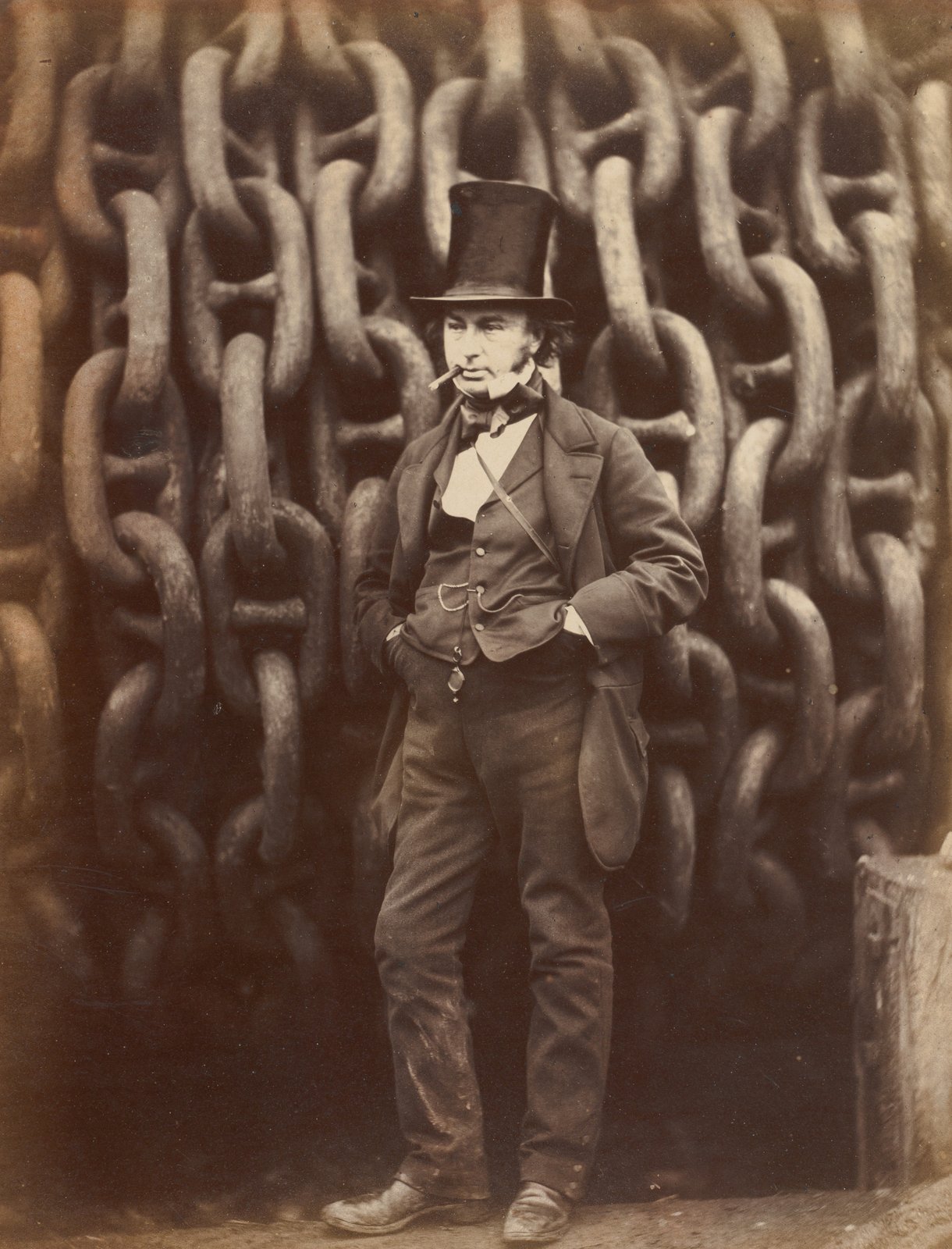
Robert Howlett, 'Isambard Kingdom Brunel Standing Before the Launching Chains of the Great Eastern', albumen silver print, taken 1857, printed 1863-64. The Metropolitan Museum of Art, Open Access (CC0). · The Metropolitan Museum of Art, New York (Gilman Collection, Purchase, Harriette and Noel Levine Gift, 2005; accession 2005.100.11), via Wikimedia Commons · CC0 1.0
Brunel was appointed engineer of the Great Western Railway on 7 March 1833. His son's biography records that the House of Lords threw out the first bill in 1834 and that a bill for the whole London-to-Bristol line received Royal Assent on 31 August 1835. The Institution of Civil Engineers' memoir lists the Hanwell and Chippenham viaducts, the Maidenhead bridge and the Box Tunnel among the works on the line.
The Great Britain was first planned as a wooden paddle steamer. According to the 1870 Life, the company chose iron in 1838 after a voyage in the iron steamer Rainbow was reported on, and adopted the screw propeller on Brunel's report of 1 October 1840. She was floated out of her dock into Bristol's Floating Harbour on 19 July 1843 in the presence of Prince Albert, a date that both the Life and Daniel Gooch, who took the Prince to the launch by special train, give.
On 9 April 1844 Robert Stephenson reported to the Chester and Holyhead directors that the atmospheric railway was not an economical way of transmitting power and was unsuited to long lines. On 19 August 1844 Brunel recommended the system to the South Devon Railway directors, who adopted it. After the leather valve of the traction tube deteriorated, he reported on 19 August 1848 that he did not recommend extending it, and the directors suspended atmospheric working in September 1848.
Recommending the system against a leading engineer's published conclusions, on his own stated responsibility, is consistent with the independent thinking reading of this profile. The 1848 reversal suggests the position was not held against the test results. Independent Thinking
Richard Beamish, who worked beside him at the Thames Tunnel, records that in early September 1826 a boiler feed-pipe burst while Brunel was on the surface with him. Brunel jumped onto the boiler, pressed packing over the split with a timber wedged against the roof, and hung on it until weight could be added, so the engine kept working. At the first irruption of the river on 18 May 1827, Beamish says, Brunel seized a rope and slid down one of the shaft's iron ties to reach an engine man caught in the water.
Beamish's account, and the ICE memoir's remark about his presence of mind when the river broke in, are consistent with quick decisions in an emergency. They do not show how he decided when there was time to test alternatives. Decisiveness
In spring 1840 the screw steamer Archimedes reached Bristol, and the Great Western Steam-Ship directors, on Brunel's advice, held back the Great Britain's paddle engines and the parts of her frame a change would affect. The 1870 Life says he then spent about three months testing screw forms on the Archimedes, and on 1 October 1840 read the Board a report after which the screw was adopted. The Institution of Civil Engineers' memoir independently says his Archimedes experiments convinced him the screw would suit large vessels.
A design change made after weeks of comparative trials rather than on argument alone illustrates the experimentation reading of this profile. Experimentation
People whose overall profiles resemble theirs.