
Leonardo da Vinci
93% Profile Match
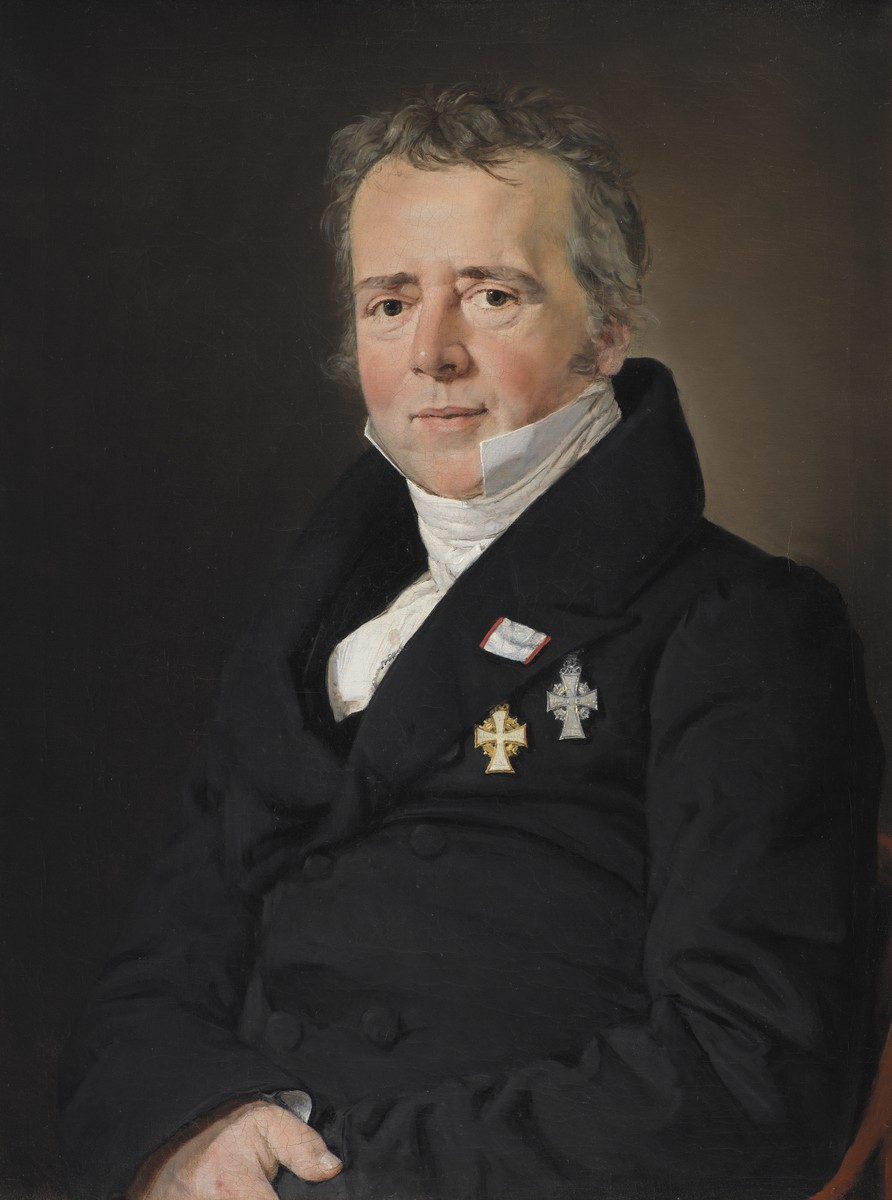
C. A. Jensen, Portrait of the Scientist Hans Christian Ørsted, 1832-1833, oil on canvas, Statens Museum for Kunst (KMS8176), public domain; downscaled from the SMK Open image · Statens Museum for Kunst (SMK, National Gallery of Denmark), SMK Open record KMS8176 -- Christian Albrecht Jensen (1792-1870), 'Portrait of the Scientist Hans Christian Ørsted' (also catalogued as 'Portrait of the Physicist Hans Christian Ørsted'), 1832-1833, oil on canvas, 678 x 510 mm, painted during the sitter's lifetime and exhibited at Charlottenborg in 1833; the museum's open API record states that the work is in the public domain and carries the Public Domain Mark 1.0; native image 5214 x 7015 pixels (16.2 MB JPEG), downscaled once to 892 x 1200 (never upscaled, no cropping). · Public domain (SMK Open: Public Domain Mark 1.0; painter C. A. Jensen died 1870)
physicist · 19th Century
1777–1851
Not yet included in personality matching — the documented evidence doesn't yet cover enough of the personality model. Everything else on this page is fully available.
After a first faint observation during a lecture demonstration in 1820, Ørsted repeated the experiment in July with a much stronger battery and showed that an electric current in a wire deflects a nearby magnetic compass needle, publishing the result in a four-page Latin pamphlet dated 21 July 1820. Within months Arago, Ampère, Biot and Savart in Paris had repeated and extended it, and the later work of Faraday and Maxwell built on the connection it established.
He also helped build science education in Denmark. In 1824 he founded the Society for the Dissemination of Natural Science, which he led until his death, and in 1829 he helped found the Polytechnic, now the Technical University of Denmark, serving as its first director until 1851.
In chemistry he prepared the alkaloid piperine from pepper in 1820 and metallic aluminium in 1825. From 1817 to 1845 he also measured how liquids and gases compress, using a piezometer he redesigned so that the pressure was the same inside and outside the vessel, and concluded that compression stays in proportion to the applied force until a substance changes state.
After the faint movement of the needle in his lecture, Ørsted did not experiment on it again for about three months; in an account he wrote in the third person he gave the feebleness and confusion of the effect and the memory of earlier philosophers' errors, especially his friend Ritter's, as possible reasons. In July 1820 he resumed with a much larger battery, had six named observers witness the work and made a long series of measurements of how the wire's distance and orientation changed the needle's deflection before publishing.
This is consistent with checking a faint result carefully before announcing it. Analytical Rigour
On his way home from England in 1823, after visiting institutions that taught natural science to craftsmen and workers, Ørsted conceived a plan for a Danish society that would spread knowledge of natural science among craftsmen, farmers and industrial workers and managers. He founded the Society for the Dissemination of Natural Science in 1824 and, according to the Danish Biographical Lexicon, led it and gave it much of his time until his death; the American Physical Society adds that he thought making science accessible to the public very important.
This is consistent with being driven to bring science to people outside the laboratory. Impact Motivation
During his study trip to Paris in 1802-04, Ørsted, then an enthusiastic follower of the German natural philosophers, backed his friend Johann Ritter's candidacy for a Napoleonic prize for a galvanic discovery that did not hold up; he was sharply criticised in a French journal and returned to Copenhagen with a reputation for more enthusiasm than judgment. According to the Danish Biographical Lexicon, he came to recognise many of Ritter's results as products of imagination and afterwards kept his philosophical ideas in check until he had at least some proof of them.
This is consistent with raising his standard of evidence after a public failure. Belief Updating
People whose overall profiles resemble theirs.



Not a rival — a different profile shape worth a look.
