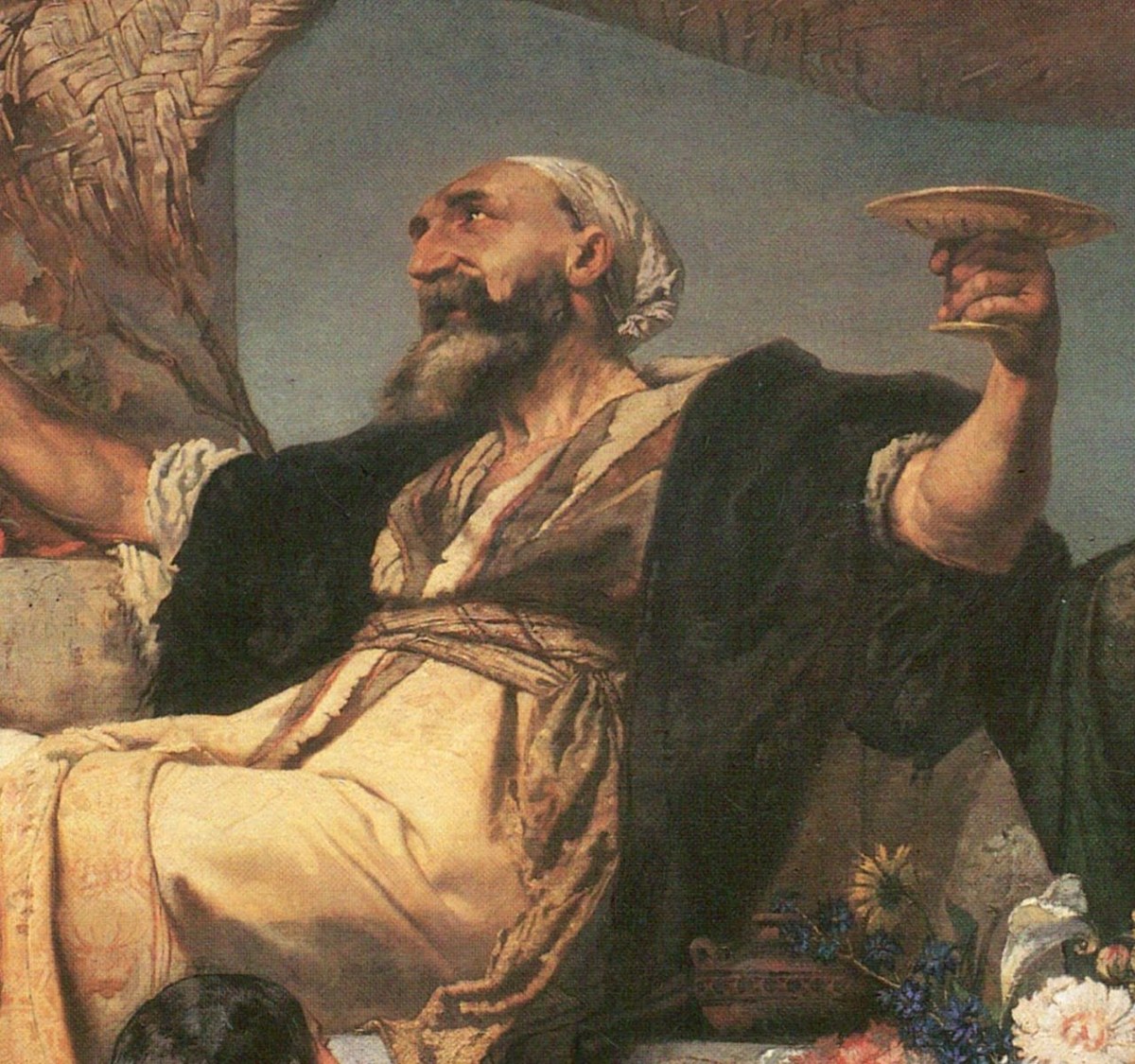

Anselm Feuerbach, Hafis vor der Schenke, 1852, Kunsthalle Mannheim, public domain, via Wikimedia Commons · Detail of 'Hafis vor der Schenke' (Hafez in front of the tavern), oil on canvas, Anselm Feuerbach, 1852, Kunsthalle Mannheim (acquired 1913). An imagined nineteenth-century painting made about 460 years after the poet's death, so it is a later depiction and not a likeness. The painter died in 1880, so the work is in the public domain by age worldwide, and a faithful photograph of a flat painting adds no new copyright. The file is a plain crop of the figure from the full 3000 x 2428 pixel image on Wikimedia Commons (originally from Zeno.org), downscaled to 1200 x 1125 with no upscaling. · Public domain (artist died 1880)
poet · Medieval
Hafez
1325–1390
Known For
Not yet included in personality matching — the documented evidence doesn't yet cover enough of the personality model. Everything else on this page is fully available.
Key Achievements
He wrote the ghazals collected in the Divan, which Britannica counts among the finest lyric poetry of Persia, and which scholars say may have been arranged by others after his death.
As a court poet under several rulers of Shiraz, he used the ghazal rather than the traditional ode for praise poems and cut the praise to a line or two.
His simple, often colloquial verse became so widely loved that many of its lines are used as proverbs and sayings.
Moments That Reveal Them
Britannica says he lectured on the Quran and other theological subjects and wrote commentaries on religious classics, while serving as court poet.
This is consistent with a poet whose work rested on a scholar's training as well as on court service. Mastery Orientation
Turning Points
Around 1368 or 1369 he fell out of favour at the Shiraz court and did not regain his position until about twenty years later, shortly before his death; another entry dates the disfavour to 1366-1376.
This is consistent with a career that was interrupted by changing court fortunes while his work continued. Mastery Orientation
Similar People
People whose overall profiles resemble theirs.


Leonardo da Vinci

Yayoi Kusama

Ada Lovelace

Frida Kahlo

Franz Kafka
Opposite Profile
Not a rival — a different profile shape worth a look.
Frederick Douglass
Sources
- Hafez (Q6240), verified live via the Wikidata API (2026-10-31): label 'Hafez', description 'Persian poet and mystic (1325-1389)', born 1326 and 1325 (year precision), died 1389, Korean label present, images 'Anselm Feuerbach Hafis vor der Schenke (cropped).jpg' and a statue photograph. Orientation only; not used as support for any row.
- The Editors, 'Hafez', Encyclopaedia Britannica, read in full. CANONICAL SIGNIFICANCE SOURCE: one of the finest lyric poets of Persia, born 1325/26 and died 1389/90 in Shiraz; classical religious education, lectures on the Quran and commentaries on religious classics; court poet under several rulers of Shiraz who fell out of favour about 1368-69 and regained his place only about twenty years later; his principal form the ghazal, used instead of the qasida in panegyrics with the panegyric element cut to a line or two; colloquial and musical language; the Divan and its partial English translations. Reference entry; the praise is retrospective.
- Baha'-al-Din Khorramshahi, 'Hafez ii. Hafez's Life and Times', Encyclopaedia Iranica (2002), read in full. Scholarly entry: details of the life are 'extremely sketchy' and the tazkira sketches often unreliable or fictitious; the earliest surviving document is a preface to the Divan by a contemporary who may have been Muhammad Golandam, with scholars disagreeing on his identity and the text's accuracy; dates of birth (715/1315 or 717/1317) and death (792/1390, with 791/1389 in some sources) disputed; schooling in the Quranic sciences and Arabic; poems on patrons from the Inju and Muzaffarid courts; a warning against reading biography out of the poems. Primary scholarly source for this profile and the main limit on what can be scored.
- 'Hafiz', World Eras (Gale), via Encyclopedia.com, read in full: the Quran-memorizer nickname, said to have worked as a baker's apprentice and manuscript copyist, broad education in Arabic and Persian literature, lectures on Quranic interpretation at a college, royal disfavour dated 1366-1376 with some time away from Shiraz in Isfahan and Yazd, his refusal of distant rulers' invitations, a Divan said to have been finalised in 1368 but perhaps arranged by a follower after his death, about five hundred authentic poems amid many false attributions, and the use of ghazal conventions for other purposes; cites Wickens in the Encyclopedia of Islam and Hillmann. Reference article; some details are hedged with 'said to'.
- Poetry Foundation, 'Hafez', read in full (one paragraph): very little is known of his life, he left school to work at a bakery and as a copyist after his father's death, became a court poet under Abu Ishak, taught at a religious college and wrote ghazals of love, spirituality and protest whose lines became proverbs. Short institutional biography; its details overlap with the Gale entry and the 'bakery' account is of the traditional kind.
- Joshua J. Mark, 'Hafez Shiraz', World History Encyclopedia, read in the life and court-poet sections: the Quran-memorizer name, memorisation of earlier Persian poets as influences, no definitive collection of his works and a divan compiled by others whom scholars cannot identify or date, and the traditional anecdotes of the baker's delivery boy and Shakh-e Nabat, which it reports with 'is said to'. Popular reference article; its legendary episodes are NOT used and serve as the example of what is excluded.