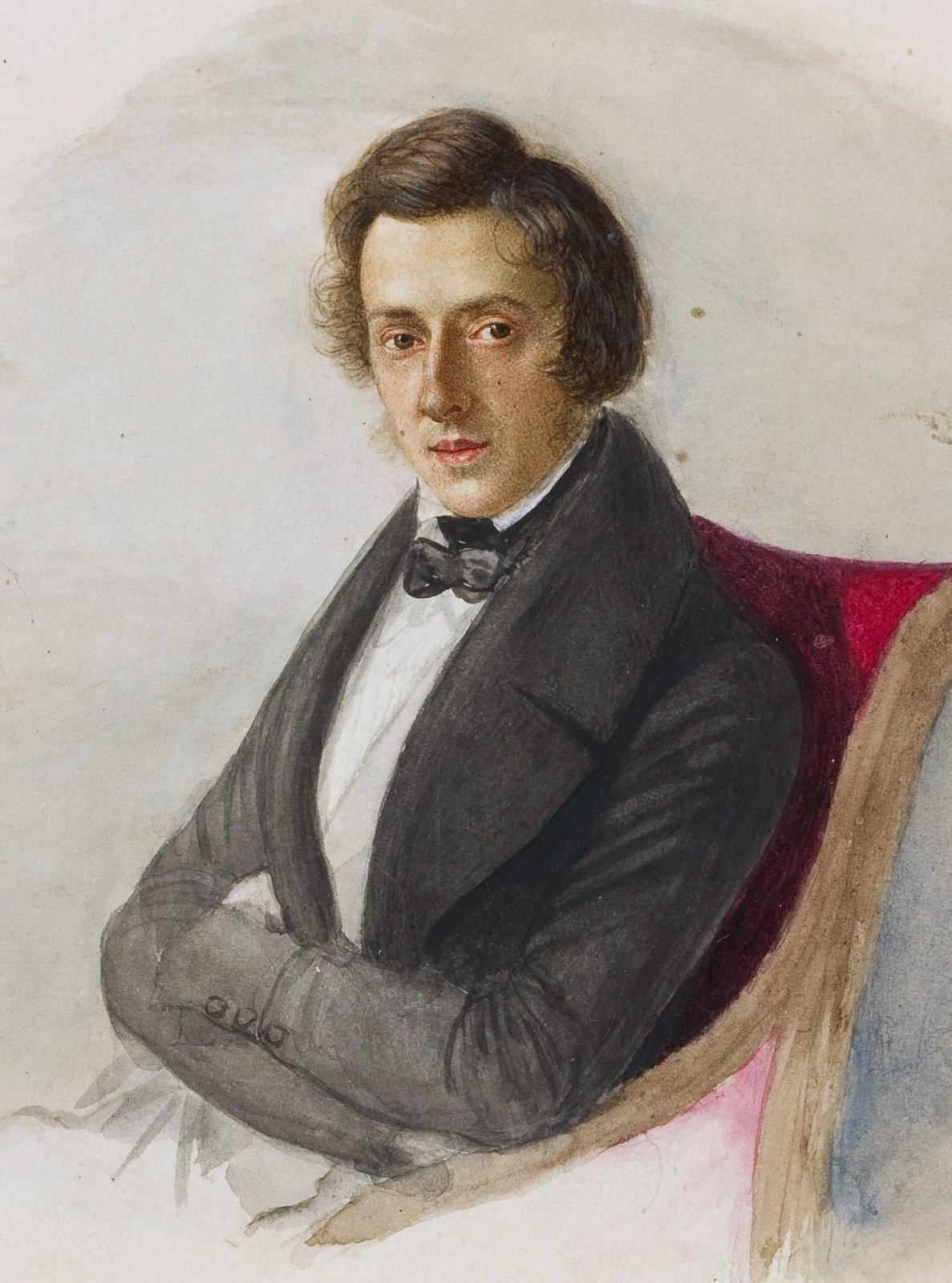
Maria Wodzińska, Portrait of Fryderyk Chopin, 1836, National Museum in Warsaw (public domain: the artist died in 1896); downscaled · Maria Wodzińska, watercolour and ink on bristol board, National Museum in Warsaw, via Wikimedia Commons · Public domain
Trait Constellation
Key Achievements
Chopin arranged for most of his mature works to be published in France, Germany and England, usually by three different firms, because copyright protection between the countries was weak. The three printings of a piece often differ, which scholars of the first editions attribute to his own revisions and proof corrections.
Chopin taught piano in Paris from the early 1830s and, according to the University of Chicago Library's exhibit, was the city's favoured piano teacher by the end of 1832. In the early 1840s he sketched the beginnings of a method for playing the instrument, which he never completed.
Chopin gave his last Paris concert on 16 February 1848 at Pleyel's rooms. The programme included a Mozart trio with Alard and Franchomme and part of his own cello sonata with Franchomme; admission was by a list of applicants, and the Gazette musicale reported that patronage was needed to obtain a ticket.
Moments That Reveal Them
In letters of December 1831 to a friend and to his former teacher Elsner, Chopin wrote that Friedrich Kalkbrenner, then the leading pianist in Paris, had offered to teach him for three years, and that he had declined because the time was too long and he did not want to become a copy of Kalkbrenner. Ferdinand Hiller, recalling the episode in 1874, wrote that Chopin nevertheless went a few times to Kalkbrenner's class for advanced pupils.
The episode is consistent with a preference for shaping his own training and career, though Hiller's account suggests he did not simply refuse the older pianist outright. Need for Autonomy
On 1 and 2 August 1844 Chopin wrote from Nohant to Franchomme asking him to place two sets of manuscripts with another Paris publisher, Meissonnier or Lemoine, if Schlesinger insisted on delaying publication beyond the 20th of the month. He also worried that Härtel's Paris correspondent might lower his German fee if he learned how little Paris paid, and on 4 August he thanked Franchomme for settling the Schlesinger matter.
The letters, which are Chopin's own account, illustrate a practical habit of arranging alternatives when one publisher delayed and of weighing how one market's price might affect another. Resourcefulness
Turning Points
Chopin left Vienna in 1831 after eight fruitless months and in Paris needed about seven more to organise a concert; the University of Chicago Library's exhibit describes his first Paris concert, on 26 February 1832, as poorly attended. Hiller, writing in 1874, described a Pleyel-rooms soirée of the period at which Chopin played his E minor Concerto, mazurkas and nocturnes and won over the sceptics. The same exhibit says that by the end of 1832 he was the city's favoured piano teacher and that lessons and publishing gave him an alternative to the concert circuit.
The change is consistent with adjusting his way of working to the circumstances he found, although the sources differ on how the first concert was received. Adaptability
Similar People
People whose overall profiles resemble theirs.
Coco Chanel

Frida Kahlo

Yayoi Kusama

Wolfgang Amadeus Mozart

Marlene Dietrich
Opposite Profile
Not a rival — a different profile shape worth a look.
Benjamin Franklin
Sources
- Frédéric Chopin (English Wikipedia) -- orientation only (dates, Paris career outline, citizenship statement); fetched with targeted questions and not used as support for any scored row.
- Frédéric Chopin (Q1268) -- identity verified live via the Wikidata API (wbgetentities): en label 'Frédéric Chopin', en description 'Polish composer and pianist (1810-1849)', ko label and kowiki title '프레데리크 쇼팽', P569 1810 (two values), P570 1849-10-17, P27 France/Russian Empire/Duchy of Warsaw/Poland and one further item, P18 'Chopin, by Wodzinska.JPG'. Orientation only.
- Standley Howell, 'Frédéric Chopin and His Publishers', University of Chicago Library exhibition text, February-April 1998 (31-page case-text PDF; library curator drawing on the published musicology and the Library's collection of early editions; no stake in the subject). Downloaded, converted with pdftotext and read through all 21 cases: Paris debut and salons/teaching (cases 3, 5), the Farrenc, Kistner, Breitkopf, Wessel and Troupenas dealings and dedications (cases 6-12, 15), collaborative pieces and the Fétis-Moscheles method (case 16), teaching and the unfinished method (case 17), unpublished works (case 18). The exhibit's health passage in case 15 is not used.
- Chopin Online, 'Annotated Catalogue of Chopin's First Editions' (online resource of a university research project; authors not named in the page text read): Historical overview; Chopin's publishers -- France, England, The German States; Legal contexts -- France, England; General characteristics -- Music text. Pages fetched with curl and read in full: three first editions of most works because of weak international copyright, differences arising from Chopin's own revisions and proof corrections, Wessel relations breaking down, Jullien negotiation abandoned.
- Chopin Online, 'Online Chopin Variorum Edition' -- Contexts: Historical background (same academic project as the Annotated Catalogue, so treated as the same perspective as src_chopin_aco). Read in full: the categories of primary sources, including 'rejected public manuscripts' prepared for publishers but abandoned by Chopin, and the three-country publication of most works.
- Frederick Niecks, 'Frederick Chopin as a Man and Musician', vol. II (London: Novello, Ewer, 1888), Internet Archive scan; whole OCR text (~1.08 million characters) downloaded with curl and read locally in the relevant chapters: XXV (semi-public concerts of 1841 and 1842 with Liszt's and press reports), XXVI (letters to Franchomme 1844-46 and publisher dealings with Wessel/Ashdown, Wolff, Heller, Gutmann; Sand's account of his composing; Delacroix's 1842 Nohant letters), the teaching-method section (pupils Mathias, Dubois, Rubio, Gutmann, Mikuli), the musical-taste section, chapter XXVII (Berlioz's 1849 article), the 16 February 1848 Paris concert (Gazette musicale), and chapter XXXI (Britain 1848: Chopin's letters, Times advertisements, Musical World, Manchester Guardian, Glasgow Courier, Benedict's recollection, Mrs. Lyschinski). Niecks is a scholarly compiler who interviewed pupils and friends; the letters he translates are Chopin's own (one self perspective) and Sand's memoir is an interested witness. Read as secondary.
- Frederick Niecks, 'Frederick Chopin as a Man and Musician', vol. I (Internet Archive scan of a Google-digitised copy; same author as src_chopin_niecks_v2, hence one perspective). Downloaded with curl; only the Kalkbrenner section was read (Chopin's letters of 14 and 16 December 1831 about Kalkbrenner's three-year proposal, and Niecks's discussion).
- Ferdinand Hiller, 'Mendelssohn: Letters and Recollections' (London: Macmillan, 1874; translated by M. E. von Glehn), Internet Archive scan; whole OCR text downloaded with curl and the Chopin passages read: the Kalkbrenner class and the Pleyel soirée (pp. 14-16), and the 1834 Aachen festival journey including Chopin's sale of a waltz manuscript to Pleyel (pp. 22-24). Hiller was a friend and fellow pianist of Chopin, writing decades later (recollection).
- Eugène Delacroix, 'Journal de Eugène Delacroix', tome 1 (Paris: Plon, 1893, ed. Paul Flat and René Piot), Project Gutenberg ebook 54020, in French; the full text was downloaded and every Chopin passage read. Used for the entry of Saturday 7 April 1849 (Chopin on fugue, counterpoint and harmony), a firsthand account by a friend who was not a musician.