Carl Jung
78% Profile Match
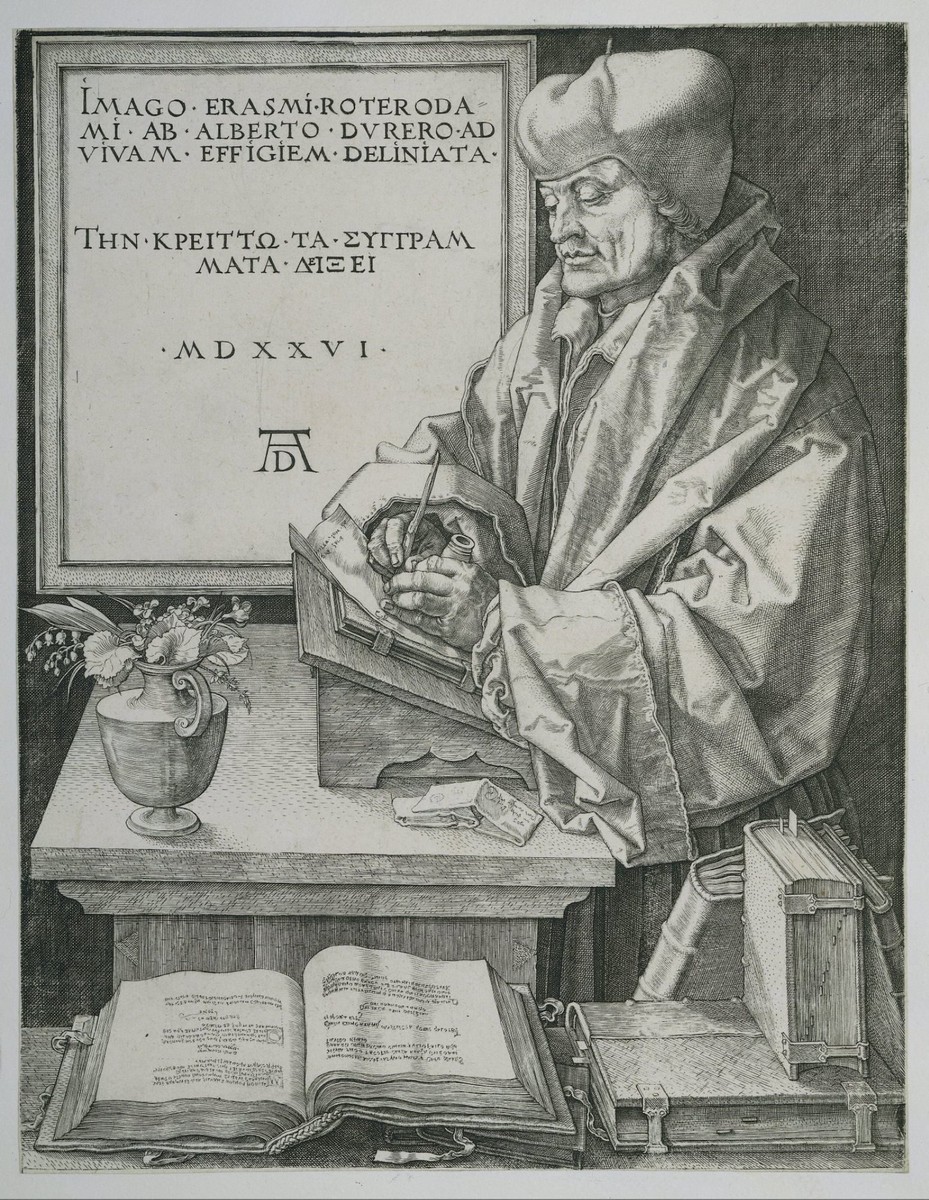
Albrecht Dürer, Portrait of Erasmus of Rotterdam, engraving, 1526. Rijksmuseum, Amsterdam, RP-P-OB-1281 (Public Domain). Downscaled. · Engraving 'Imago Erasmi Roterodami ab Alberto Durero ad vivam effigiem deliniata' by Albrecht Dürer, dated MDXXVI (1526) and monogrammed AD, in the Rijksmuseum, Amsterdam (object number RP-P-OB-1281). The plate's own lettering names the sitter and says the image was drawn from life; the file is the museum's full-image scan (original 2894 x 3736 pixels) downscaled to 929 x 1200 with no upscaling. · Public Domain Mark 1.0 on the museum's image and a CC0 right on the museum's record, as read live; the work is a 1526 engraving by an artist who died in 1528.
scholar · Early Modern
1466–1536
Not yet included in personality matching — the documented evidence doesn't yet cover enough of the personality model. Everything else on this page is fully available.
Northern Europe's leading Renaissance humanist scholar, he published a Greek New Testament with his own Latin version and notes in 1516, the first to reach the market, and revised it four times.
Wrote bestsellers including the Adages, expanded to over 3,000 entries for the Aldine press, and the satire Praise of Folly (1511), which has stayed in print.
Edited works of Jerome, Augustine, Chrysostom and Origen, and promoted learned piety and a return to the texts in their original languages.
The 1516 New Testament was put together in about ten months on his publisher Froben's urging, and the first edition carried hundreds of typesetting errors.
Consistent with working very fast under a publisher's pressure, at some cost to polish. Execution Speed
For some years he refused to endorse any religious party, and in 1524 he reluctantly published a polite discussion of free will aimed at Luther.
Consistent with holding an independent intellectual stance that drew suspicion from both sides. Independent Thinking
After his first stay in England he met More and Colet and set out to learn Greek, which turned him toward biblical scholarship and eventually the Greek New Testament.
Consistent with committing to deep mastery of a new language to pursue a scholarly aim. Mastery Orientation
People whose overall profiles resemble theirs.



Not a rival — a different profile shape worth a look.