John D. Rockefeller
87% Profile Match
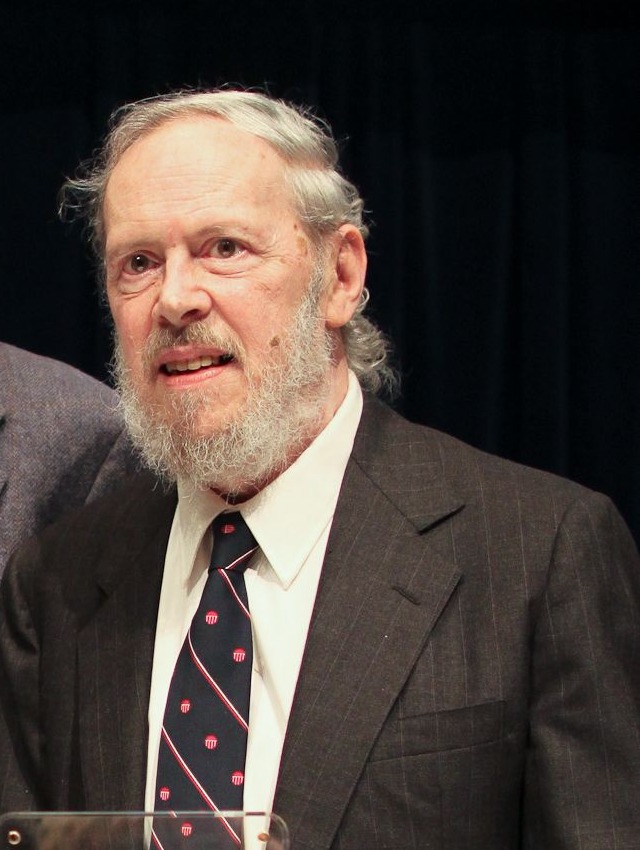
Photo by Denise Panyik-Dale, taken at the Japan Prize Foundation ceremony, 19 May 2011, CC BY 2.0; cropped from the original · Wikimedia Commons, File:Dennis Ritchie (right) Receiving Japan Prize.jpeg (1195x1628), uploaded from Flickr (dpanyikdale/5740011186); cropped to Dennis Ritchie only, no resampling · CC BY 2.0
computer scientist · 20th Century
1941–2011
Not yet included in personality matching — the documented evidence doesn't yet cover enough of the personality model. Everything else on this page is fully available.
At Bell Labs between about 1971 and 1973 Ritchie created the C programming language, extending Ken Thompson's B with a type system and writing a compiler for it. By early 1973 the essentials of modern C were complete, and C was used that year to rewrite the Unix kernel for the PDP-11. The New York Times noted at his death that C is still widely used and that successors such as C++ and Java build on its ideas.
With Ken Thompson, Ritchie co-developed the Unix operating system at Bell Labs. Thompson began it on a PDP-7 in 1969 and Ritchie joined the work; he says he contributed the idea of representing devices as files, while crediting most of the ideas and work to Thompson. They rewrote most of Unix in C in 1973. Thompson and Ritchie shared the ACM Turing Award in 1983 and the U.S. National Medal of Technology (the 1998 medal, presented in April 1999).
In 1978 Ritchie and Brian Kernighan published The C Programming Language, the first widely available description of C, which served as the language reference until a formal standard was adopted more than ten years later. Kernighan wrote almost all the expository material; Ritchie wrote the reference-manual appendix and the chapter on interfacing with Unix. The Times reports that the two editions (1978, 1988) have sold millions of copies and been translated into 25 languages.
In March 1988 Ritchie sent the ANSI C committee (X3J11) a long official comment on its draft, which he also posted to comp.lang.c. He argued that the draft's const wording made the language inconsistent with its own library, and that the proposed noalias qualifier was 'an abomination' that 'must not survive'. A note on the republished essay records that the bar on assigning to const-qualified objects was later removed and noalias was dropped.
Putting a detailed, uncompromising objection to a standards committee on the record, and stating that it was his own opinion rather than AT&T's, is consistent with independent thinking; the account and the outcome note both come from the essay's own republication, so the committee's reasons are not independently documented here. Independent Thinking
When Ritchie and Steve Johnson first moved the Unix kernel to a new machine, the Interdata 8/32, a code section in the Sixth Edition source carried the comment 'You are not expected to understand this', which Ritchie says was meant as 'this won't be on the exam' because the authors did not fully understand it either. Ritchie writes that it took about a week of agonizing before he and Johnson agreed the context-switch mechanism was fundamentally broken, and that they then redid the coroutine control-passing primitives rather than keep adjusting the compiler.
Taking about a week to establish why the mechanism could not be fixed by tinkering, and then replacing it, is consistent with analytical rigour; the whole account is Ritchie's own recollection. Analytical Rigour
In 1972 Thompson made a brief attempt to rewrite the Unix kernel in an early version of C and gave up; Ritchie says the language still lacked structures, which made the kernel's tables awkward. Over the following year Ritchie added structures and improved the compiler, and in 1973 he and Thompson rewrote the Unix kernel for the PDP-11 in C. Ritchie later wrote that this gave them the confidence to recode Unix's utilities in C too, which led to moving Unix to other machines.
Ritchie describes the 1973 rewrite as joint work ('we') that built on Thompson's earlier failed attempt, with Ritchie supplying the missing language features, which is consistent with collaboration; the detail comes mainly from Ritchie's own accounts. Collaboration
People whose overall profiles resemble theirs.