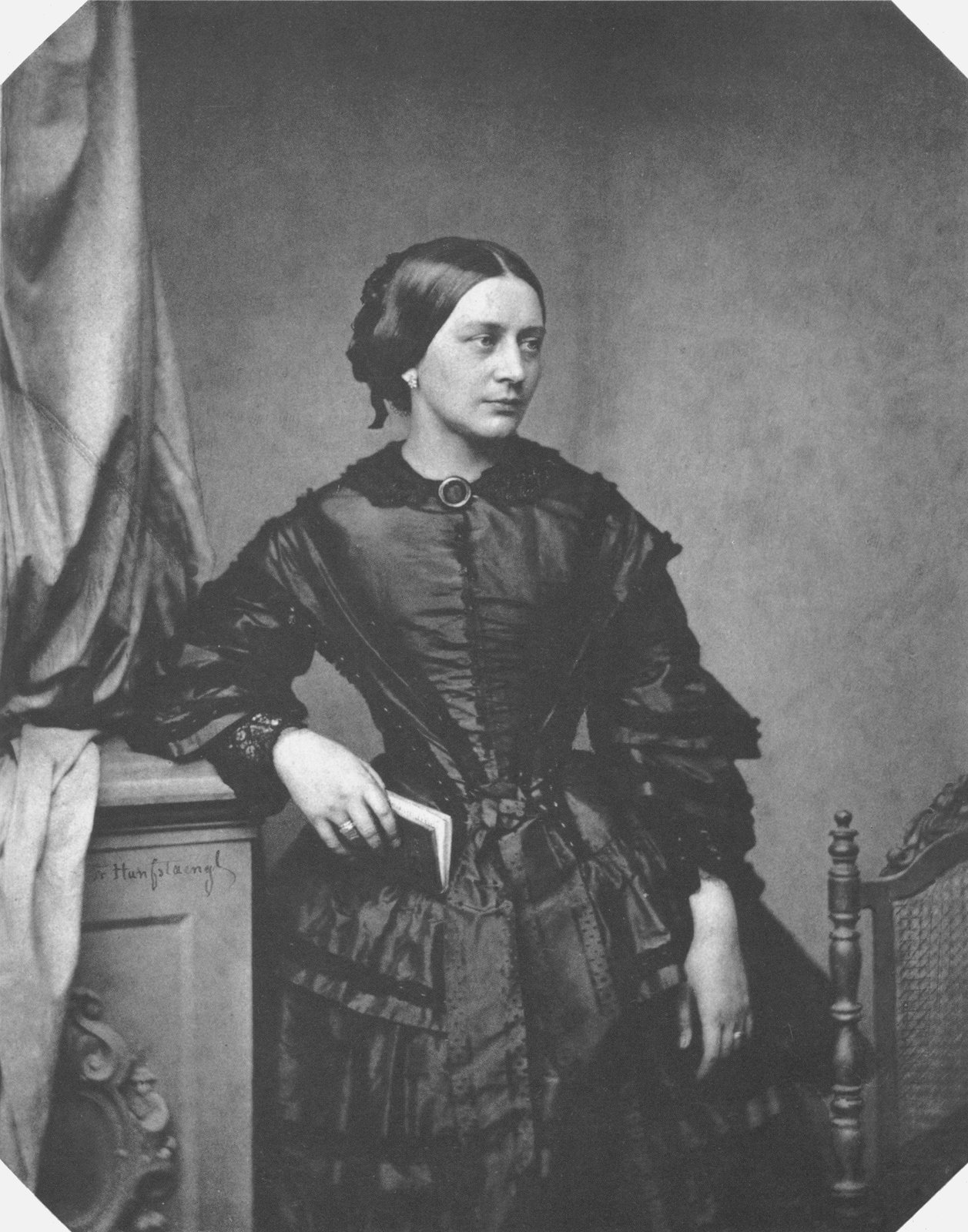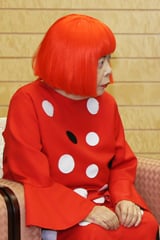

Franz Hanfstaengl, Clara Schumann (1857), public domain, via Wikimedia Commons; downscaled · Franz Hanfstaengl, photograph of Clara Schumann, Munich 1857, reproduced as an autotype (halftone) print; scan uploaded to Wikimedia Commons ('self-scanned') · Public domain
Trait Constellation
Key Achievements
In her Berlin concerts of February and March 1837, the seventeen-year-old Clara Wieck played two movements and then the whole of Beethoven's 'Appassionata' Sonata, Op. 57; Florence May, searching the press of the period, found no earlier public performance of the work. A Berlin review of the first concert noted that she played her entire programme from memory. During her stay in Vienna in 1837-38 she was appointed Imperial and Royal Chamber Virtuoso.
From her solo debut at the Leipzig Gewandhaus in 1830 to her last public concert in 1891, she regularly played the piano works of Robert Schumann, and Florence May lists several works by Johannes Brahms, including the Handel Variations, Op. 24, whose first public performances she gave. From 1856 she visited England nineteen times.
In 1878 she became principal piano teacher at the new Hoch Conservatory in Frankfurt, with her daughters Marie and Eugenie as assistants, and taught there until 1892. In the same period she took charge of the Breitkopf & Härtel Collected Edition of Robert Schumann's works (1879-86).
Moments That Reveal Them
Her daughter Eugenie, who was taught by her after leaving school, recalled that Beethoven sonatas formed the core of every lesson and that her mother 'did not let the smallest inexactitude pass'. She asked whether Beethoven would have written every dot and tie if he had meant something else. She also disliked editions with added fingerings and annotations.
The daughter's account agrees with what the Viennese critic Eduard Hanslick heard in her concerts in 1856 and 1858, and it offers one example of the close attention to the score scored in this profile. Detail Orientation
Reviewing her Vienna concerts in 1856, Hanslick called it 'unheard of' to perform Beethoven's Sonata Op. 101, Mendelssohn's Variations sérieuses and Schumann's Symphonic Etudes in a concert. He wrote that she played only serious music, while also regretting that her playing was more deeply understood than deeply felt.
At a time when concert programmes commonly mixed serious works with lighter virtuoso pieces, her choices fit the independent thinking scored here. That score is based on her adult programmes; as a child, her repertoire was chosen by her father. Independent Thinking
Turning Points
In January 1839, aged nineteen, Clara Wieck set out on a concert tour to Paris without her father for the first time. Florence May's account, based on her letters, says that in Paris she refused friends' urging to return home, dismissed the companion she had travelled with and arranged to stay with the family of her friend Emilie List. After her father refused the consent to her marriage that the law required, the dispute was decided in court, and she married Robert Schumann in September 1840.
Organising a foreign season on her own at nineteen fits the autonomy scored in this profile, as do the conditions she later set before accepting her Frankfurt teaching post in 1878. May also links the Paris journey to her hope of earning money for her future household. Need for Autonomy
Similar People
People whose overall profiles resemble theirs.

Frida Kahlo

Leonardo da Vinci

Rosalind Franklin
Coco Chanel

Jane Austen
Sources
- Clara Schumann (English Wikipedia) -- orientation only; not used as support for any scored row. Korean Wikipedia title '클라라 슈만' confirmed via the Wikidata sitelink.
- Clara Schumann (Q132232) -- verified live via wbgetentities (2026-09-26): en label 'Clara Schumann', description 'German musician and composer (1819–1896)', ko label '클라라 슈만', born 1819-09-13, died 1896-05-20, citizenship Q153015 (Kingdom of Saxony), P18 'Franz Hanfstaengl - Clara Schumann (1857).jpg', kowiki '클라라 슈만'. Orientation only.
- Florence May, The Girlhood of Clara Schumann (Clara Wieck and her time) (London: Edward Arnold, 1912), archive.org OCR (girlhoodofclaras00mayfuoft) -- SCHOLAR/FORMER-PUPIL perspective: May studied with Clara Schumann in 1871 and knew her personally; for the personal events of 1819-40 she relies on Litzmann vol. I (i.e. on the family diaries), but she adds her own research in concert records (Dorffel's Gewandhaus history, contemporary newspapers such as the Leipziger Tageblatt, Preussische Staatszeitung and Allgemeine Musikalische Zeitung, which she quotes). Read: Preface; ch. V end (Paris 1832, first public extemporising and playing from memory); ch. VI pp. 81-82 (Jan.-May 1833 programmes introducing Chopin and Schumann); ch. XII pp. 189-195 (Berlin concerts Feb.-Mar. 1837: programmes, the Preussische Staatszeitung reviews, the probable first concert performance of Beethoven's Op. 57); ch. XVI pp. 266-274 (autumn 1838 - Jan. 1839: her resolve to tour without her father, the Paris journey, choice of instrument, refusal to return, move to the List household); ch. XIX 'Afterwards' pp. 316-330 (May's OWN FIRSTHAND characterisation of her mature playing, repertoire, first performances of Brahms, teaching and Frankfurt appointment 1878, and a candid paragraph on her difficulty in private association).
- Florence May, The Life of Johannes Brahms, vol. I (London: Edward Arnold, 1905), Project Gutenberg #40643 -- FORMER-PUPIL EYEWITNESS perspective (non-self): May's own account of arriving at Lichtenthal (Baden-Baden) in May 1871 to study with Clara Schumann for a year, specifically to correct deficiencies in her mechanism that Clara had pointed out; Clara's daily household, her arranging lessons with Brahms during her Swiss absence, and her handing May over to Brahms for the rest of the stay. Read: ch. I opening chapter pp. 1-15 (Gutenberg lines c. 330-1110).
- Eduard Hanslick, Aus dem Concert-Saal: Kritiken und Schilderungen aus 20 Jahren des Wiener Musiklebens 1848-1868 (2nd ed., Vienna: Braumueller, 1897), archive.org Google-scan OCR (ausdemconcertsa01hansgoog), read in German from the Fraktur OCR -- CONTEMPORARY CRITIC perspective (non-self, independent of the family, admiring but openly critical). Read: the 1856 review 'Clara Schumann' (pp. 110-114: her subordination of her own subjectivity to the composer's intention as an 'inviolable law', study of each work 'in the finest detail', near-exceptionless strictness of tempo against the prevailing rubato, a metronome-like middle section in Chopin's D-flat Impromptu that he questions, her programmes of Beethoven Op. 101, Mendelssohn's Variations serieuses and Schumann's Etudes symphoniques as 'unheard of' in a modern concert, 'she plays only serious music', her successive presentation of Robert Schumann's piano works, his reservations that her playing is more deeply understood than deeply felt); and the 1858 review (pp. 179-182: 'piety' that gives nothing more or other than the composer prescribed; criticism that her tempi had become markedly faster, e.g. the first Kreisleriana piece and the second Novellette; her choice of Beethoven's Op. 27 No. 1 and of Kreisleriana despite worries about its 'impossibility' in concert; her performance of Schumann's A minor concerto, not played in Vienna by anyone since she played it there eleven years earlier).
- Eugenie Schumann, The Schumanns and Johannes Brahms: The Memoirs of Eugenie Schumann (New York: Dial Press, 1927; English translation of 'Erinnerungen', 1925), archive.org OCR (schumannsjohanne00schu) -- DAUGHTER/INSIDER EYEWITNESS perspective (non-self but family, affectionate). Read: 'Childhood' pp. 16-18 (her mother's daily practice routine in the Baden-Baden summers: scales and arpeggios, Czerny's Toccata, Bach, Schumann's Toccata and Chopin studies; practising without the music; learning Brahms's new works); 'Our Mother' pp. 96-101 (Eugenie's own lessons from her mother c. 1869-70: twice weekly kept 'with the greatest regularity', Beethoven as the nucleus of every lesson, 'she did not let the smallest inexactitude pass', her refusal of fingered and annotated editions and the argument with Brahms over Czerny's Bach edition, her lowering of her initial demands); p. 146 (comparison of her mother's and Brahms's teaching); pp. 183-184 (Frankfurt from 1878: Marie and Eugenie as her assistants, attention to pupils' welfare, a subscription fund she administered for talented students).
- Marion Brueck, 'Schumann, Clara Josephine geborene Wieck', Neue Deutsche Biographie 23 (2007), pp. 746-749, online at Deutsche Biographie (Historische Kommission bei der Bayerischen Akademie der Wissenschaften), read in German in full 2026-09-26 -- MODERN SCHOLARLY perspective, independent of the period family sources and drawing on the modern letter editions. Read: the whole biography section (training under Wieck, Weinlig and Dorn; 1837-38 Vienna and Op. 57; the 1839 Paris tour without her father as a fact; the court decision; marriage years and her organisation of household and tours; resumption of full concert activity in autumn 1854; the touring pattern and 19 visits to England; the 1878 Hoch Conservatory appointment with Marie and Eugenie teaching technique while she taught interpretation; carefully planned programme disposition shifting from mixed virtuoso programmes to demanding classical literature; her becoming a tireless advocate of Robert Schumann's works after 1856; her giving up composition in 1856; editing, proofreading for Haertel, responsibility for the Breitkopf & Haertel Collected Edition 1879-86 and the 1886 'instructive edition'; the letters' picture of her as highly self-disciplined and serious) plus the Werke/Quellen/Literatur lists.
- Letters of Clara Schumann and Johannes Brahms 1853-1896, ed. Berthold Litzmann, English ed. (London: Edward Arnold / New York: Longmans, 1927), vol. II (1872-1896), archive.org OCR (lettersofclarasc0002bert) -- MIXED: Clara's own letters are SELF; Brahms's letters and Litzmann's editorial notes are NON-SELF (friend/insider). Read: 1877 letters on the Novello and Breitkopf & Haertel offers to revise Robert Schumann's works (pp. 8-12); Brahms's letter of early 1878 on the edition (pp. 29-30); Clara's letter of 21 March 1878 listing the conditions she set for the Hoch Conservatory post (1.5 hours' teaching a day, four months' holiday, freedom to travel, lessons at her house, salary, an assistant) and on comparing Haertel's proofs with her husband's manuscripts (pp. 30-31); Brahms's 1878 letter sending her songs and duets for her criticism (p. 34); her detailed criticism of his Op. 76 piano pieces, her statement that she looks through proofs before sending them to him, and her routine of 1-2 hours' daily practice (pp. 38-40); her 1880s letter on not giving 'superficial criticism' of his manuscripts (p. 5178 region, c. 1880s); her 1881 letter asking his frank opinion on the Czerny course translation.
- Berthold Litzmann, Clara Schumann: An Artist's Life, Based on Material Found in Diaries and Letters, trans. Grace E. Hadow, vol. II (London: Macmillan / Leipzig: Breitkopf & Haertel, 1913), archive.org OCR (claraschumannart02litz) -- FAMILY-AUTHORISED INSIDER narrative built on Clara Schumann's own diaries and letters: the quoted diary and letter passages are treated as SELF, Litzmann's linking narrative as insider. Read: table of contents; p. 67 (diary, March 1854); pp. 87-88 (the departure on the concert tour of October 1854); p. 310 (diary, 30 May 1876: the Berlin Hochschule offer of six lessons a week for 1000 thaler, which she refused, agreeing instead to a winter engagement); pp. 338-339 (diary, early 1878: Raff's offer of a post at the new Hoch Conservatory, her reservations about working under Raff and his assurances that she could teach at home without central management; Brahms's advice to accept); the letter to Joachim of 26 Jan. 1858 (Stuttgart teaching offer). Vol. I (claraschumannana001384mbp) was downloaded but only used through May's citations, not read directly.