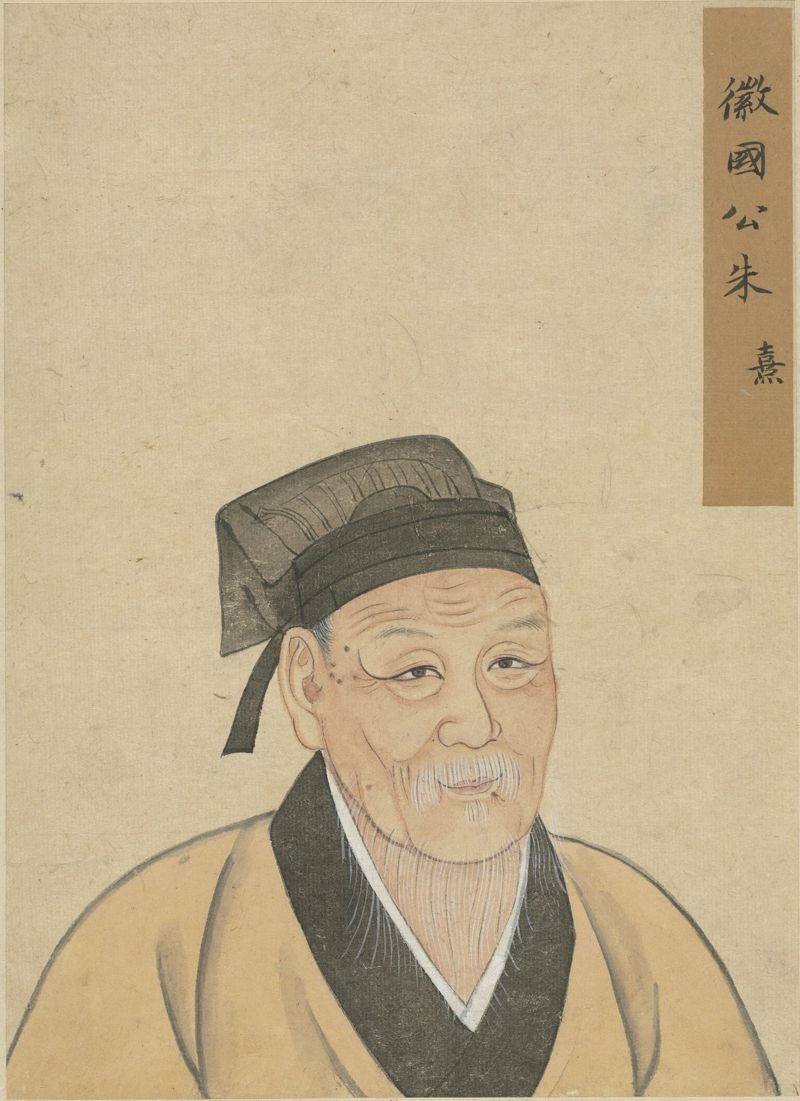

Anonymous (Yuan dynasty), Half Portraits of the Great Sage and Virtuous Men of Old, leaf for Zhu Xi. The National Palace Museum, Taipei, open data (CC0 low-resolution tier; cropped and downscaled) · Leaf for Zhu Xi from the album 'Half Portraits of the Great Sage and Virtuous Men of Old', anonymous, Yuan dynasty (probably after 1330), ink and colours on paper, main sheet 33.3 x 24.3 cm, National Palace Museum, Taipei (object number 中畫000329N000000059, work number 中畫00032900117). The leaf's inscription reads 徽國公朱熹 (Duke of Hui, Zhu Xi) and the museum's catalogue entry names the sitter; the title Duke of Hui was granted to him after his death, so the leaf is a conventional posthumous portrait made well after 1227 and more than a century after his death, not a likeness from life. The file is a crop of the leaf (the museum's colour card, number tag and mount edge removed) from the museum's own image service, downscaled from about 1530 x 2105 source pixels to 800 x 1101 (about 0.88 million pixels) with no upscaling. · CC0 (the museum's open-data declaration for images up to about 1 million pixels; the painting is also public domain by age)
철학자 · 중세
주희
1130–1200
주요 업적 분야
아직 성격 매칭에 포함되지 않았습니다 — 기록된 근거가 성격 모델 전체를 다루기에는 충분하지 않습니다. 이 페이지의 다른 모든 내용은 자유롭게 확인하실 수 있습니다.
핵심 특성
주요 업적
남송의 신유학(성리학) 철학자로, 스탠퍼드 철학 백과사전이 영향력에서 공자 다음으로 꼽는 인물이다. 『대학』『논어』『맹자』『중용』을 엮고 주석해 '사서'로 만들었으며, 이는 원나라 때부터 1908년까지 중국 과거시험의 기초가 되었다.
수백, 어쩌면 수천 명의 제자를 가르쳤고 그의 강론은 『주자어류』에 전한다. 1179~80년 백록동서원을 재건하고 그 규약을 정했으며, 『근사록』 편찬에도 참여했다.
'격물(사물을 탐구함)'의 방법과 이(理)를 기(氣)보다 앞세운 사상은 이후 유학 논쟁을 좌우했으며, 생전에는 육구연과 진량이, 후대에는 왕양명·왕부지·대진이 이를 비판했다.
삶의 장면들
한 승려의 주장을 검증하려고 그는 낮과 밤에 콩나물이 자라는 정도를 재어 보았고 차이가 없음을 확인했다.
이는 문헌의 권위에만 기대지 않고 관찰로 주장을 시험해 보기도 한 학자의 면모와 일치한다. 분석적 엄밀성
그의 학문이 '위학(거짓 학문)'으로 금지되고 일부 제자가 흩어지는 동안에도 그는 날마다 제자들을 가르쳤고, 제자들을 돌려보내라고 권하는 이들에게는 웃기만 하고 답하지 않았다.
이는 중단하라는 압력 속에서도 자신의 일을 계속한 스승의 면모와 일치한다. 끈기
전환점
선불교와 도가에 관심을 두던 그는 1160년 서른 살에 이통의 제자가 되어 유가의 도를 확신하게 되었고, 이후 40년을 그 길에 바쳤다.
이는 숙고 끝에 지적 방향을 바꾸고 이후 수십 년간 그에 헌신한 사상가의 면모와 일치한다. 입장 수정 성향
비슷한 인물
전체적인 프로필이 이 사람과 닮은 사람들이에요.


마리 퀴리

로절린드 프랭클린

제인 구달

앨런 튜링

볼프강 아마데우스 모차르트
출처
- Zhu Xi (Q9397), verified live via the Wikidata API (2026-11-02): English label 'Zhu Xi', description 'Chinese historian, neo-Confucian philosopher, poet, and politician during the Song dynasty (1130-1200)', Korean label 주희, birth 18 October 1130 and death 23 April 1200, occupations including philosopher, image a Qing rubbing of a stele reproducing a self-portrait. Orientation only; not used as support for any row.
- Stanford Encyclopedia of Philosophy, 'Zhu Xi' (first 100,000 of about 118,000 characters read: life, the Four Books, Reflections on Things at Hand, debates and later criticism; the final bibliography portion was not read). CANONICAL SIGNIFICANCE SOURCE: the preeminent Neo-Confucian (daoxue) master of the Southern Song, 'generally ranked as second only to Confucius in influence'; born in Youqi, Fujian, in 1130, passed the jinshi examination at nineteen, studied Chan Buddhism before becoming Li Tong's student in 1160, took mostly temple sinecures that left time for study, taught hundreds if not thousands of students, whose discourses are preserved in the Classified Dialogues; compiled, edited and commented on the Great Learning, Analects, Mencius and Doctrine of the Mean as the Four Books, which the Yuan dynasty adopted as the basis of the imperial examinations until 1908; the anthology Reflections on Things at Hand; debates with Lu Jiuyuan, Chen Liang, Lu Zuqian and Zhang Shi; later criticism by Wang Yangming (too outward and diffuse), Wang Fuzhi and Dai Zhen (who accused him of reading his own concepts into the classics). Scholarly reference; its praise of influence is retrospective.
- Internet Encyclopedia of Philosophy, 'Zhu Xi' (Neo-Confucian philosopher, 1130-1200), read in full: early life, the 1160 turn to Li Tong after an interest in Buddhism and Daoism, his teaching of 'hundreds, if not thousands' of students, the annotated editions and the Four Books (the commentary as a guide to self-cultivation, in Daniel Gardner's reading), observation guided by questions (he measured bean-sprout growth by day and by night to test a monk's claim and found no difference), the dispute with Zhang Shi over 'introspection in action' that he first accepted and later found hindered effective action, the debates with Lu Zuqian, Lu Jiuyuan and Chen Liang, and the later criticism by Wang Yangming, Wang Fuzhi and Dai Zhen. Independent scholarly reference.
- 'History of Song' (Song Shi, compiled in the Yuan dynasty), chapter 429, the biography of Zhu Xi (Chinese Wikisource, original Chinese read in full): his early studies, the teaching post at Tong'an where he selected local students and lectured daily on the Way of cultivating oneself and governing others, his poverty and simple meals shared with students who came from afar, the list of his commentaries and compilations (Yi, Odes, Great Learning and Doctrine of the Mean, Analects and Mencius commentaries, Reflections on Things at Hand), the official accusations of 'false learning' and the ban on his school during which he went on lecturing to students daily and smiled without answering those who urged him to dismiss them, his deathbed letter urging his son and students to study and revise his writings, and the Yuan-era admission of his commentaries to the schools. Written about 150 years after his death by official historians sympathetic to his school; the nearest surviving full biography. His memorials and official career in it are not used here.
- Wang Yangming, 'Instructions for Practical Living' (Chuanxilu), part 2, passage 318 (Chinese Wikisource, original Chinese read): Wang says that people say 'investigating things' should follow Zhu Xi ('Huiweng') but none had used it as he did; he and a friend tried to investigate the principle of the bamboo in front of a pavilion, the friend falling ill after three days and Wang after seven, and Wang concluded that 'there is nothing in the world that can be investigated' and that the work of investigating things lies in the mind. Critical later text from the Ming Neo-Confucian whose school opposed Zhu's method, written about three centuries after Zhu's death; used only as the counter-voice on his method of study.
- New World Encyclopedia, 'Academies (Shuyuan)', read: Zhu Xi rebuilt and expanded the White Deer Grotto Academy in 1179-80 while prefect of Nankang, after it had fallen into ruin; the academy reopened in 1180 and he taught there; he set down rules that had a lasting influence on later Confucianism; it remained a major centre for about eight centuries and hosted lectures by Lu Jiuyuan, Lu Zuqian and later Wang Yangming. A tertiary encyclopedia; the dates agree with Britannica as relayed in a web search but the Britannica entry itself returned HTTP 403 and was not read.