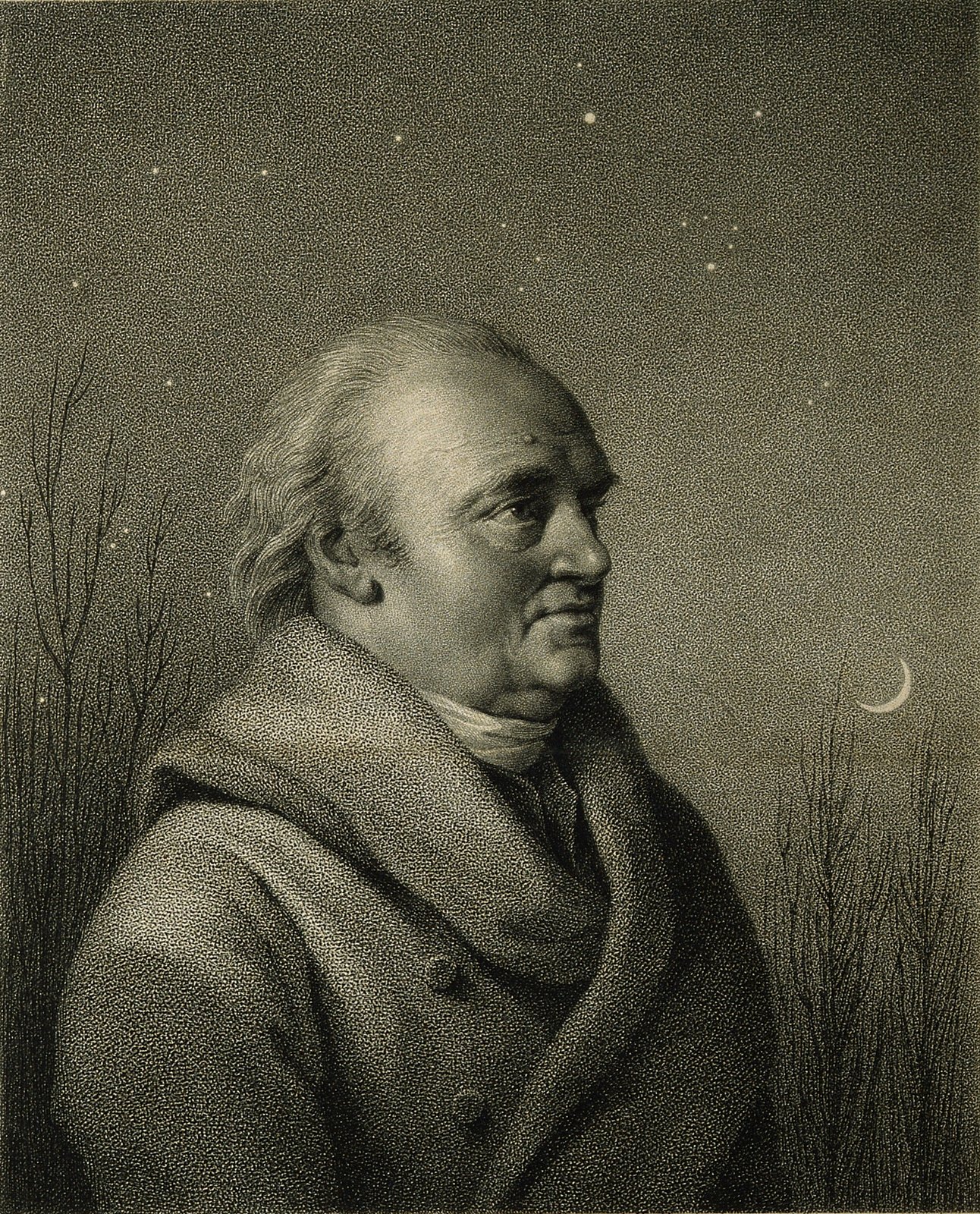

James Godby, stipple engraving after Friedrich Rehberg, 'Dr. Herschel', published London 1 Nov 1814 (inscribed 'Fr. Rehberg del. ad viv. Windsor 1814'); Wellcome Collection V0002727 (Wellcome page: Public Domain Mark; Commons tags the scan CC BY 4.0); cropped to the plate and downscaled · Wellcome Collection, London (portrait print V0002727) via Wikimedia Commons · CC BY 4.0
핵심 특성
주요 업적
허셜은 1773년 9월부터 바스에서 음악 교사이자 연주회 지휘자로 일하는 한편 직접 반사망원경을 만들기 시작했다. 드라이어가 편집한 그의 비망록에 따르면 그는 2피트 반사경을 빌려 쓰다가 9월 22일 바스의 한 아마추어가 쓰던 거울 제작 도구를 사들였고, 스미스의 《광학》과 에머슨의 《역학》을 바탕으로 작업했다. 드라이어는 1818년 12월까지 이어지는 그의 4권짜리 대형 기록에 거울 관련 작업이 모두 2,160건 적혀 있다고 센다.
허셜은 1783년 10월 28일 데이체트에서 새 20피트 반사망원경으로 하늘을 훑는 '스위프' 관측을 시작했다. 드라이어에 따르면 그는 혼자 41번의 스위프를 한 뒤 이 방식이 지나치게 고되고 성과가 적다고 판단했고, 이후 일꾼이 망원경을 올리고 내리는 사이 누이 캐럴라인이 관측 내용을 받아 적는 방식으로 바꾸었으며, 1783년 12월 18일의 46번 스위프부터 1802년 9월 30일의 1112번 스위프까지 관측이 이어졌다.
허셜은 1800년 3월 27일 왕립학회에서 낭독된 논문에서, 태양을 관측할 때 색유리를 시험해 보다가 햇빛의 모든 색이 똑같이 열을 내는지 의심하게 되었다고 적었다. 그는 프리즘이 만든 스펙트럼 옆에 온도계를 놓고, 하나는 골라 둔 색 안으로 옮기고 나머지 둘은 그늘에 기준용으로 둔 채 같은 실험을 되풀이했다.
삶의 장면들
1781년 3월 13일 허셜은 바스에서 하늘을 체계적으로 훑어보다가 일지에 '이상한, 성운상의 별이거나 어쩌면 혜성'이라고 적었고, 3월 17일에는 그것이 위치를 옮겼다고 기록했다. 왕립학회에 낸 논문의 제목은 〈한 혜성에 대한 보고〉였으며, 드라이어에 따르면 처음 제출한 원고에는 측정 가능한 시차를 주장하는 단락이 있었지만 다른 곳의 더 정확한 관측이 이를 반박하자 인쇄되지 않았다.
제출본과 인쇄본의 차이는 이후 측정이 뒷받침하지 않은 논거를 접을 줄 아는 태도와 부합한다. 다만 이는 한 번의 사례이며, 비판을 받았을 때 자신의 입장을 되풀이한 다른 기록도 있다. 입장 수정 성향
1781년 12월 윌리엄 왓슨은 허셜에게 런던 사람들이 그가 쓴 높은 배율을 믿지 않으며, 매스켈린과 오베르가 항성이 둥글고 또렷하게 보인 적이 없다고 말했다고 전했다. 허셜은 1782년 1월 7일 답장에서 '본다는 것은 어느 정도 배워야 하는 기술'이며 자신은 '여러 밤' 그 연습을 했다고 썼고, 이후 오베르에게 배율을 서서히 높여 보라고 권했다. 그의 비망록에 따르면 1782년 5~6월 그의 망원경은 그리니치에서 시험을 받았고 사용한 이들은 다른 기기보다 낫다고 평가했다.
그의 편지는 좋은 관측을 반복 연습으로 쌓는 기술로 다루는데, 이는 숙달 지향과 부합한다. 다만 근거가 대부분 그 자신의 말과 비망록이어서 결정적이라기보다 예시에 가깝다. 숙련 지향
전환점
드라이어는 허셜의 삶의 전환점을 1772~73년 겨울로 보는데, 스미스의 《광학》을 읽고 하늘을 직접 보고 싶어졌다는 것이다. 그의 비망록에는 1773년 4월 19일 사분의, 5월 24일 대물렌즈, 9월 22일 거울 제작 도구를 샀다는 기록이 있으며, 같은 해 11월 15일이 든 주에도 그는 개인 제자 46명을 가르치고 있었다.
책과 바스의 한 아마추어가 쓰던 도구로 기기를 만들면서 수업 부담도 그대로 진 것은 임기응변적 수완과 부합한다. 이 서술은 그 자신의 비망록과 누이의 훗날 회고에 의존한다. 자원 활용 성향
비슷한 인물
전체적인 프로필이 이 사람과 닮은 사람들이에요.
출처
- William Herschel (English Wikipedia; lead extract fetched via the MediaWiki API) -- orientation only (dates 15 Nov 1738 - 25 Aug 1822, Hanover-born, emigrated to Britain, astronomer and composer); not used as support for any scored row.
- 윌리엄 허셜 (Korean Wikipedia; lead extract fetched via the MediaWiki API) -- confirms the conventional Korean rendering of the name and the person's identity (German-born astronomer, mathematician and composer, 1738-1822). Orientation only.
- William Herschel (Q14277) -- identity verified live through the Wikidata API (wbsearchentities, then wbgetentities on labels, descriptions and claims): en label 'William Herschel', en description 'German-born British astronomer and composer (1738-1822)', ko label '윌리엄 허셜', P569 1738-11-15, P27 = Electorate of Hanover / Great Britain / United Kingdom of Great Britain and Ireland, P3373 siblings include Caroline Herschel (Q76948), P18 'William Herschel01.jpg'. Orientation only.
- J. L. E. Dreyer, 'A Short Account of Sir William Herschel's Life and Work, chiefly from unpublished sources' (biographical introduction, pp. xiii-xlix and following, to The Scientific Papers of Sir William Herschel, vol. 1, Royal Society and Royal Astronomical Society, London, 1912), Internet Archive OCR text (scientificpapers032804mbp) -- an independent scholar-editor's account built on Herschel's unpublished memoranda, polishing record, journals, sweep-books and letter-book, and quoting letters written TO him (William Watson jun., Maskelyne, Hornsby, Michell, Edwards, Priestley, Aubert, Walsh) and Auwers's later check of his nebula positions. Read in sequence from the opening of the introduction through the 40-foot telescope, machine polishing and the list of telescopes made to order (Sections I-IV, roughly pp. xiii-l); Section V and the unpublished-papers section were not read. Herschel's own memoranda quoted in it are the self perspective; Dreyer's commentary and the incoming letters are non-self. Not family-authored, but Dreyer worked from the family's manuscripts and used Caroline Herschel's Memoir for some particulars.
- The Scientific Papers of Sir William Herschel, vol. 1 (1912), same Internet Archive text as above -- Herschel's OWN papers (self perspective). Read at: 'On Nebulous Stars, properly so called' (Phil. Trans. 81, 1791, read 10 Feb 1791; edition pp. 415-425) -- the opening, the section weighing the former grounds against the new object, and the conclusion (the middle pages, about pp. 419-424, were not read). The rest of the volume (the Bath papers, the double-star and nebula catalogues, the sweep observations) was only searched by keyword, not read.
- The Scientific Papers of Sir William Herschel, vol. 2 (1912), Internet Archive OCR text (scientificpapers02hersuoft) -- Herschel's OWN papers (self perspective; the same self perspective as the other Herschel-authored records). Read at: the opening and first experiments of 'Investigation of the Powers of the prismatic Colours to heat and illuminate Objects' (Phil. Trans. 1800, read 27 Mar 1800); the wheat-price passage of 'Observations tending to investigate the Nature of the Sun' (1801) and his 1805-06 letter to Bode answering the translator Ideler's footnote. The rest of the volume was not read.
- Memoir and Correspondence of Caroline Herschel (by Mrs. John Herschel, London/New York, 1876), Internet Archive OCR text (memoircorrespond00hers) -- Caroline Herschel's firsthand recollections, recorded decades later, compiled by her nephew's wife: an INSIDER, family-compiled source (one perspective). Read at the Bath chapter (pp. 35-42: the purchase of a Bath amateur's mirror-making tools, the workshop years, the casting failure, the visitors of 1781-82); the volume as a whole was not read.
- Agnes M. Clerke, The Herschels and Modern Astronomy (Century Science Series, Cassell, 1895), Internet Archive OCR text (herschelsmoderna00clerrich) -- a Victorian historian of astronomy's synthesis (draws heavily on Caroline Herschel's Memoir, so only partly independent of it; also reports the Schroter exchange and Brougham's Edinburgh Review attack). Read at Chapter I (pp. 21-29), the Venus and sun-spot passages (pp. 88-89) and the passage on heat rays (pp. 95-96); the book as a whole was not read.