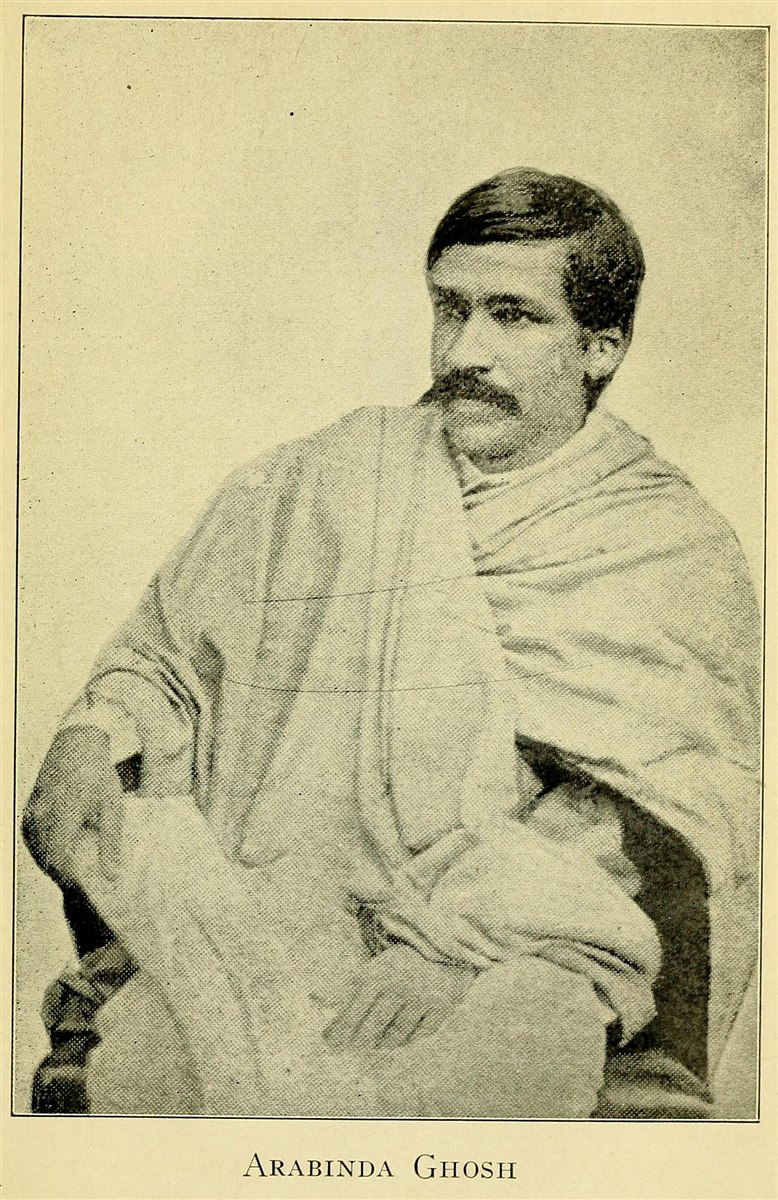

Arabinda Ghosh, photographic plate in Lajpat Rai, Young India, New York, B. W. Huebsch, 1916. Internet Archive, Library of Congress copy, public domain · Photographic plate captioned 'ARABINDA GHOSH' in Lajpat Rai, 'Young India: An Interpretation and a History of the Nationalist Movement from Within' (New York: B. W. Huebsch, 1916), from the Library of Congress copy digitised by the Internet Archive. The photographer and the date of the sitting are not named in the book. The file is a crop of the plate and its caption from the full-page scan (2154 x 3446), downscaled to 778 x 1200 with no upscaling. · Public domain (book first published in New York in 1916 with a 1916 copyright notice in the name of its publisher, so out of copyright in the United States by age)
철학자 · 20세기
아우로빈도 고시
1872–1950
영국령 인도 제국
주요 업적 분야
아직 성격 매칭에 포함되지 않았습니다 — 기록된 근거가 성격 모델 전체를 다루기에는 충분하지 않습니다. 이 페이지의 다른 모든 내용은 자유롭게 확인하실 수 있습니다.
핵심 특성
주요 업적
1910년 민족운동에서 물러나 퐁디셰리로 간 그는 통합 요가를 발전시켰고, 월간지 『아리아』(1914~21)에 『신성한 삶』, 『요가의 종합』, 『기타 에세이』 등 영적 진화의 철학을 담은 저작을 연재했다. 그의 전기를 평한 한 서평자는 이 잡지에 실린 글이 4,600쪽이 넘는다고 센다.
영국 유학 시절부터 시를 쓴 그는 성인기의 상당 부분을 서사시 『사비트리』에 바쳤다. 서평자들은 이 작품이 2만 행이 넘고 그의 죽음 직전에 완성되었다고 설명하며, 그는 시론서 『미래의 시』도 썼다.
퐁디셰리에서 제자들이 그의 곁에 모여 공동체를 이루었고 이것이 스리 아우로빈도 아시람으로 자랐다. 이곳의 운영은 '어머니'로 불린 미라 알파사가 맡았으며, 지지자와 비판자들은 지금도 그의 삶을 어떻게 서술할지를 두고 논쟁한다.
삶의 장면들
1914년 퐁디셰리에서 4년간 요가를 한 뒤 그는 월간지 『아리아』를 시작했고, 이 잡지는 6년 반 동안 중단 없이 나오며 그의 주요 산문 저작 대부분을 연재물로 실었다.
이는 몇 해에 걸쳐 규칙적인 집필 일정을 지켜 가는 모습과 일치한다. 자기 규율
그의 전기를 평한 서평자들은 그가 성인기의 상당 부분을 서사시 『사비트리』에 쏟았고 죽음 직전에야 완성했다고 말한다.
이는 서평자들의 설명처럼 한 편의 긴 작품으로 수십 년에 걸쳐 되돌아오는 모습과 일치한다. 끈기
전환점
1910년 그는 공적 활동에서 물러나 프랑스령 인도의 퐁디셰리로 갔고, 아시람은 그 일이 그의 모든 힘을 쏟아야 하는 것이었다고 설명한다. 이후 그는 요가와 글쓰기에 전념했다.
이는 활동 범위를 하나의 까다로운 작업으로 좁혀 가는 모습과 일치한다. 몰입
비슷한 인물
전체적인 프로필이 이 사람과 닮은 사람들이에요.
출처
- Aurobindo Ghosh (Q192207), verified live via the Wikidata API (2026-11-06): English label 'Aurobindo Ghosh', Korean label present, description 'Indian Bengali philosopher, yogi, maharishi, poet and nationalist (1872-1950)', born 15 August 1872, died 5 December 1950, image 'Sri aurobindo.jpg'. Orientation only; not used as support for any row.
- Sri Aurobindo Ashram Trust, 'Life Sketch' (excerpt from the Complete Works, vol. 30, pp. 1-6; read in full). CANONICAL SIGNIFICANCE SOURCE, with the reviews below: educated in England (St Paul's School, King's College Cambridge, first class in the classical tripos), passed the Indian Civil Service competition but was disqualified at the riding test, served the Maharaja of Baroda from 1893 as administrator, professor of English and vice-principal, learned Sanskrit and several Indian languages there, left the nationalist movement in 1910 for Pondicherry, where after four years of yoga he began the monthly Arya in 1914 in which The Life Divine, The Synthesis of Yoga, Essays on the Gita, The Isha Upanishad, The Secret of the Veda, The Human Cycle, The Foundations of Indian Culture, The Future Poetry and The Ideal of Human Unity appeared serially until 1921, and around whom a community of disciples grew into the Sri Aurobindo Ashram. DEVOTIONAL: published by the Ashram that carries on his work and written in the Ashram's own voice, so its characterisations are favourable and partly his own account; used for the dated facts and the list of works. The political chapter of the sketch is not used.
- Reviews of Peter Heehs, 'The Lives of Sri Aurobindo' (Columbia University Press, 2008), compiled with their original journal credits on the biographer's own website, 'Reviews of The Lives of Sri Aurobindo in English-language Publications' (read in full). Independent academic and press reviewers summarise the biography's account of his scholarship, his years of yoga and writing, the Arya, Savitri and the Ashram: Hanna H. Kim (Adelphi University), Ramakrishna Puligandla, W. Michael Ashcraft (Truman State University), Amiya P. Sen (Jamia Millia Islamia, The Book Review India), Antony Copley (University of Kent, Journal of the Royal Asiatic Society), Jayant Bapat (Monash University, South Asia), a Telegraph (Kolkata) reviewer and EnlightenNext magazine. Several reviewers criticise the biography or its subject (Copley on poetic style and self-neglect, Sen noting the biographer's own admission that he paid inadequate attention to social problems, the Telegraph reviewer asking what funded his early years at Pondicherry), while the book's critics from the Ashram are in the next entry. LIMITS: all the reviews rest on one biography, which itself draws heavily on the subject's papers and was written by a former Ashram archivist, and the compilation is selected by the biographer, so this is one underlying source seen through many readers, not many independent sources.
- Raman Reddy (Sri Aurobindo Ashram Archives), 'A review of The Lives of Sri Aurobindo by Peter Heehs' in the Ashram-community collection 'A Counter to Deliberate Distortions' (read in the opening review article). COUNTER-VOICE: a forty-year Ashram archivist who accepts that the biography is skilfully written and weaves historical data as no earlier biography had, but argues it is hostile to its subject, misrepresents his relationship with Mirra Alfassa (the Mother) and neglects the spiritual dimension. Openly partisan and about the biography rather than about his behaviour; used only to record the dispute over how he should be presented.
- Cambridge University, 'A Cambridge Alumni Database' (Venn), entry for Aravinda Acroyd Ghose (identifier GHS890AA; read in full). A university record of: scholar of King's College admitted 11 October 1890, matriculated 1890, classical tripos part I, first class, 1892, prizeman, admitted to the Indian Civil Service 1890, later service to the Maharajah of Baroda and professor of English and vice-principal of Baroda College, and a list of his published works. Documentary and independent of the Ashram, but it dates the Baroda service 1903-05 where other sources give 1893-1906, so no row depends on that date; its political lines are not used.
- Lajpat Rai, 'Young India: An Interpretation and a History of the Nationalist Movement from Within' (New York: B. W. Huebsch, 1916; Internet Archive item youngindiainterp01lajp, Library of Congress copy). Portrait source only: the book contains a full-page plate captioned 'ARABINDA GHOSH'; its text on him (a first-class education in England, first-class honours in the classics at Cambridge) matches the subject's schooling, and no row depends on the book's political narrative.