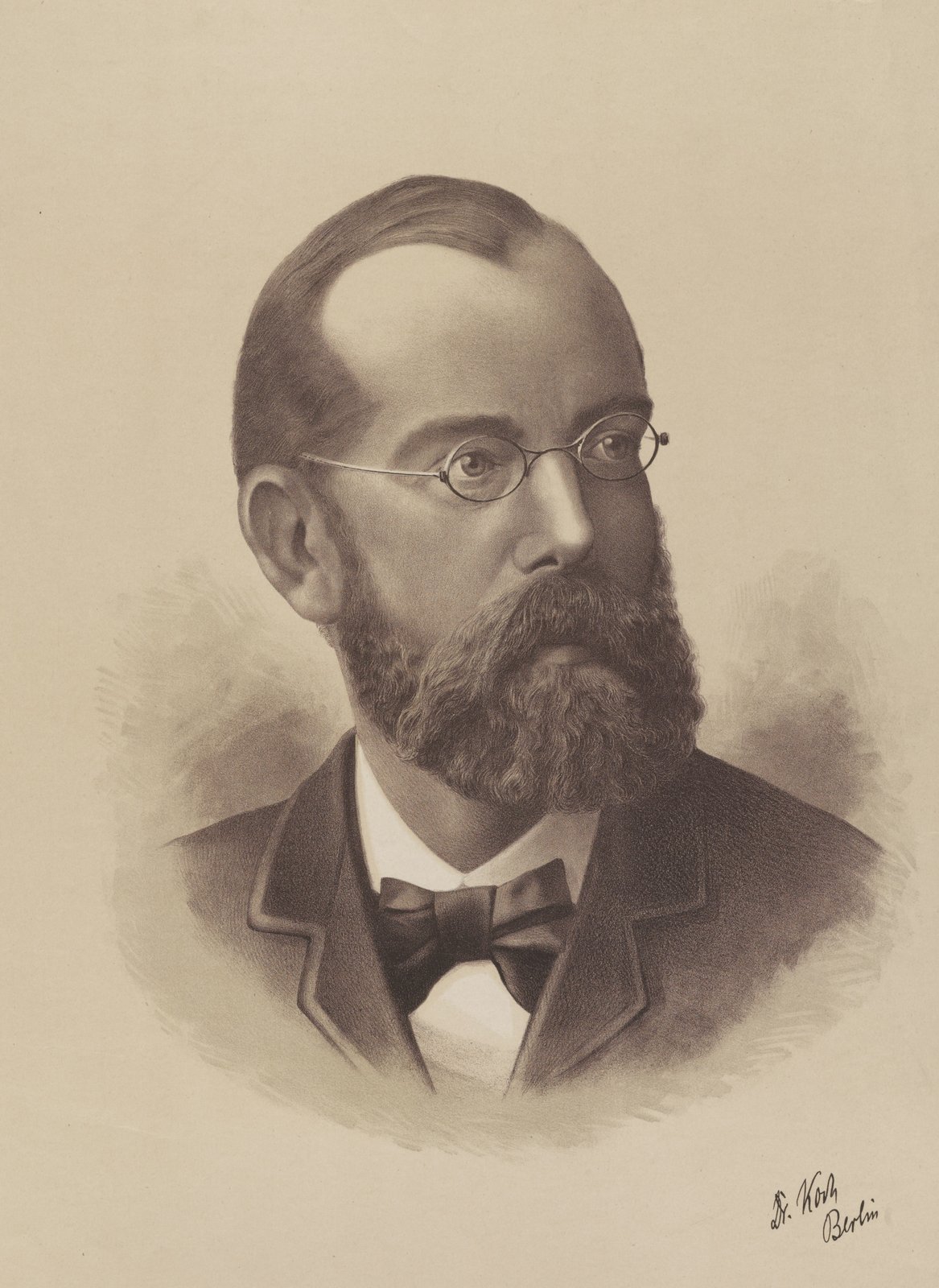

Compton Litho. Co., Dr. Robert Koch (Gallerie berühmter Männer), lithograph, 1887; Library of Congress, LC-USZ62-75478; public domain (US publication 1887). Cropped to the printed image area (title, imprint line and stamps removed) · Compton Litho. Co., St. Louis, 'Gallerie berühmter Männer. Dr. Robert Koch', lithographic print with facsimile signature 'Dr. Koch Berlin', copyright 1887 (imprint on the plate: 'Copyright 1887 and pub. by Compton Litho. Co. St. Louis'; distributed with the stamp 'Compliments of Parke, Davis & Co., Detroit'); Library of Congress Prints and Photographs Division, Popular Graphic Arts collection, LCCN 2003674738, digital ID pga.04671 (LC-USZ62-75478), copyright-deposit stamp; via Wikimedia Commons · Public domain
핵심 특성
주요 업적
1882년 3월 24일 코흐는 베를린 생리학회에서 한 간균이 결핵의 원인이라고 발표했다. 그는 새로운 염색법으로 이 균을 보여 주었고, 응고시킨 혈청에서 배양했으며, 그 배양균으로 실험동물에게 같은 병을 일으켰다. 1905년 노벨 생리학·의학상은 결핵에 관한 그의 연구와 발견에 수여되었다.
코흐는 프로이센 포젠주 볼슈타인에서 지역 보건의로 일하면서 진료실 한쪽에 마련한 실험실에서 탄저병을 연구했다. 1876년 논문에서 그는 탄저균이 자라고 포자를 만드는 과정을 추적했고, 생쥐를 길게 이어 가며 병을 옮겼다. 그의 제자 프리드리히 뢰플러는 훗날 1887년에 펴낸 세균학사에서 이 연구를 자세히 기술했다.
1883~1884년 코흐는 독일 콜레라 조사단을 이끌고 이집트와 인도에 갔으며, 캘커타에서 쉼표 모양의 간균을 순수배양으로 분리하고 조사한 모든 콜레라 환자에게서 이 균을 확인했다. 1892년 함부르크 유행을 다룬 글에서 그는 강물을 여과해 쓰던 이웃 도시 알토나와의 경계를 신중한 모래 여과의 근거로 제시했다.
삶의 장면들
1883년 9월 17일 알렉산드리아에서 보낸 첫 공식 보고서에서 코흐는, 모든 초기 콜레라 환자에게서 발견된 간균이 아직 원인이라는 증거는 되지 못한다고 썼다. 균의 침입이 병을 일으킨 것이 아니라 병의 결과일 수도 있다는 이유였다. 그는 베를린에서 데려간 생쥐와 원숭이, 개, 닭에게 먹이거나 접종한 실험이 모두 실패했다고 보고했다. 1년 뒤 그에게 비판적이던 영국 동물학자 레이 랭커스터는 그가 동물에서 병을 재현하지도 못한 채 원인을 선언했다고 비난했다.
자기 발견이 아직 보여 주지 못하는 것을 분명히 적어 둔 태도는 이 프로필의 분석적 엄밀성 점수와 부합한다. 랭커스터의 비판은 그 옆에 놓아 둘 만하다. 코흐의 이후 인과 주장이 동물 실험 증거보다 앞서 나갔기 때문에 이 프로필은 이 특성을 중간 정도로만 평가한다. 분석적 엄밀성
1882년 9월 제네바 국제위생회의에서 루이 파스퇴르는 강연을 통해 탄저병에 관한 코흐의 연구를 비판했다. 코흐 자신의 기록에 따르면 그는 회의장에서는 짧게 항의하는 데 그친 뒤 상세한 반론을 글로 펴냈다. 그는 이 글에서 파스퇴르가 백신 제조법을 비밀에 부치고 유리한 실험 결과만 보고한다고 비판하면서도, 파스퇴르의 다른 학문적 공로는 인정했다.
즉석 공방 대신 상세하고 날카로운 반론을 글로 내놓은 선택은 이 프로필의 높은 갈등 감내 점수를 보여 주는 한 예다. 다만 이 글은 길고 양쪽이 모두 공세를 편 논쟁에서 코흐 쪽의 주장이므로, 누가 옳았는지보다 그가 어떻게 싸웠는지를 보여 준다. 갈등 감내
전환점
1890년 8월 코흐는 기니피그의 결핵을 멈추게 하는 물질을 발표했다. 11월에는 이것으로 초기 폐결핵을 치료할 수 있다고 썼지만, 제조 방법은 밝히지 않았다. 몇 달 지나지 않아 상태가 나빠지거나 숨진 환자들에 관한 보고가 이어지며 이 약은 신뢰를 잃었고, 그는 대중과 정부의 압력을 받고서야 대략적인 성분을 공개했다. 그는 1897년 개량 투베르쿨린을 발표했으며, 1905년 노벨상 강연에서도 요양소에서의 투베르쿨린 치료를 권했다.
초기의 실패 이후에도 오랫동안 투베르쿨린에 대한 믿음을 유지한 모습은 이 프로필의 낮은 신념 수정 점수와 나란히 놓인다. 역사학자 크리스토프 그라트만은 이 사건을 결핵에 대한 자신의 기존 설명에 대한 집착에서 비롯된 자기기만으로 읽으며, 파스퇴르 학파와의 경쟁과 제도적·재정적 압박이 이를 강화했다고 본다. 이는 하나의 학술적 해석이지, 그의 동기에 대한 확정된 판단은 아니다. 입장 수정 성향
비슷한 인물
전체적인 프로필이 이 사람과 닮은 사람들이에요.
출처
- Robert Koch (English Wikipedia) -- orientation only; not used as support for any scored row. Korean Wikipedia title '로베르트 코흐' confirmed via the Wikidata kowiki sitelink.
- Robert Koch (Q37193) -- verified live via wbgetentities (2026-10-03): en label 'Robert Koch', description 'German physician, bacteriologist (1843–1910)', de 'deutscher Mediziner und Mikrobiologe (1843–1910)', ko label '로베르트 코흐' (ko description '독일의 의사, 미생물학자 (1843~1910)'), P569 1843-12-11, P570 1910-05-27, P18 'Robert Koch.jpg', enwiki 'Robert Koch', kowiki '로베르트 코흐', dewiki 'Robert Koch'. Orientation only.
- Christoph Gradmann, 'Robert Koch and the Pressures of Scientific Research: Tuberculosis and Tuberculin', Medical History 45 (2001), pp. 1-32 (Cambridge Core open PDF, DOI 10.1017/S0025727300000028), read in full (body text; footnotes skimmed) -- SCHOLAR, CRITICAL (historian of medicine, Heidelberg; works from the Robert Koch Institute archive and Koch's letters). Read: the eight months from Aug. 1881 to the 24 March 1882 lecture; methylene-blue/vesuvin double staining developed while trying to photograph the bacilli (per Loeffler's account); blood-serum medium, guinea-pig passage, 10-15 day growth criterion, inoculation series; Baumgarten's near-simultaneous identification and Koch's continued experiments into 1883; the unpublished failed photographs and the speculative 'spores'; the 1884 shift from naming disposition/heredity/social conditions (1882) to treating them as residual; failed attenuation and disinfectant-therapy trials with Gaffky (never published, ended 1886); the 1885-90 career break and 1 Dec. 1886 letter to Flügge ('it may well take years'); 1888 letter to Farbwerke Lucius & Brüning on dyes; the Aug. 1890 announcement, his reluctance to disclose composition (only under pressure c. Jan. 1891), the 'secret remedy', his own revenue estimate of several million marks a year and the commercial negotiations with Prussian officials, inability to show the 'cured' guinea pigs, patient deteriorations/deaths, development with only Pfuhl and Libbertz, first human testing on himself; Gradmann's verdict of self-deception from 'an unshakeable commitment to his previously developed explanatory framework', not simple fraud; Koch's continued faith in tuberculin (improved tuberculin 1897, faithful at least until 1901); the 1902 bovine/human non-identity claim noted as 'ill-fated'. The identity of the second early human test subject (a private-life detail) is NOT used.
- Robert Koch, Nobel Lecture, 12 Dec. 1905, 'The Current State of the Struggle against Tuberculosis' (English text from Nobel Lectures, Physiology or Medicine 1901-1921), nobelprize.org, read in full -- SELF. Read: his statement that his early warnings about bacilli-laden sputum 'have been un-heeded'; reasoning from the Prussian, English and Stockholm mortality declines to his conviction that hospital accommodation of advanced cases 'contributed most'; the open/closed tuberculosis distinction; his restatement (with Schütz) that bovine tuberculosis can be dismissed as a human source, citing the Imperial Health Office re-examination; continued recommendation of tuberculin preparations in sanatoria; the programme of notification, free sputum testing, hospitals, sanatoria and welfare centres, and his view that compulsory isolation could be dispensed with.
- K. A. H. Mörner, Presentation Speech for the 1905 Nobel Prize in Physiology or Medicine (10 Dec. 1905), and the Nobel Foundation's biographical note on Koch (from Nobel Lectures, Physiology or Medicine 1901-1921), nobelprize.org, both read in full -- INSTITUTIONAL (award body; laudatory). Used for achievement facts and dates: anthrax work 1876 and wound infections 1878 at Wollstein while a district medical officer; solid-medium/pure-culture methods; Imperial Health Office from 1880 with Loeffler and Gaffky; the 24 March 1882 lecture; leadership of the German Cholera Commission in Egypt and India 1883-84; Hygiene Institute chair 1885; Institute for Infectious Diseases 1891; tuberculin 1890 ('did not live up to what was hoped', per the speech) and new tuberculin; the 1901 London claim on human vs. bovine tuberculosis and the 'strong opposition' it met; later expeditions (rinderpest, malaria, plague, East Coast fever, sleeping sickness and atoxyl 1906-07). The prize was 'for his investigations and discoveries in relation to tuberculosis'. Supports no trait row on its own; the biographical note's anecdote about teaching himself to read at five and its 'methodical persistence' characterisation are NOT used.
- E. Ray Lankester, 'The Truth about Koch's Cholera Germ', Pall Mall Gazette, 6 Oct. 1884, pp. 1-2 (Wellcome Library copy, archive.org b30476379, OCR full text), read in full -- NON-SELF, ADVERSARIAL CONTEMPORARY (British zoologist, Professor at University College London; writes amid Anglo-German rivalry and openly says English men of science felt 'a certain sense of shame' that Germany led the India work). Read: his praise of Koch's tuberculosis proof by pure culture and reinoculation and his view of Koch as 'a conscientious reporter of his observations' whose account was 'perfectly candid and convincing'; his complaint that Koch let the public be 'mystified' by press reports for months before publishing; his charge that the Sept. 1884 report made a 'dogmatic declaration' that the comma bacillus 'must and shall' be regarded as the cause although no inoculation had reproduced cholera; Timothy Lewis's claim that the organism matched a mouth spirillum; and his attribution of the haste to German-French rivalry ('a rival to the French investigator Pasteur'). Hostile and partly wrong in hindsight about the organism; used as contemporary adversarial evidence about Koch's evidentiary standard and assertiveness, not as fact about cholera.
- 'The Cholera Bacillus -- Koch's Reply to His Critics', Science vol. 4 no. 98 (19 Dec. 1884), pp. 554-555 (JSTOR Early Journal Content, archive.org jstor-1761175, OCR full text), read in full -- NON-SELF, CONTEMPORARY JOURNAL REPORT (unsigned editorial note) summarising Koch's reply in the Deutsche medicinische Wochenschrift no. 45 (1884). Read: Koch examined Finkler and Prior's own specimens and found they had not obtained pure cultures and that their organism differed in size, growth rate and culture form; he did not find the comma bacillus in three cases of cholera nostras; he reported reproducing a cholera-like disease in rabbits and guinea pigs by duodenal inoculation of a minute dose of pure culture; E. van Ermengen's independent confirmation (Belgium, Oct. 1884); a slide of pure culture sent to the journal 'put up and forwarded by Koch himself'.
- George W. Lewis Jr., 'Ten Days in the Laboratory with Dr. Robert Koch, of Berlin: The Methods to be Employed in the Cultivation and Detection of the Comma Bacillus of Asiatic Cholera', Buffalo Medical and Surgical Journal, March 1885 (reprint, 15 pp., US National Library of Medicine copy, archive.org 101704288.nlm.nih.gov, OCR full text), read in full -- NON-SELF, FIRSTHAND PARTICIPANT (an American physician admitted to one of the government-funded ten-day cholera courses Koch ran in Berlin, Oct. 1884-Jan. 1885, for delegations of four to six physicians). Read: the course organisation under Koch's direct supervision with assistants from the Egypt/India commission; side-by-side cultivation of the comma bacillus with the Finkler-Prior bacillus, typhoid bacillus and micrococci, including mixed inoculation of one tube, 'to render stronger the contrast between them'; the step-by-step medium preparation, sterilisation and dilution-plate procedure taught. Mostly technical; low weight, used only for the teaching/method-transfer pattern.
- Robert Koch, 'On the Present State of the Bacteriological Diagnosis of Cholera', 'Water-Filtration and Cholera' and 'The Cholera in Germany during the Winter of 1892-93' (Zeitschrift für Hygiene, 1893), English translation by George Duncan, Professor Koch on the Bacteriological Diagnosis of Cholera, Water-Filtration and Cholera, and the Cholera in Germany during the Winter of 1892-93 (Edinburgh: David Douglas / New York: Jenkins, 1894-95), with a prefatory note by W. T. Gairdner (Glasgow, 15 Oct. 1894); archive.org professorkochonb00koch (Countway Library copy), read by sections: Gairdner's foreword and translator's preface in full; diagnosis chapter on gelatine-plate errors and Finkler's bacteria (pp. 11-13); the Hamburg-Altona-Wandsbek comparison and the reply to the 'localists' (pp. 25-29); the Nietleben asylum filter investigation (pp. 33-37) -- SELF (Koch) plus a short NON-SELF foreword. Read: Koch's use of the Hamburg/Altona water-supply boundary as an experiment that 'performed itself on more than a hundred thousand human beings'; his personal checking of contrary claims about house connections ('on the basis of information received by myself in Altona and Hamburg'); his sharp, sarcastic reply to Pettenkofer ('the revered Herr Localist in his embarrassment'); the protocolled interview of the Nietleben filter attendant and his computation of filtration rates; his insistence that filtration protects only if managed as strictly as at Altona; dismissal of Finkler's bacteria as the product of 'egregious blunders'. Gairdner (non-self, admiring) notes that 'many persons in this country ... have little confidence in Professor Koch' after the tuberculin failure, and that some will not 'coincide with the highly controversial attitude of Dr Koch in rebutting the ideas of his opponents', while praising the 'firm and logical statement of his arguments'.
- Robert Koch, 'A Further Communication on a Remedy for Tuberculosis' (Deutsche medizinische Wochenschrift, 14 Nov. 1890), English translation as reprinted in Nature 43 (20 Nov. 1890), pp. 66 ff. ('Dr. Koch on Tuberculosis', from the British Medical Journal supplement), archive.org paper-doi-10_1038_043066a0, OCR full text, read in full -- SELF. Read: he had intended to complete the research before publishing but 'too many accounts have reached the public'; 'As regards the origin and the preparation of the remedy I am unable to make any statement'; the investigations carried out under his direction by Libbertz and Pfuhl with patients supplied by Brieger, Levy, Fräntzel, Köhler and von Bergmann; the 1:1,500 guinea-pig/human sensitivity estimate; the reaction he observed 'after an injection made in my own upper arm'; claims that first-stage phthisis patients 'might be pronounced cured' within four to six weeks and 'phthisis in the beginning can be cured with certainty', with a footnote that no conclusive experience on lasting cure existed; an earnest warning against 'indiscriminate application'; his omission of statistics and case descriptions.
- Friedrich Loeffler, Vorlesungen über die geschichtliche Entwickelung der Lehre von den Bacterien, Teil 1 (Leipzig: F. C. W. Vogel, 1887), archive.org vorlesungenberd00lfgoog (Google scan, German OCR), read by sections: Koch's 1876 anthrax work (pp. 168-175) and Koch's 1877 preparation/staining/photomicrography methods and the 1878 wound-infection study, including his adoption of the Abbe condenser (pp. 216-235) -- NON-SELF, INSIDER (Koch's assistant at the Imperial Health Office from 1880, co-discoverer of the diphtheria and glanders bacilli; an admiring pupil writing a technical history). Read: Koch's serial transmission of anthrax from mouse to mouse 'durch lange Reihen von Generationen' (longest series twenty mice); step-by-step observation of growth and spore formation in a drop of aqueous humour on a heated stage; germination of spores followed back to bacilli; controls showing that other spore-forming bacilli from putrefying matter or hay infusions did not produce inoculation anthrax; drying and wetting tests on bacilli vs. spores and his explanation of soil/pasture outbreaks; his 1877 cover-glass drying, aniline staining and photography so that pictures would be free of 'willkürlicher oder unwillkürlicher Entstellung'; photographic distinction of B. subtilis from B. anthracis (flagella, cut-off ends); his search ('nach langem Suchen') for an illumination apparatus ending with the Zeiss/Abbe condenser. Admiring tone ('jeder Irrthum war ausgeschlossen') discounted.
- H. C. Ernst, 'Robert Koch (1843-1910)', memorial notice for a Foreign Honorary Member, Proceedings of the American Academy of Arts and Sciences 53 (1918), pp. 825-827 (JSTOR Early Journal Content, archive.org jstor-25130022), read in full -- NON-SELF, CONTEMPORARY COLLEAGUE (Harold C. Ernst, Harvard professor of bacteriology). Read: the Wollstein consulting room partly converted into a laboratory with photomicrographic apparatus and dark room; the 'bitter controversy with Pasteur'; the 1887 cholera report bearing 'the marks of painstaking research and great accuracy'; the 'forced circumstances surrounding the announcement' of tuberculin and the disappointment; his characterisation of Koch's 'patience, a strong will and great persistence', modest manner and clear diction early, and in later life 'a tendency to general and dogmatic statement, and a greater inclination to controversial methods than had been seen before'.
- S. Adolphus Knopf, 'Robert Koch. In Memoriam', address of 28 May 1910 at the New York Post-Graduate Medical School, Medical Record (New York), 4 June 1910 (reprint, Wellcome copy, archive.org b30614971), read in full -- NON-SELF, ADMIRING ACQUAINTANCE (American tuberculosis physician who calls himself one of Koch's 'humble disciples' and had received letters from him). Read: the motto 'nunquam otiosus' on his first scientific paper; 'the thoroughness with which he discussed any subject, and the firmness with which he defended any theory or fact which he thought right'; his repeated government assignments to local epidemics. A eulogy delivered the day after his death; very low weight, used only as minor corroboration.
- Robert Koch, 'Berichte über die Tätigkeit der zur Erforschung der Cholera im Jahre 1883 nach Ägypten und Indien entsandten Kommission' (official dispatches to State Secretary von Boetticher, Alexandria 17 Sept. 1883 to Calcutta 1884; Arbeiten aus dem Kaiserlichen Gesundheitsamte III, 1887), as reprinted in Gesammelte Werke von Robert Koch, ed. J. Schwalbe with G. Gaffky and E. Pfuhl, vol. II/1 (Leipzig: Thieme, 1912), pp. 1-19 (Wellcome/LSHTM copy, archive.org b21353207_0001, German OCR), read: the volume's table of contents and the Alexandria and first Calcutta dispatches (pp. 1-12) -- SELF (official reports). Read: arrival when the Egyptian epidemic was already declining; the specific bacilli found in the intestinal wall of all fresh cholera cases and absent in a post-cholera case and in other deaths; his explicit statement that coincidence 'noch nicht' proved causation and that the bacterial invasion might be secondary; that he had earlier set no value on the same finding in Indian material because of possible putrefaction; 50 mice brought from Berlin plus monkeys, dogs and hens fed and inoculated without any result; his request to extend the expedition to India, offering to lead it; in Calcutta, isolation in gelatine culture, detection in all cholera cases and absence in eight non-cholera corpses (pneumonia, dysentery, phthisis, kidney disease) and in animal intestines, and his conditional argument that exclusive occurrence would make the causal link hardly doubtful 'selbst wenn die Reproduktion der Krankheit an Tieren nicht gelingen sollte'.
- Robert Koch, 'Über die Milzbrandimpfung. Eine Entgegnung auf den von Pasteur in Genf gehaltenen Vortrag' (Kassel/Berlin: Fischer, 1882), as reprinted in Gesammelte Werke von Robert Koch, vol. I (Leipzig: Thieme, 1912), pp. 207 ff. (Wellcome copy, archive.org b21463608_0001, German OCR), read by sections: the opening (pp. 207-209), the passages on the chicken-cooling experiment and on Pasteur's publication practice (pp. 212-214), and the closing assessment of the Packisch and Hungarian trials (pp. 224-226) -- SELF. Read: that at the Geneva hygiene congress (Sept. 1882) he limited himself to 'einen kurzen Protest' against Pasteur's 'persönlich' and 'gereizt' polemic and reserved a full written reply; his statement of method -- it is 'noch nicht bewiesen' that all infectious diseases are parasitic, so proof must be furnished case by case, starting with exhaustive microscopic study using every staining and sectioning technique; that he disputed not Pasteur's chicken-cooling fact but its interpretation, citing 'vielfache eigene Versuche' with other birds; his principle that whoever claims the scientific world's trust 'hat die Pflicht, die von ihm befolgten Methoden so zu veröffentlichen, daß ein jeder in den Stand gesetzt wird, jene Angaben auf ihre Richtigkeit zu prüfen', with his charge that Pasteur kept his attenuation methods secret and reported only favourable trial results (Packisch, Hungary); and his acknowledgement of Pasteur's 'bedeutenden Verdiensten'. A polemical text; used for Koch's own stated standards and conflict style, not as a judgement on Pasteur.