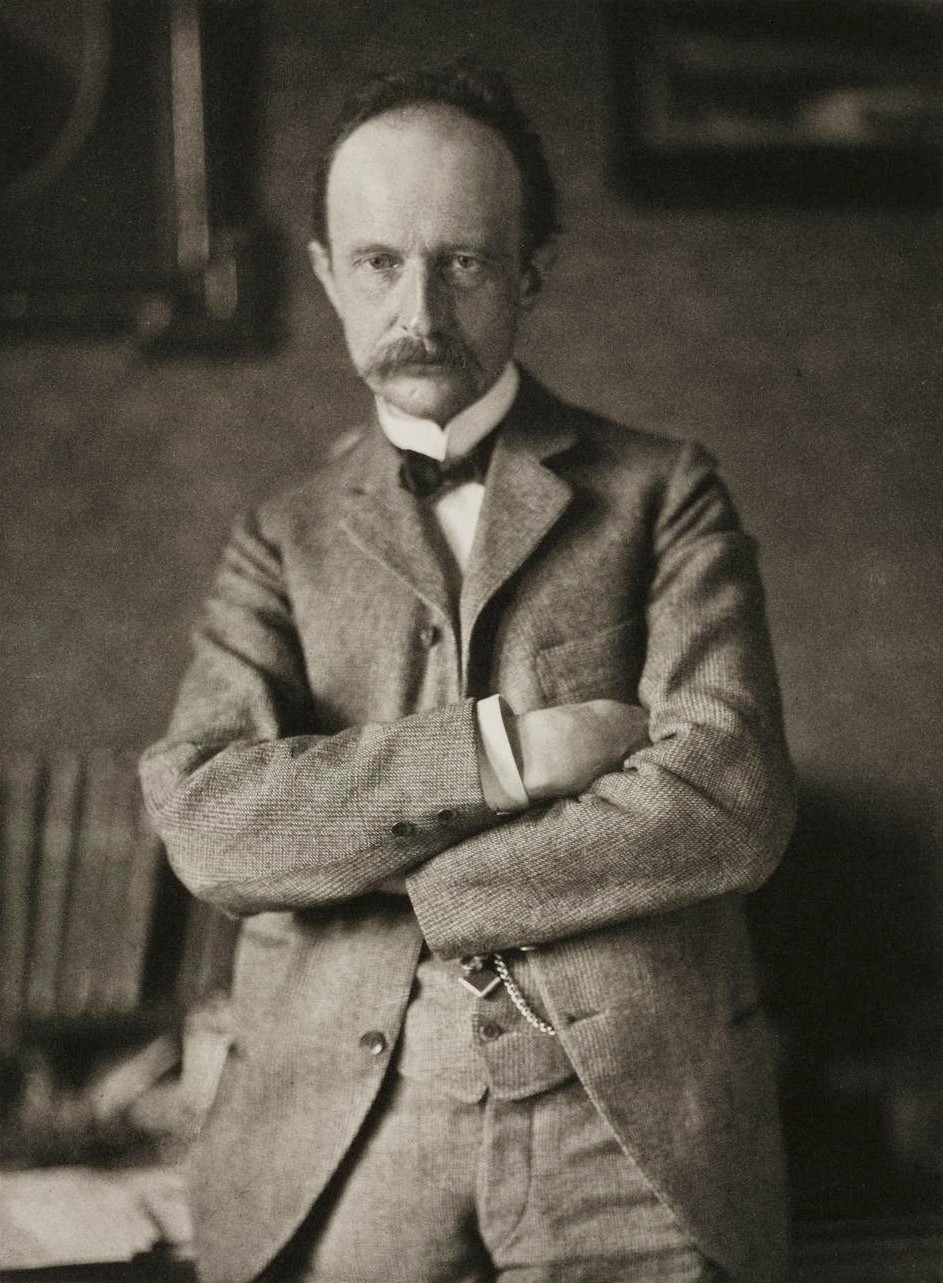

Rudolf Dührkoop, Max Planck, photogravure, Photographische Gesellschaft in Berlin, c. 1910; public domain (photographer died 1918); paper margin with imprint and signature cropped · Rudolf Dührkoop (1848-1918), photograph of Max Planck, reproduced as a photogravure published by the Photographische Gesellschaft in Berlin (plate no. 8175; plate inscribed 'R. Dührkoop phot.', facsimile signature 'Planck'), c. 1910; scan via Wikimedia Commons (uploaded 2023 from a JSTOR Community collection copy) · Public domain
핵심 특성
주요 업적
1900년 10월 19일 플랑크는 베를린의 독일물리학회에서 열복사 스펙트럼에 대한 새로운 공식을 발표했다. 같은 해 12월 14일에는 이 공식의 이론적 유도를 발표하면서 오늘날 플랑크 상수 h로 불리는 상수를 도입했다. 그가 당시 고전물리학과의 단절을 어디까지 인식했는지는 지금도 역사학자들 사이에서 논쟁거리다.
그는 기본 양자 이론에 관한 업적으로 1918년도 노벨 물리학상을 받았으며, 수상 발표는 1919년 11월에 있었다. 상은 1920년 6월 스톡홀름에서 받았다. 1908년에는 스웨덴 왕립과학원이 그에게 상을 주자는 위원회의 제안을 받아들이지 않았다.
그는 1889년 베를린 대학에서 구스타프 키르히호프의 뒤를 이었고, 1926년 은퇴할 때까지 그곳에서 이론물리학을 가르쳤다. 1894년부터는 프로이센 과학아카데미 회원이었다. 많은 물리학도가 그가 펴낸 강의록으로 공부했으며, 막스 폰 라우에도 그의 제자였다.
삶의 장면들
열역학 제2법칙을 다룬 플랑크의 1879년 박사 논문은 거의 아무런 반응을 얻지 못했다. 그가 말년에 쓴 회고에 따르면 헬름홀츠는 아마 그 논문을 읽지도 않았고, 키르히호프는 내용에 반대했으며, 클라우지우스는 그의 편지에 답하지 않았다. 그는 1880년대 내내 엔트로피 연구를 이어 갔고, 제자 막스 폰 라우에는 1947년 장례식 추도사에서 '그는 자기 길을 계속 갔다'고 말했다.
선배들이 외면한 주제를 여러 해 붙들고 연구한 것은 이 프로필의 높은 끈기 점수와 부합한다. 다만 이 이야기는 플랑크 자신의 회고록과 그를 존경한 제자의 추도사에 기대고 있으며, 두 기록의 세부 내용은 서로 일치한다. 끈기
리제 마이트너는 제1차 세계대전 이전에 플랑크의 조교로 일했다. 그녀는 1958년 강연에서, 물리학 질문을 하면 그가 자주 '내일 대답해 드리겠습니다'라고 답했다고 회상했다. 마이트너는 이를 자기가 하는 말 하나하나에 온전히 책임지려 한 그의 태도와 연결 지었다.
답을 하기 전에 먼저 확인하는 습관은 이 프로필의 분석적 엄밀성 점수와 맞아떨어진다. 가까운 동료 한 사람의 기억에서 나온 이야기이므로, 그가 유도 과정을 얼마나 엄격하게 요구했는지에 대한 역사학자들의 서술과 함께 읽는 것이 좋다. 분석적 엄밀성
전환점
1900년 말 플랑크는 새 복사 공식을 유도하기 위해, 오랫동안 받아들이지 않았던 루트비히 볼츠만의 통계적 엔트로피 해석을 택했다. 그는 1931년의 한 편지에서 이 단계를 '절망에서 나온 행동'이라 부르고, 에너지 요소는 '순전히 형식적인 가정'이었다고 썼다. 그 자신의 회고와 역사학자들의 서술에 따르면 그는 그 뒤로도 몇 년 동안 양자를 고전물리학 안에 끼워 맞추려 애썼다. 역사학자 헬게 크라그는 그가 그것이 불가능하다는 점을 받아들인 시기를 1908년 무렵으로 본다.
측정 결과가 다른 길을 남겨 두지 않자 반대하던 방법을 받아들이고, 그 뒤로도 여러 해 고전물리학을 붙들고 있었던 모습은 이 프로필의 중간 수준인 신념 수정 점수와 나란히 놓인다. 이 프로필은 이를 단순한 저항이 아니라 느리지만 실제로 일어난 변화로 읽는다. 입장 수정 성향
비슷한 인물
전체적인 프로필이 이 사람과 닮은 사람들이에요.
출처
- Max Planck (English Wikipedia) -- orientation only; not used as support for any scored row. Korean Wikipedia title '막스 플랑크' confirmed via the Wikidata kowiki sitelink.
- Max Planck (Q9021) -- verified live via wbgetentities (2026-10-03): en label 'Max Planck', description 'German theoretical physicist (1858–1947)', de 'deutscher Physiker, Nobelpreisträger (1858–1947)', ko label '막스 플랑크' (ko description '독일의 물리학자 (1858~1947)'), P569 1858-04-23, P570 1947-10-04 (a second P570 value 1947-12-04 is also present), P18 'Max Planck.png', enwiki 'Max Planck', kowiki '막스 플랑크', dewiki 'Max Planck'. Orientation only.
- Max Planck, 'A Scientific Autobiography' (Wissenschaftliche Selbstbiographie, written 1946-47, publ. Leipzig 1948), in Scientific Autobiography and Other Papers, tr. Frank Gaynor (New York: Philosophical Library, 1949), pp. 13-51, read in full from an archive.org OCR text (community upload 'complete-work-of-max-planck'; the lending-library copies are access-restricted); cross-checked against the German text in Vorträge, Reden, Erinnerungen (2001), pp. 55-72 -- SELF. Read: dissertation 1879 ignored (Helmholtz probably did not read it, Kirchhoff disapproved, Clausius did not answer letters or receive him) and 'such experiences could not deter me' from continuing entropy work; Gibbs priority; Göttingen prize 1884-85 (second prize, attributed by him to his siding with Helmholtz against Weber); Arrhenius dispute; controversy with Ostwald/Helm/Mach over Energetics ('All my sound arguments fell on deaf ears'); the 'new scientific truth' remark; his own early hostility to atomism and Boltzmann's sarcasm over Zermelo's paper; the radiation work: Wien-law assumption abandoned after Lummer-Pringsheim and Rubens-Kurlbaum measurements, formula of 19 Oct. 1900, Rubens's overnight check, statistical derivation; 'My futile attempts to fit the elementary quantum of action somehow into the classical theory continued for a number of years'; immediate interest in Einstein's 1905 relativity paper; correspondence with Sommerfeld (phase-space quatrains).
- Max von Laue, Memorial Address delivered in the Albani Church, Göttingen, 7 Oct. 1947, printed as the Introduction to Planck, Scientific Autobiography and Other Papers (1949), pp. 7-12, read in full (same archive.org text) -- NON-SELF, INSIDER: Planck's pupil and later close colleague (Nobel 1914). Read: that his first papers were not read even by Helmholtz, Kirchhoff and Clausius, 'Yet, he continued on his way'; that deriving the radiation law forced him to 'fall back on methods of the atom theory, which he had been wont to regard with certain doubts' and to venture a hypothesis whose audacity was not clear 'not even to him'; 58 years of membership of the German Physical Society with 'selfless work in the most diverse administrative posts', several terms as chairman; teaching at Berlin for more than forty years. Funeral oratory by an admiring pupil; the bereavement passage was read and is NOT used.
- Albert Einstein, address for Planck's sixtieth birthday at the Berlin Physical Society (1918, 'Motive des Forschens'), as printed in English as the 'Prologue by Albert Einstein' to Planck, Where Is Science Going? (New York: Norton, 1932), pp. 7-12, archive.org OCR full text (whereissciencego00plan_0, York University copy), read in full -- NON-SELF, FIRSTHAND COLLEAGUE (Berlin colleague since 1914). Read: Einstein's account that the longing for a 'preestablished harmony' is 'the inexhaustible source of that patience and persistence with which we have seen Planck devoting himself to the most ordinary questions arising in connection with physical science, when he might have been tempted into other ways which led to more attractive results'; that colleagues traced this to Planck's 'extraordinary personal gifts of energy and discipline' (Einstein disagreed about the motive); the Mach-Planck controversy. An admiring occasional speech; used only for the observed sustained-effort pattern, not for the motive claims.
- James Murphy, 'Introduction: Max Planck, a biographical sketch', in Planck, Where Is Science Going? (1932), pp. 13-38, archive.org OCR (whereissciencego00plan_0), read in full -- JOURNALIST/TRANSLATOR who visited Planck and Einstein in 1932 (non-self but admiring and secondary). Read: Planck's public stand against positivism and on causality in lectures and essays, and Murphy's report of a Göttingen dinner (Weyl, Born, Franck) discussing 'his intransigence on the causation principle'; Sommerfeld's quoted tribute ('in polemical questions he has always been chivalrous to his opponent'; trusted arbiter of both sides when the German Physical Society was reorganized) and the Sommerfeld-Planck quatrains; climbing the Jungfrau at seventy-two. Murphy makes factual errors (says Planck 'experimented' with cavity radiation; garbles his son's post) so only the quoted Sommerfeld material and the 1932 dinner report are used, at low weight. Bereavement passages read and NOT used.
- Max Planck, Nobel Lecture, 2 June 1920, 'The Genesis and Present State of Development of the Quantum Theory' (English text from Nobel Lectures, Physics 1901-1921), nobelprize.org, read in full -- SELF. Read: 'the long and ever tortuous path'; his initial 'naively charming' expectation that classical electrodynamics would suffice and his avoidance of Lorentz's electron theory ('I did not quite trust the electron hypothesis'); Boltzmann's objection to his irreversibility hypothesis; abandoning his belief that the Wien-based relation was the general law once Lummer-Pringsheim and Rubens-Kurlbaum deviations appeared; 'some weeks of the most strenuous work of my life'; 'a fresh attempt at proof is urgently required'; his statement that experiment decided for the quantum and the credit given to Einstein, Bohr, Sommerfeld and the experimenters; the remaining 'monstrous' features of Bohr's theory for a classically trained physicist and 'the old framework must somehow or other be burst asunder'.
- A. G. Ekstrand, Presentation Speech for the 1918 Nobel Prize in Physics (delivered 1 June 1920; prize announced 13 Nov. 1919), and the Nobel Foundation's biographical note (from Nobel Lectures, Physics 1901-1921), nobelprize.org, both read in full -- INSTITUTIONAL. Used only for achievement facts (radiation formula of 1900, the constants, the prize 'for his work on the establishment and development of the theory of elementary quanta', career dates); supports no trait row.
- Lise Meitner, 'Max Planck als Mensch', lecture of 24 April 1958 (Berlin, Planck centenary), Die Naturwissenschaften 45 (1958), pp. 406-408, reprinted in Max Planck, Vorträge, Reden, Erinnerungen, ed. H. Roos and A. Hermann (Berlin: Springer, 2001), pp. 77-83, read in full in German from an archive.org OCR text (MaxPlanckVortraegeRedenErinnerungen) -- NON-SELF, FIRSTHAND INSIDER: his student from 1907, his assistant c.1912-15 and a friend for forty years. Read: his lectures' clarity and outward reserve; his answer 'Ich will es Ihnen morgen beantworten' to her physics questions as assistant, which she ties to his wish to stand fully behind everything he said; the Bad Nauheim relativity session (she dates it '1921, I believe'; it was Sept. 1920), where Planck, who had told her he would do anything not to lose Einstein, chaired and cut off an opponent who raised the newspaper article ('das gehöre nicht zur Sache'); his first reaction to problems 'always toward moderation' and his attachment to tradition, combined with understanding for other lines of thought; few research pupils (Laue, Bothe, Reiche, Lamla) and a reluctance to intervene strongly in pupils' intellectual development; a 'very systematic' daily schedule (half an hour of piano at the same time daily) and systematic walks covering the surroundings of Berlin by a fixed plan over several months. Passages on the 1914 manifesto letter to Lorentz, the 1935 lecture, the Haber memorial and family deaths were read and NOT used for any row (politics / bereavement).
- Armin Hermann, 'Max Plancks wissenschaftliche Leistung', in Vorträge, Reden, Erinnerungen (Springer, 2001), pp. 213-221, read in full in German (same archive.org text) -- SCHOLAR (historian of physics). Read: Planck's 'Akt der Verzweiflung' and 'friedlich und bedenklichen Abenteuern abgeneigt' (Planck's own later words, quoted); his use of Boltzmann's statistics, which he had opposed, 'um jeden Preis'; 'eine gewisse, ihm sonst fremde Ungeduld' in Dec. 1900 with derivations 'nicht ganz einwandfrei'; letter of 13 Nov. 1900; his rejection of Einstein's light-quantum hypothesis (quoted: 'Da bedarf es denn doch noch schwereren Geschützes') while being 'fasziniert und sogleich überzeugt' by special relativity (letter to Einstein 7 July 1907; letter to Runge 23 Feb. 1908 on the invariance of h as his motive); the 1913 Academy recommendation saying Einstein had overshot the mark with light quanta; the 1908 Nobel decision blocked by Mittag-Leffler; Hermann's characterisation of Planck as cautious and conservative. Hermann's checking of the Erwin/Grunewald anecdote via Robert Pohl was read; that anecdote is NOT used.
- Helge Kragh, 'Max Planck: the reluctant revolutionary', Physics World, 1 Dec. 2000 (feature; Kragh is a historian of physics), physicsworld.com, read in full up to the publisher's registration cut-off near the end (the section on Einstein's role and the Solvay conference was read; the final paragraphs and further-reading list were not) -- SCHOLAR, REVISIONIST/CRITICAL perspective (follows and weighs Kuhn's thesis). Read: Planck's 1882 prediction that atomism would have to be given up; his opposition waning in the 1890s while he kept priority for macroscopic thermodynamics; Boltzmann's 1897 demolition of his electrodynamic irreversibility argument; the Wien-Planck law of 1899 and its failure against the Berlin measurements, 'Planck had to return to his desk'; turning in Nov. 1900 to Boltzmann's probabilistic entropy 'that he had ignored for so long'; the 1931 letter (to R. W. Wood) calling the quanta 'a purely formal assumption ... no matter what the cost, I must bring about a positive result'; his silence on the subject 1901-06 and the continuum treatment in his 1906 lectures; conversion c.1908 under Lorentz's analysis, acceptance of the statistical second law only c.1912, and his 1911 statement that 'the hypothesis of quanta will never vanish'; Kuhn's and Darrigol's arguments that Einstein, not Planck, first grasped quantum discontinuity.
- Max Planck, 'Zur Geschichte der Auffindung des physikalischen Wirkungsquantums' (1943) and 'Persönliche Erinnerungen aus alten Zeiten' (1946), German texts in Vorträge, Reden, Erinnerungen (Springer, 2001), pp. 11-24 and 41-54, read in part (the 1943 account of the constants k and h and of his later attempts to fit h into classical physics; the 1946 recollections of Helmholtz, Kundt, Bezold, Paalzow and his 1890 lecture criticised by Du Bois-Reymond) from the archive.org OCR text (MaxPlanckVortraegeRedenErinnerungen) -- SELF (same perspective as the Scientific Autobiography record). Read: his own computation of the elementary charge (4.69 x 10^-10) from the radiation constants, that the computation 'was in places not taken quite seriously' but he did not let such doubts shake his confidence in k, full certainty coming only with Rutherford and Geiger's count; 'Durch mehrere Jahre hindurch machte ich immer wieder Versuche, das Wirkungsquantum irgendwie in das System der klassischen Physik einzubauen. Aber es ist mir das nicht gelungen.'