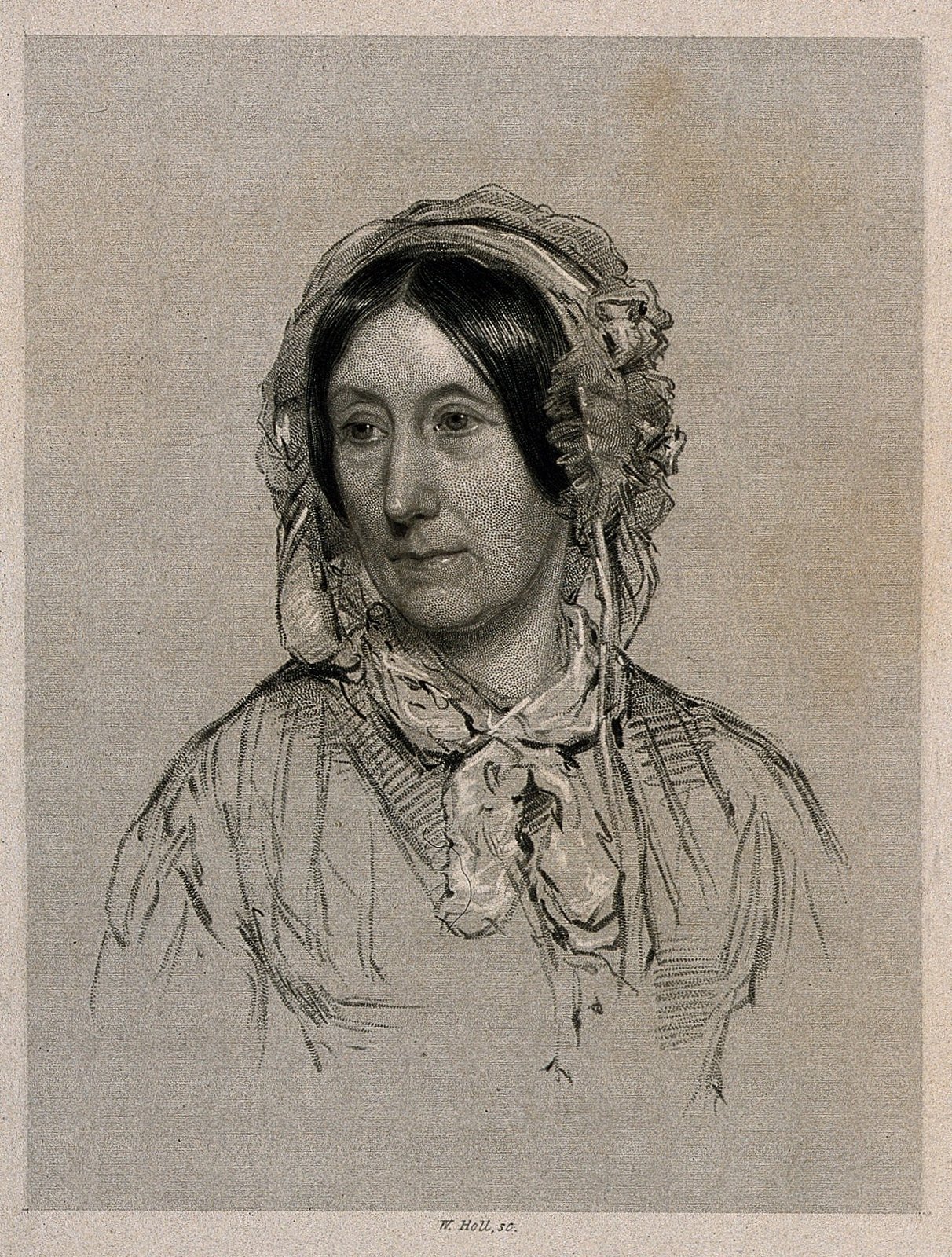

William Holl the Younger (1807-1871), stipple engraving of Mary Somerville, 1858, after a drawing by James Rannie Swinton (1816-1888), 1848; Wellcome Collection (Public Domain Mark), via Wikimedia Commons · Wellcome Collection, iconographic collections no. 8891i (Burgess, Portraits of doctors & scientists, no. 2779.2), digitised as V0005546EL, via Wikimedia Commons · Public domain
핵심 특성
주요 업적
서머빌의 『천체의 역학』(1831)은 라플라스의 천체역학을 그 수학과 함께 영어로 풀어낸 책이다. 1832년 조지 피콕은 자신과 윌리엄 휴얼이 이 책을 케임브리지의 교과 과정에 넣기 위한 조치를 취했다고 썼다. 존 허셜이 쓴 것으로 알려진 1832년 『쿼털리 리뷰』 서평은 이 책의 서론을 지금까지 나온 뉴턴 체계에 대한 가장 훌륭한 요약이라고 평가하면서도, 용어를 습관적으로 느슨하게 쓴다는 점을 지적했다.
『물리 과학들의 연관에 대하여』(1834)는 그 서론에서 출발한 책으로, 천문학·음향·광학·열·전기·자기를 수학적 해석으로 묶인 하나의 그림으로 개관했다. 휴얼이 쓴 것으로 알려진 『쿼털리 리뷰』 서평이 1834년 이 책을 다루었고, 서머빌은 이후 판에서도 계속 내용을 고쳤다. 예컨대 1849년 판에는 얼마 전 이루어진 해왕성 발견이 추가되었다.
1835년 2월 서머빌은 캐럴라인 허셜과 함께 왕립천문학회의 첫 여성 명예회원으로 선출되었다. 이후 『자연지리학』(1848)과 『분자 및 미시 과학』(1869)을 펴냈다.
삶의 장면들
서머빌은 『천체의 역학』 원고를 헨리 브루엄에게 보내 철저히 검토하고 비판해 달라고 했다. 원고를 읽은 존 허셜은 1830년 2월 편지에서 자신이라면 첫머리의 원리 설명에 지금의 두 배 이상 지면을 할애하겠다고 조언했다. 그녀가 간직한 그의 편지들은 사후에 나온 회고록(1873)에 실렸다. 역사학자 브리짓 스텐하우스의 기록 연구에 따르면 다음 책도 출간 전에 교정쇄가 휴얼과 J. D. 포브스에게 보내졌다.
출간 전에 원고를 전문가 독자에게 보내는 습관은 이 프로필의 중간 수준 협업 점수를 뒷받침하는 관행 중 하나다. 다만 이는 자기 저작에 대한 검토였지 공동 저술은 아니었다. 협업 성향
1835년 3월 역사학자 헨리 핼럼은 『물리 과학들의 연관에 대하여』가 고대 이집트의 역년을 365일 6시간으로 적었지만 실제로는 365일뿐이었다고 지적하는 편지를 보냈다. 1835년 제2판에는 옛 수치가 그대로 남아 있지만, 1849년 판과 1858년 판은 핼럼이 제시한 365일의 해와 1,461년 주기를 따른다. 그녀는 회고록에서 이 오류와 바로잡아 준 데 대한 감사를 기록했다.
자기 분야 밖에서 온 지적을 이후 판에 반영한 일은 이 프로필이 점수로 매긴 신념 수정의 소박한 한 예다. 다만 수정이 반영되기까지는 한 판 이상이 걸렸다. 입장 수정 성향
전환점
1827년 3월 헨리 브루엄은 그녀의 남편에게 편지를 보내, 유용지식보급협회를 위해 라플라스의 『천체역학』을 해설하는 책을 그녀가 써 줄 수 있는지 물었다. 그녀 자신의 기록에 따르면, 그녀는 작업을 비밀로 하고 실패하면 원고를 불태운다는 조건으로만 수락했다. 책은 협회 총서의 분량을 넘어섰고 1831년 존 머리 출판사에서 나왔다. 이것이 그녀의 첫 책이었고, 케임브리지와 서평에서 받은 반응으로 그녀는 과학 저술가로 자리 잡았다.
행성 궤도에서 조석에 이르기까지 중력의 결과를 하나로 엮은 이 책의 서론은 이 프로필의 체계적 추상화 점수와 나란히 놓인다. 다른 면에서는 이 책에 비판적이었던 1873년 왕립천문학회 부고도 그 서론만큼은 높이 평가했다. 시스템적 사고
비슷한 인물
전체적인 프로필이 이 사람과 닮은 사람들이에요.
출처
- Mary Somerville (Q268702) -- verified live via wbgetentities (2026-10-03): en label 'Mary Somerville', description 'Scottish scientist, writer and polymath (1780–1872)', P569 1780-12-26, P570 1872-11-28 / 1872-11-29 (two values), P27 United Kingdom of Great Britain and Ireland (Q174193), P31 human; ko label '메리 서머빌' (ko description '영국 저술가', ko alias '메리 페어팩스'), kowiki sitelink '메리 서머빌', enwiki 'Mary Somerville'. Orientation only; not used as support for any row.
- Mary Somerville (English Wikipedia) -- orientation only; not used as support for any scored row.
- Personal Recollections, from Early Life to Old Age, of Mary Somerville, with selections from her correspondence, ed. by her daughter Martha Somerville (London: John Murray, 1873/74) -- Project Gutenberg eText 27747, downloaded and read by grep/line ranges: contents; ch. III (Nasmyth's Euclid remark, Mr Craw's Euclid and Bonnycastle, night study and the candle order); ch. V (studies after 1807, Wallace correspondence and prize problem, Wallace's book list, Playfair's advice, reading Laplace with John Wallace); ch. VIII (Young); ch. XI in full (Brougham's letter of 27 Mar 1827, her conditions, writing at Chelsea, Martha's note on her 'power of abstraction', Herschel's letters on the manuscript and of 23 Feb 1830, Whewell's 2 Nov 1831 and Peacock's 14 Feb 1832 letters, RAS honorary membership, Biot, Peel's 1835 pension letter, beginning of the Connexion); ch. XII Paris 1832 (Poisson's advice); ch. XIII (Hallam's letter of 12 Mar 1835 correcting the Egyptian year, the form-of-the-earth and curves-and-surfaces manuscripts, editions); ch. XVI (Herschel's letter of 21 Nov 1845 on her spectrum experiments). Mixed perspective: her own memoir (SELF) interleaved with bracketed editorial notes by her daughter Martha (INSIDER, family) and verbatim letters from correspondents (Brougham, Herschel, Whewell, Peacock, Hallam, Poisson, Biot -- contemporary non-self, but selected and published by the family). Never the sole support of any row.
- Augustus J. C. Hare (ed.), The Life and Letters of Maria Edgeworth, vol. 2 (London: Edward Arnold, 1894) -- Maria Edgeworth's letters from Beechwood Park (16-17 Jan 1822) and London (spring 1822), Project Gutenberg eText 9095, read by grep/line ranges (all passages naming Mrs Somerville). Contemporary eyewitness, acquaintance (non-self, friendly). Used only for her first-hand description of Somerville's manner on meeting her in Jan 1822 (modest and 'timid, not disqualifying timid', with 'self-possession') and the remark that Laplace named her as understanding his works.
- Ellen Mary Clerke, 'Somerville, Mary', Dictionary of National Biography vol. 53 (1898) -- reference entry by a historian of astronomy (non-self, scholarly; her stated sources are the Recollections, the Quarterly Review of Jan 1874, the MNRAS notice of Feb 1873 and family information). Read in full via Wikisource (MediaWiki parse API). Used: the 1826 Royal Society paper on the magnetic properties of the violet rays and that its theory 'was subsequently negatived by the researches of Moser and Ries'; the 1827 SDUK request and 1831 publication; the Connexion's several editions and the 1842 Uranus sentence cited by J. C. Adams; the Physical Geography being nearly destroyed after Humboldt's Cosmos appeared, then submitted to Herschel and published in 1848; Molecular and Microscopic Science published 1869. Its closing character paragraph is an admiring summary and is not used as evidence; family deaths not used.
- Royal Astronomical Society, Report of the Council to the 53rd Annual General Meeting, obituary notice 'Mary Somerville', Monthly Notices of the RAS vol. 33 no. 4 (Feb 1873), pp. 190-197 (unsigned Council notice) -- read in full from the ADS scanned PDF via text extraction. Independent, partly CRITICAL contemporary assessment by the society that had made her an honorary member: quotes John Herschel's 1832 review of the Mechanism of the Heavens on her 1826 magnetism experiments ('feeble though unequivocal indications'; their 'simple and rational manner', 'absence of needless complication') and on the book's 'habitual laxity of language'; states that as a popularisation the Mechanism 'failed entirely' while judging it as advanced literature a work 'of which any geometer might be proud' and showing 'the decision of one perfectly familiar with the subject'; reports (quoting an unnamed obituarist) that under her publisher John Murray's pressure to simplify the Connexion she tried but found every departure from scientific terms a departure from clearness. Its passages on her Italian years and longing for Scotland are not used. Note: it misdates the magnetism experiments to her first marriage (they were 1825-26).
- [John Herschel], review of 'Mechanism of the Heavens. By Mrs. Somerville' (with Bowditch's Laplace translation), Quarterly Review vol. 47 no. 94 (July 1832), art. VIII, pp. 537-559 -- unsigned contemporary expert review; attributed to John Herschel by the RAS 1873 notice (the record of the Royal Astronomical Society's 1873 obituary notice), which quotes it as his. Read from the Digital Library of India scan on the Internet Archive (in.ernet.dli.2015.21527) djvu text by line ranges: the opening paragraphs on her 1826 magnetism experiments and the book's origin, the assessment of the preliminary dissertation, the planetary-theory passages, and the closing critique. Non-self, expert, partly critical; NOT fully independent (Herschel was a close friend who had read and commented on the manuscript). Used: the experiments' 'simple and rational manner' without 'needless complication' or costly apparatus; the work, undertaken for the SDUK, 'outgrew its first destination' as 'the views of the author' extended; her derivations by direct integration and use of Poisson's later investigations; omissions (Gauss, Lambert, comets 'summarily dismissed'); and 'the most considerable fault' -- 'an habitual laxity of language' that obliges the reader to be 'constantly on his guard'.
- [William Whewell], review of 'On the Connexion of the Physical Sciences. By Mrs. Somerville', Quarterly Review vol. 51 no. 101 (March 1834), art. III, pp. 54-68 -- unsigned contemporary review (the review in which the word 'scientist' is floated); read from the Google-Books scan on the Internet Archive (quarterlyreview47smitgoog, which contains vol. 51) djvu text by line ranges (pp. 54-58 and 64-68; parts of pp. 58-63 are illegible OCR). Non-self, contemporary expert reviewer, admiring; Whewell was a friendly acquaintance (cf. his 1831 letter in the record of her Personal Recollections (1873)), so not adversarial. Used only for his reading of the book's purpose -- to counter the subdivision of science by 'showing how detached branches have, in the history of science, united by the discovery of general principles' -- and for the fact that the book grew out of the Mechanism's preliminary dissertation. His generalisations about 'the female intellect' are period opinion and are not used.
- Brigitte Stenhouse (The Open University), 'Mister Mary Somerville: Husband and Secretary', The Mathematical Intelligencer 43 (2021, online 2020), pp. 7-16, doi:10.1007/s00283-020-09998-6, CC BY 4.0 -- modern historian of mathematics working from the Mary Somerville Papers (Bodleian, on behalf of Somerville College), Royal Society lending records and election certificates (non-self, scholarly, archival). PDF downloaded from Springer and read in full via text extraction. Used: her 1811 solution to a prize question in the Mathematical Repository (published there, silver medal) and the ensuing Wallace correspondence in which he set questions and critiqued her solutions; Playfair's 16 Jun 1812 introduction calling her mathematical knowledge rare; the 1826 Phil. Trans. paper communicated by William Somerville; Brougham's judgment that her Laplace account was too long and technical for the SDUK library, so that William arranged publication by John Murray (Nov 1831); sheets of the Connexion sent to Whewell for proofreading and to J. D. Forbes (who returned two corrections) before publication (1833); her inquiries through correspondents (Baily on the compression of the earth, Feb 1833; Broderip on Himalayan plants, Mar 1832); that she did not append society honours to her name and in 1844 claimed not to know of her 1835 RAS election; and Stenhouse's caution that dates and details in the Recollections 'are often unreliable'. Its account of William's role as chaperone, representative and literary agent is context only.
- Mary Somerville, On the Connexion of the Physical Sciences (London: John Murray), four editions compared directly: 1st ed. 1834 (Wellcome Collection scan, Internet Archive b22029382), 2nd ed. 1835 (Internet Archive india.history.resource.111623), 8th ed. 1849 (onconnexionofphy00somerich) and 9th ed. 1858 (connexionofphysi00somerich); djvu texts downloaded and read by grep/line ranges at the civil-year section (sect. XII), the Uranus perturbation passage (1849), the prefaces to the 2nd and 8th editions, and the closing passages used by the reviewers. SELF (her own published text), used only as a textual record of revision behaviour, checked against Henry Hallam's letter of 12 Mar 1835 (printed in the record of her Personal Recollections (1873)): the 1834 and 1835 editions both still give the Egyptian year as 365 d 6 h with a Sothiac period of 14,601 years and an epoch of 2782 BC; the 1849 and 1858 editions replace this with Hallam's figures (a 365-day year, a 1461-year Sothiac cycle; 1849 also adds his 1322 BC epoch). The 1849 edition also adds an account of the discovery of Neptune after the earlier sentence on unexplained perturbations of Uranus, noting 'that prediction has been fulfilled since the last edition'. Intermediate editions (3rd-7th) were not checked, so the exact edition of the Hallam correction is unknown.