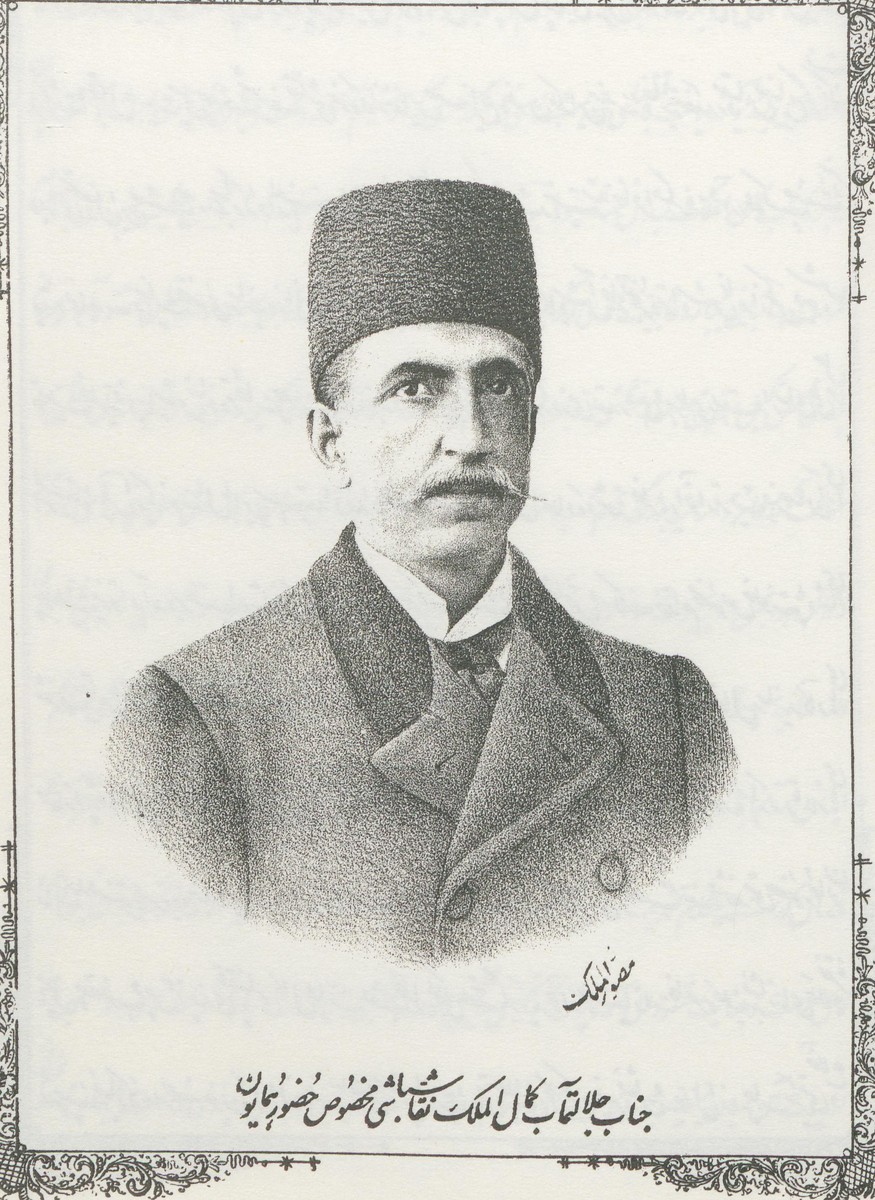

Portrait lithograph by Mehdi Mossavar al-Molk, Sharafat no. 60 (1902), digitised by the Universitats- und Landesbibliothek Bonn, Public Domain Mark 1.0, via Wikimedia Commons · Portrait lithograph of Kamal-ol-Molk, signed by Mehdi Mossavar al-Molk, printed as the full-page frontispiece of the Tehran periodical Sharafat (Sherafat) no. 60, Ramadan 1319 AH (about December 1901 to January 1902), with the printed caption naming 'Kamal-ol-Molk, naqqashbashi (chief painter) to His Majesty's presence'; Encyclopaedia Iranica independently records that Sharafat no. 60 (1902) carried his portrait drawn by Mossavar al-Molk. A depiction made in his lifetime by another artist, not a documented sitting or photograph, so recorded as a historical depiction. Rights basis: the holder of the digitised periodical, the Universitats- und Landesbibliothek Bonn (record 7070386, Translatio project), states in its METS metadata that the work is under Public Domain Mark 1.0; independent of that, the print was published in Tehran in 1902, i.e. before 1931, so it is in the public domain in the United States by age (as far as I could establish Iran was not a Berne or UCC partner, so no URAA restoration is expected), and nothing in the record claims a conflicting copyright. Caveats: the Commons file (File:Sharafat, Issue 60, p. 01.png, 4096 x 5120 pixels, originally a scan of a bound volume that may be a later reprint of the 1900s original) carries a PD-Iran tag and the library's PD mark; I could not open the library's live viewer (it served a browser-verification page), so the rights statement was read from the library's OAI-PMH METS record instead; the creator Mossavar al-Molk's death date was not established. The image used here is a crop of the framed portrait and its caption from that page (the surrounding book margins and the facing page removed), downscaled from a 2100 x 2880 crop to 875 x 1200 pixels, never upscaled. · Public domain (published 1902; Public Domain Mark 1.0 by the digitising library)
화가 · 19세기
카말올몰크
1848–1940
주요 업적 분야
아직 성격 매칭에 포함되지 않았습니다 — 기록된 근거가 성격 모델 전체를 다루기에는 충분하지 않습니다. 이 페이지의 다른 모든 내용은 자유롭게 확인하실 수 있습니다.
핵심 특성
주요 업적
카자르 왕조 궁정 화가로 1894년 '카말알몰크' 칭호를 받았으며, 유럽 아카데미 사실주의를 이끈 대표적인 이란 화가가 되었고, 1880~90년대의 〈거울의 방〉이 그의 가장 잘 알려진 작품이다.
1911년 테헤란에 미술학교(마드라세예 사나예 모스타즈라파)를 세워 약 10년간 이끌며 한 세대의 화가를 길러 냈고, 그 제자들이 그의 이름을 딴 화풍(캄알몰크 화파)을 이루었다.
1898~1901년 피렌체와 파리에서 거장들의 작품을 연구한 뒤 도시 풍경과 보통 사람들의 삶으로 소재를 옮겼고, 그의 사실주의는 한 세대 동안 이란 회화를 지배했으나 훗날 모더니스트 비평가들은 그것이 더 진정한 페르시아 현대미술의 발전을 가로막았다고 비판했다.
삶의 장면들
1898년 왕실 주문작에 대한 보상을 스스로 고르게 되자 그는 기량을 높이기 위해 유럽행을 청했고, 피렌체와 파리에서 약 3년간 렘브란트의 〈성 마태오와 천사〉, 티치아노의 〈그리스도의 매장〉 같은 작품을 모사했다.
이는 궁정의 보상보다 기량의 숙달을 우선시하는 태도와 부합한다. 숙련 지향
나세르 알딘 샤가 의뢰한 〈거울의 방〉은 거의 5년이 걸렸으며, 건축과 거울의 반사, 카펫과 가구에 이르기까지 정밀한 묘사로 주목받는다.
이는 지속적이고 정밀한 세부 묘사에 대한 집중과 부합하지만, 그 정밀함은 완성된 작품에서 읽어 낸 것이다. 디테일 지향
전환점
1911년 교육장관의 도움으로 미술학교를 위한 부지와 예산을 얻은 그는 학교 정문 옆 방에서 지내며 학생들과 점심을 함께 했고 가난한 학생들에게 자신의 봉급에서 장학금을 지급했다고 전해진다.
이는 제도를 세우고 후진을 키우려는 동기와 부합하지만, 개인적 일화는 지인들의 증언에 의존한다. 영향 창출 동기
비슷한 인물
전체적인 프로필이 이 사람과 닮은 사람들이에요.
출처
- Kamal-ol-molk (Q1659496), verified live via the Wikidata API (2026-11-01): label 'Kamal-ol-molk', description 'Iranian artist (1847-1940)', preferred birth value 1848-09-29 (other values 1847 and 1848 are present, one marked deprecated), death 1940-08-18, citizen of Iran, no Korean label. Orientation only; not used as support for any row.
- Encyclopaedia Iranica, 'Kamal-al-Molk, Mohammad Ghaffari', part i 'Life' (Encyclopaedia Iranica Foundation, vol. XV, fasc. 4, 2010; read in full, about 5,000 words). CANONICAL SIGNIFICANCE SOURCE: the entry's lead calls him a widely acclaimed Iranian painter of the European academic style during the late Qajar and early Pahlavi periods; it covers the Dar al-Fonun training, the court career from about 1880, the Hall of Mirrors painting, the 1898 journey to Europe, the departure from court and the 1911 founding of the Academy of Fine Arts, the 1920s conflicts with education ministers and his 1927 resignation, and it explicitly separates the documented record from a later romantic and political myth about him. Passages on his marriages, family, temper, love affair, eye injury and Constitutional-era politics were read and are not scored.
- Encyclopaedia Iranica, 'Kamal-al-Molk, Mohammad Ghaffari', part ii 'Style' (read in full, about 4,500 words). Scholarly account of his training in academic painting, the court years and his plein-air work, the study of the old masters in Florence and Paris, the Academy and its curriculum, his statement about his models (Raphael and Rembrandt), and a survey of critical opinion: admiring students (Ashtiani, Shaykh), who praise his accuracy and say he revolutionised Persian painting but note weakness in composition, and modernist critics (Aghdashlou, Vaziri-Moqaddam), who say he merely copied nature and discouraged an authentic Persian modern art. CRITICAL / COUNTER-VOICE source.
- Layla S. Diba, 'Muhammad Ghaffari: The Persian Painter of Modern Life', Iranian Studies 45(5), 2012, pp. 645-659 (Cambridge Core page; only the abstract was readable, the article itself is behind a paywall and was not opened). Scholarly abstract: leading court painter of the late Qajar period, recognised early as the leading exponent of academic painting, whose art by the constitutional period had moved to a style representing contemporary Persian life, with attention to his training, photography, the European journey and parallels with the Ottoman painter Osman Hamdi.
- Rute Ferreira, 'Painting of the Week: Kamal-ol-Molk and the Perfection of the Mirror Hall', DailyArt Magazine, 17 June 2018 (read in full, about 600 words; a popular art magazine). Describes the Hall of Mirrors painting (1885-1890, Golestan Palace) as his best-known work, which took five years, its detail and verisimilitude and play of light and shadow, and his later study of classical artists in Europe. Popular source: used for the Hall of Mirrors description only.
- 'Kamal-ol-Molk', Iran Chamber Society, Iranian Visual Arts (read in full, about 1,500 words; an Iranian cultural-society website with an admiring, national-pride tone and no named author). Used only for facts that Encyclopaedia Iranica also states: the Dar al-Fonun training, the European study and copying of old masters, the art school with its carpet-weaving and wood-work classes, and the allotment of part of his salary to poor students. Its account of the later years as an exile for love of freedom is the political myth that Encyclopaedia Iranica rejects, and it is not used.
- Sharafat (Sherafat), no. 60, Ramadan 1319 AH (about December 1901 to January 1902), p. 1: portrait lithograph of Kamal-ol-Molk signed by Mehdi Mossavar al-Molk, captioned 'Jenab-e Jalalatma'ab Kamal-ol-Molk, naqqashbashi-ye makhsus-e hozur-e homayun'. Digitised by the Universitats- und Landesbibliothek Bonn (Translatio project), record 7070386, marked Public Domain Mark 1.0 in the library's METS metadata. Used for the portrait only, not for any trait row.