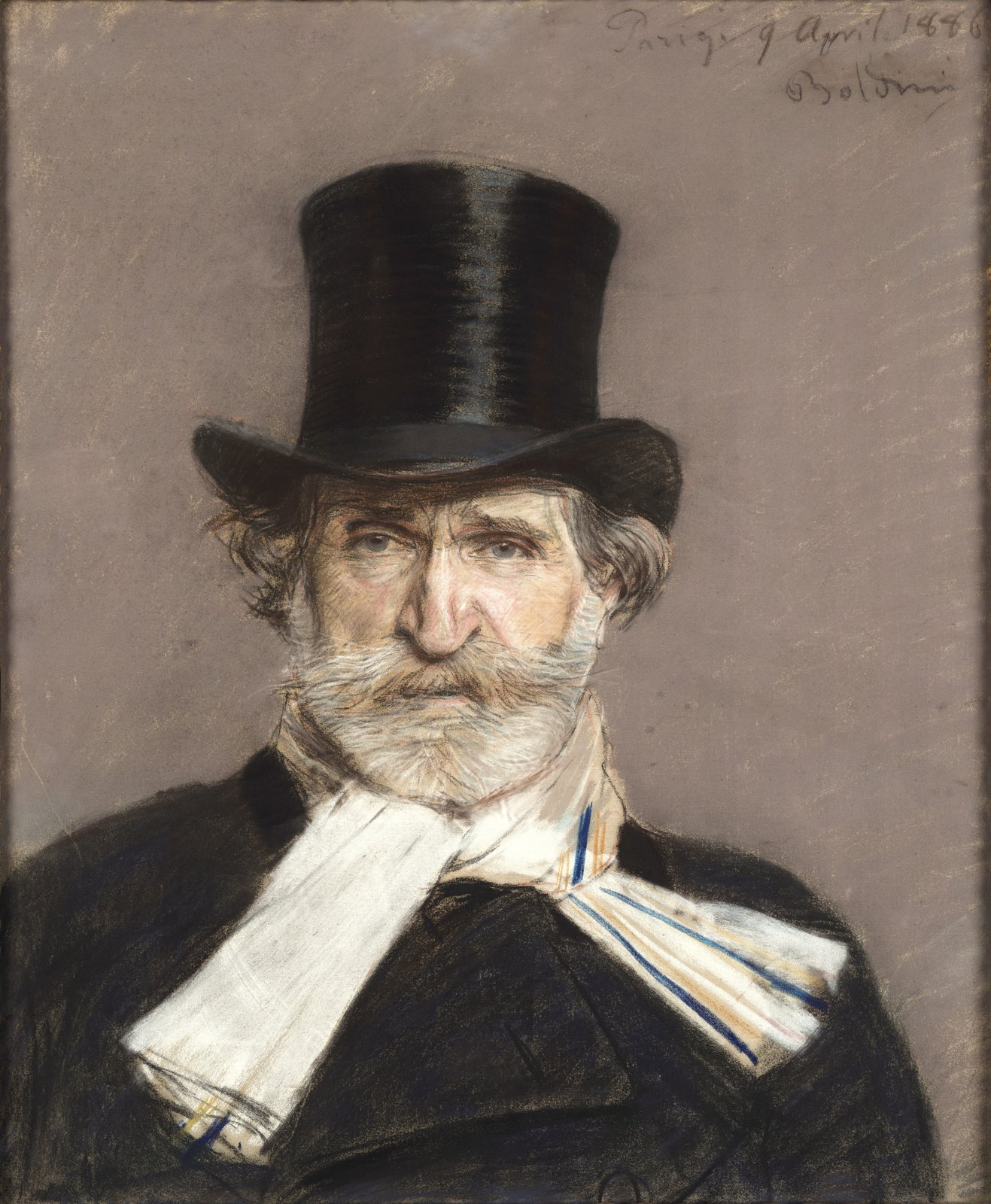

Giovanni Boldini, Portrait of Giuseppe Verdi, 1886, Galleria Nazionale d'Arte Moderna, Rome; faithful reproduction (Google Arts & Culture) of a public-domain work; downscaled · Giovanni Boldini, Portrait of Giuseppe Verdi (Ritratto di Giuseppe Verdi), pastel on paper, 65 x 54 cm, inscribed 'Parigi 9 April 1886', Galleria Nazionale d'Arte Moderna e Contemporanea, Rome (inv. 464; Wikidata Q20091566); reproduction from Google Arts & Culture via Wikimedia Commons · Public domain
핵심 특성
주요 업적
1851년 3월부터 1853년 3월까지 베르디는 지금까지도 세계 오페라 극장의 단골 레퍼토리로 남아 있는 세 편의 오페라, 《리골레토》(베네치아), 《일 트로바토레》(로마), 《라 트라비아타》(베네치아)를 잇달아 초연했다. 《아이다》는 1871년 12월 24일 카이로 오페라 극장에서 초연되었고, 1872년 2월 라 스칼라 극장에서 유럽 초연을 가졌다.
만년에 베르디는 아리고 보이토의 대본으로 셰익스피어 원작 오페라 두 편을 썼다. 《오텔로》는 약 7년간의 작업 끝에 1887년 2월 5일 라 스칼라 극장에서 초연되었고, 희극 《팔스타프》는 베르디가 일흔아홉 살이던 1893년 2월 9일 같은 극장에서 초연되었다.
1890년대에 베르디는 밀라노에 형편이 어려운 노년의 음악가들을 위한 거처인 '음악가 휴식의 집'(Casa di Riposo per Musicisti)을 자비로 짓고 공사를 직접 꼼꼼히 챙겼으며, 1899년 12월 이를 운영할 재단을 세웠다. 그의 뜻에 따라 이 집은 그가 세상을 떠난 뒤에야 문을 열어 1902년 10월 첫 입주자를 맞았고, 그는 자기 오페라의 저작권 수입을 이곳에 남겼다.
삶의 장면들
1847년 피렌체에서 열린 《맥베스》 초연을 앞두고, 소프라노 마리안나 바르비에리니니는 훗날 피아노 및 오케스트라 리허설이 백 번을 넘었고, 몽유병 장면 하나에만 석 달을 들였으며, 한 이중창은 150번 넘게 연습했다고 회상했다. 1899년 평론가 지노 모날디가 펴낸 책에 실린 그녀의 회고에 따르면, 베르디는 관객이 이미 객석을 채운 총연습 직전에도 두 가수를 불러 그 이중창을 한 번 더 연습시켰다.
이 일화는 이 프로필의 높은 완벽주의 점수와 부합하지만, 그 숫자들은 한 가수가 수십 년 뒤에 남긴 회고에서 나온 것이다. 같은 회고는 그 대가도 기록하는데, 출연진은 그녀가 '과도한 요구'라고 부른 것에 불만을 품었다. 완벽주의
1858년 초 나폴리의 검열 당국은 왕의 암살을 다룬 베르디의 새 오페라에 대한 공연 허가를 철회했다. 전기 작가 아르튀르 푸쟁이 인용한 당시 언론 보도에 따르면, 베르디는 공식 항의와 손해배상 청구에도 불구하고 자기 음악을 다른 대본에 맞추기를 거부했고, 결국 작품은 철회되었다. 이 오페라는 1859년 2월 무대를 식민지 시대의 보스턴으로 옮긴 《가면무도회》라는 제목으로 로마에서 상연되었다.
나폴리에서의 거부는 이 프로필에 기록된 갈등 감수 성향을 보여 주는 한 가지 사례다. 다만 로마판은 그가 달리 상연할 길이 없을 때에는 타협도 받아들였음을 함께 보여 준다. 갈등 감내
전환점
연구자 파브리치오 델라 세타에 따르면, 《에르나니》(1844) 이후 베르디의 계약에는 가수 선정에 대한 승인권이 그에게 있다는 조항이 들어갔다. 《나부코》 이후 그는 다른 사람이 미리 써 둔 대본에 곡을 붙인 적이 없었다. 소재를 직접 고르고 장면 구성을 스스로 짰으며, 대본 단계가 작곡보다 더 오래 걸리는 경우도 많았다.
이러한 작업 조건의 변화는 이 프로필에 기록된 높은 자율성 욕구와 맞아떨어진다. 델라 세타는 이를 당시 이탈리아 작곡가들의 지위가 전반적으로 달라지던 흐름 속에 놓고 보므로, 베르디 개인만이 아니라 그 시대 극장 산업의 사정도 반영한 일이다. 자율성 욕구
비슷한 인물
전체적인 프로필이 이 사람과 닮은 사람들이에요.
출처
- Giuseppe Verdi (English Wikipedia) -- orientation only; not used as support for any scored row. Korean Wikipedia title '주세페 베르디' confirmed via the Wikidata kowiki sitelink.
- Giuseppe Verdi (Q7317) -- verified live via wbgetentities (2026-10-02): en label 'Giuseppe Verdi', description 'Italian opera composer (1813–1901)', ko label '주세페 베르디', P569 values 1813-10-09 / 1813-10-10 (plus an apparently erroneous 1813-04-10), died 1901-01-27, citizenship Q165040 and Q172579 (Kingdom of Italy), P18 three images incl. the Boldini 1886 portrait, kowiki '주세페 베르디'. Orientation only.
- Fabrizio Della Seta, 'VERDI, Giuseppe Fortunino Francesco', Dizionario Biografico degli Italiani, vol. 98 (Rome: Istituto dell'Enciclopedia Italiana / Treccani, 2020; online text updated), read in full in Italian 2026-10-02 (c. 50,000 characters, extracted from the page's embedded data) -- MODERN SCHOLARLY perspective, independent of the period memoirs; Della Seta is a Verdi scholar (author of the MGG Verdi article). Used for: his warning that early-life material depends on later recollections and is 'circonfusa da un'aura di leggenda'; the 1832 Conservatory refusal and private study with Lavigna; from Ernani (1844) reserving by contract the right to approve the performers; the 'composer-dramatist' role -- after Nabucco never setting a pre-existing libretto, planning situations by acts, scenes and numbers, libretto drafting often taking longer than the music; the exceptional effort in the composition and staging of Macbeth (1847); his reading (Shakespeare, Schlegel, de Stael recommended to Piave in 1845, Manzoni) and contacts with painters and sculptors; Re Lear libretto drafts 1849-56 never realised; the Naples 1858 'lungo braccio di ferro' over Una vendetta in domino / Un ballo in maschera; the break with La Scala 1845-69 'perche insoddisfatto della qualita delle esecuzioni'; Aida staged by him in person in several cities 1872-80; the 1871 Florimo letter and its context; the 1879-86 Otello process 'with a slowness and care he had never given any other opera', interrupted for the Boccanegra (1881) and Don Carlo (1884/1886) revisions; Falstaff (1893) and its later retouches; the Villanova hospital (1888), the Casa di riposo per musicisti (built 1889-99, opened 1902) and his will. Political career (1861 deputy, 1874 senator) and Risorgimento reception were read but are not scored.
- Arthur Pougin, Verdi: An Anecdotic History of His Life and Works, trans. with notes by James E. Matthew (London: H. Grevel, 1887; French original 1886), archive.org OCR full text (Cornell copy cu31924022318830) -- CONTEMPORARY JOURNALIST/CRITIC perspective: Pougin was a Paris music critic who did not claim personal intimacy with Verdi; he compiles press reports (Gazette Musicale etc.), printed letters and the recollections of Verdi's librettists, and is admiring and explicitly anecdotal. Read: contents; ch. VIII pp. 132-157 (Rigoletto and the Venice censorship 1850-51 -- 'Le Roi s'amuse or nothing', the score written and orchestrated in forty days; Verdi's practice of choosing subjects and sketching the libretti; the 'La donna e mobile' secrecy anecdote; the Traviata failure of 6 March 1853 with his note to Muzio, the singers' disconcertion at the music's novel character, its revision and 1854 recovery; the Gazette Musicale's 1857 change of view on his 'effort of transformation'); ch. IX pp. 179-186 (Un ballo in maschera: the Naples 1858 standoff as reported by the Gazette Musicale of 4 April 1858 and a fuller press account, the Rome compromise and first night 17 Feb. 1859, his complaint about the female singers); ch. XI pp. 196-215 (Don Carlos rehearsals 1866-67 incl. the Gazette Musicale report that 'Verdi himself went through his part with each of the interpreters'; Aida -- Camille du Locle's letter of 28 March 1880 on the genesis of the libretto, written 'under the eye of the maestro, who took a large share in the work'); ch. XIV pp. 267-277 (Sant'Agata: a long quotation from the Aida librettist Antonio Ghislanzoni's Reminiscenze artistiche describing his 1868 visit -- routine, farm management, reading -- and Pougin's own account of the daily timetable and charities); ch. XV pp. 278-291 (letters printed in full: to Pedrotti 1 Jan. 1875 and to the Padua theatre commission 6 June 1884 declining to appear in public; to Florimo, Jan. 1871, declining the Naples Conservatory; on the diapason, 10 Feb. 1884; to Cencetti, July 1873, on stage direction; to Filippi, 1865; the Times note of Oct. 1886 that the Otello singers were to study their parts at Sant'Agata under his supervision). The ch. V account of the 1840 bereavements and the 'near-abandonment then Nabucco' story was read and deliberately NOT used.
- Blanche Roosevelt, Verdi: Milan and 'Othello' (London: Ward and Downey, 1887), archive.org OCR full text (verdimilanothell00roos) -- JOURNALIST EYEWITNESS perspective: Roosevelt (an American singer turned writer) met Verdi in Paris in 1875 and wrote these letters from Milan in Jan.-Feb. 1887 during the Otello rehearsals and premiere; admiring of the music but openly critical of the man in places ('Theatrical directors in Italy and elsewhere have complained a great deal about Verdi's hardness'), and partly gossip-based. Read: pp. 82-93 (her 1875 Paris call on Verdi -- his remark that Paris was too noisy for work while Sant'Agata's solitude helped him; her description, partly from hearsay, of Sant'Agata, his farming, daily routine, punctual fulfilment of contracts, support of the librettist Piave, the 1887 condition that La Scala also give Aida if it wanted Otello, and a planned charitable foundation); pp. 112-115 (Otello rehearsals closed to outside critics; his reported doubts, relayed second-hand from a Ricordi); pp. 177-179 (the costume designer Edel's workroom: 'Verdi's orders are peremptory'); pp. 229-230 (Boito's report of the dress rehearsal); pp. 247-249 (his wish to return to Sant'Agata after the premiere); p. 203 (his music 'required being sung as it was written'). Hearsay passages are marked as such where used.
- Gino Monaldi, Verdi 1839-1898 (Turin: Fratelli Bocca, 1899), archive.org OCR full text (verdi1839189800mona_0), read in Italian -- CONTEMPORARY CRITIC/IMPRESARIO perspective: Monaldi (1847-1932) was an Italian music critic and theatre manager who corresponded with Verdi and met him at Montecatini; admiring. Read: the index/chapter summaries; ch. VIII pp. 79-82 (the Florence Macbeth of 1847, including the long first-person recollection of the soprano Marianna Barbieri-Nini, the first Lady Macbeth: more than a hundred piano and orchestra rehearsals, three months on the sleepwalking scene, the duet rehearsed 'more than 150 times' and a 151st time just before the dress rehearsal, and the cast's resentment of his 'esagerate esigenze' -- an INSIDER PERFORMER account, retrospective by decades and not independently dated, so its numbers are treated as approximate); ch. XXVIII pp. 262-266 (Verdi's letters to Monaldi of 3 Dec. 1890 and 18 Jan. 1892 on Falstaff, and Monaldi's own conversation with him at Montecatini in July 1891, where he said he was working two hours a day on the orchestration).
- Verdi's OWN letters -- SELF perspective, one perspective, never sole support for a row. Main edition read: I copialettere di Giuseppe Verdi, ed. Gaetano Cesari and Alessandro Luzio (Milan, 1913), archive.org OCR (icopialettere00verd), read in Italian by line ranges: to Salvadore Cammarano, Paris, Nov. 1848 (pp. 60-63: requests for added scenes and verses in La battaglia di Legnano; his objections to Eugenia Tadolini as Lady Macbeth for Naples and detailed staging and orchestration instructions); to Colini, Nov. 1848 (p. 63); to the Turin competition committee, 5 Dec. 1880, and to Arrigo Boito, 11 Dec. 1880, on revising Simon Boccanegra (pp. 315-316); to Domenico Morelli, 24 Sept. 1881, on Otello costumes (p. 316); to Giulio Ricordi, 25 Dec. 1882 (footnote p. 328), and to the mayor of Villanova and to Frignani, 16 Feb. 1885 (pp. 328-329), on the Villanova hospital; to Boriani, president of the Villanova hospital, 22 April 1891 (pp. 367-368); to the mayor of Parma, 29 April 1891; to Hans von Bulow, 14 April 1892; to Giulio Ricordi on the Falstaff production terms, 1892 (pp. 377-378; date line illegible in the OCR, placed between April and Sept. 1892) and 18 Sept. 1892 (pp. 379-382); to the architect 'Camillo' [Boito; surname garbled in the OCR] on the Casa di riposo, 3 April 1893 (pp. 398-399); to Giulio Ricordi, 8 and 10 May 1896 (pp. 407-408). Also letters printed in Pougin 1887 ch. XV (Florimo 1871, Pedrotti 1875, Cencetti 1873, Padua 1884, diapason 1884) and in Monaldi 1899 (3 Dec. 1890, 18 Jan. 1892). The Werfel and Stefan English selection (1942) was not available as text and was not read.
- Casa di Riposo per Musicisti - Fondazione Giuseppe Verdi, Milan (casaverdi.it) -- INSTITUTIONAL perspective (the foundation Verdi created; interested in his memory, but documentary in content). Pages read in full 2026-10-02: 'Istituzione' (foundation deed of 16 Dec. 1899; the house opened, at his explicit request, only after his death; first nine guests on 10 Oct. 1902; his will assigning capital and royalties) and 'La costruzione e le origini' (his letter to Giulio Ricordi of Oct. 1889 on buying the land 'senza idea fissa'; that he was reluctant to give small subsidies and loans but wanted to programme help 'con precisione assoluta', being informed of his income 'fino all'ultimo centesimo'; the 1895 meeting with the architect Camillo Boito and the building contract of 16 April 1895; his insistence on 'riposo' and 'Ospiti' rather than 'ricovero'; costs exceeding the estimate).