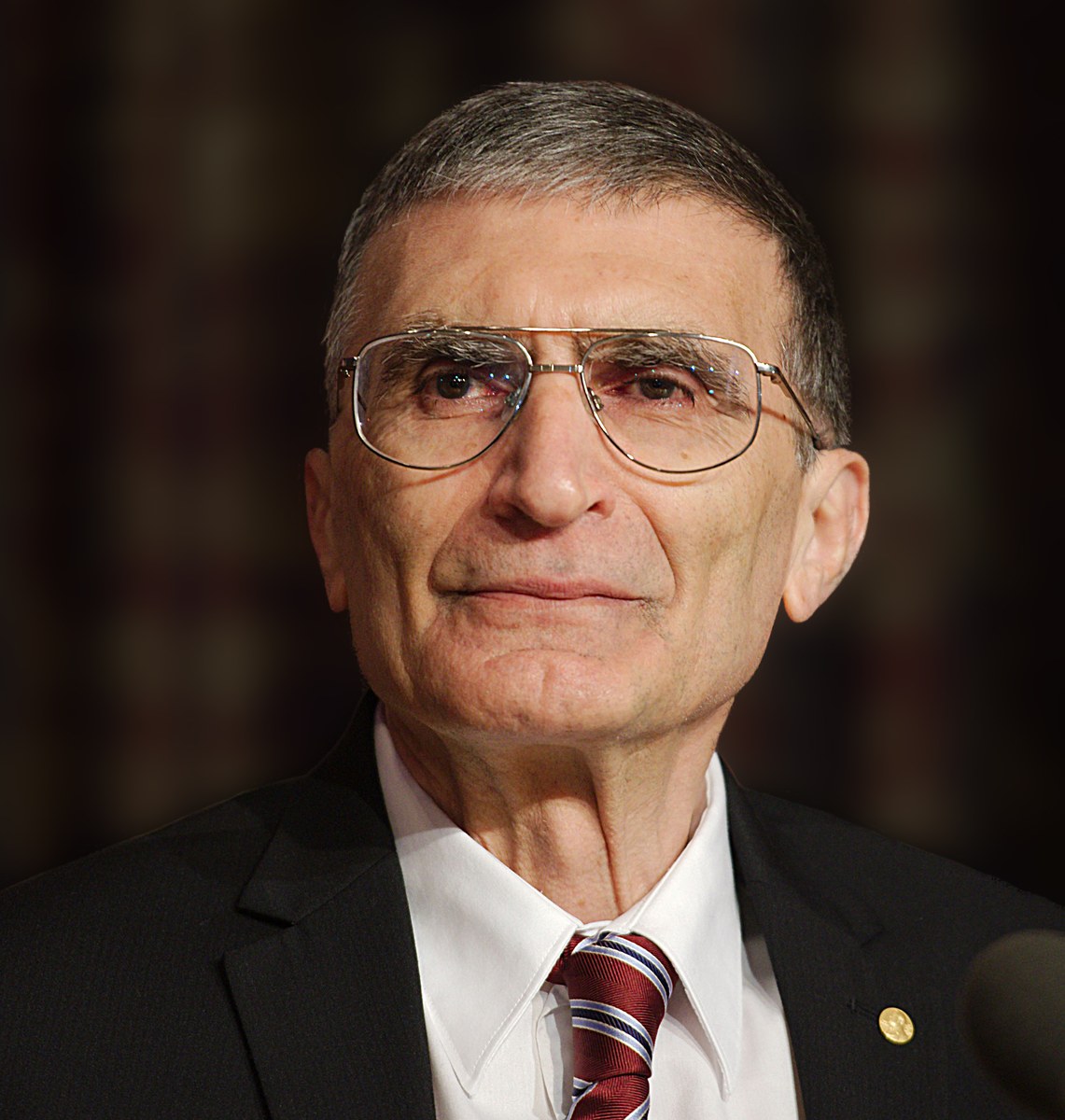

Photo: Holger Motzkau, 2015, Wikimedia Commons, CC BY-SA 3.0 · Photograph of Aziz Sancar at the Nobel Prize week press conference at the Royal Swedish Academy of Sciences, Stockholm, 7 December 2015, by Holger Motzkau (Wikimedia Sverige Nobel-week series); Commons file 'Aziz Sancar 0060.jpg', original 3132 x 3293, uploaded by the photographer as own work. Downscaled to 1141 x 1200 for the site; not upscaled. · CC BY-SA 3.0
과학자 · 현대
아지즈 산자르
b. 1946
주요 업적 분야
아직 성격 매칭에 포함되지 않았습니다 — 기록된 근거가 성격 모델 전체를 다루기에는 충분하지 않습니다. 이 페이지의 다른 모든 내용은 자유롭게 확인하실 수 있습니다.
핵심 특성
주요 업적
그는 정제한 UvrA, UvrB, UvrC 단백질이 자외선 손상 부위 양쪽을 이중으로 절단한다는 것을 1983년에 보여 뉴클레오타이드 절제 수선의 작동 방식을 밝혔고, 이후 사람의 반응도 시험관에서 재구성했다. 이 DNA 수선 메커니즘 연구로 2015년 토마스 린달, 폴 모드리치와 노벨 화학상을 공동 수상했다.
박사과정 때 가시광선으로 자외선 손상을 고치는 효소 광분해효소(포토라이아제)의 유전자를 클로닝했고, 이후 이 효소가 빛을 흡수하는 보조인자 두 개를 지니며 플라빈의 전자 전달 순환으로 작동함을 밝혔다.
그의 연구실은 광분해효소와 유사한 사람 유전자 두 개를 찾아냈고, 이것이 크립토크롬임을 확인했으며 공동연구자들과 함께 이 단백질이 포유류 생체시계의 핵심 구성 요소임을 보였다.
삶의 장면들
광분해효소 유전자를 클로닝하려면 먼저 이 유전자가 없는 돌연변이가 필요했는데, 선별 실험은 처음 여러 번 실패했고 그는 성공까지 약 11개월이 걸렸다고 밝힌다.
이는 어려운 실험을 성공할 때까지 반복한 연구자의 면모와 부합하지만, 이 이야기는 대체로 본인의 진술에 기댄다. 끈기
1993년 사람에게는 광분해효소가 없다고 발표한 뒤, 1995년 광분해효소와 유사한 사람 유전자가 나타났다. 복구 활성이 없다는 것을 확인한 그는 이 유전자들이 생체시계 단백질일 것이라고 보고 그 가설을 검증했다.
이는 새 유전자가 나타나자 자신의 이전 결론을 다시 해석한 과학자의 면모와 부합하며, 이 서술은 본인의 설명에 따른 것이다. 입장 수정 성향
전환점
1996년 그는 광분해효소와 유사한 사람 단백질 두 가지를 크립토크롬이라 부르자고 제안하고 이들이 생체시계에서 작용하는지 검증하기 시작해, 연구실의 중심을 DNA 수선에서 생체시계 연구로 넓혔다.
이는 인접 분야로 연구를 넓혀 처음부터 배워 나간 연구자의 면모와 부합한다. 분야 횡단성
비슷한 인물
전체적인 프로필이 이 사람과 닮은 사람들이에요.
출처
- Aziz Sancar (Q15118973) -- verified live via the Wikidata API (2026-10-30): English label 'Aziz Sancar', description 'Turkish geneticist; Nobel Prize in Chemistry 2015', Korean label '아지즈 산자르', born 1946-09-08, no death date, citizenship Turkey, United States and a third value, P18 'Aziz Sancar 0060.jpg'. Orientation only; not used as support for any row.
- NobelPrize.org, 'The Nobel Prize in Chemistry 2015 - Advanced information: Scientific Background, Mechanistic studies of DNA repair' (Royal Swedish Academy of Sciences, Nobel Committee for Chemistry; PDF, 15 pages), read in full for the Sancar sections. CANONICAL SIGNIFICANCE SOURCE: it credits Sancar with the Maxicell technique, the 1983 reconstitution of UvrA, UvrB and UvrC dual incision in nucleotide excision repair, the two chromophores and light-driven mechanism of photolyase, and states in its summary that Lindahl (base excision repair), Modrich (mismatch repair) and Sancar (nucleotide excision repair, plus the mechanism of photoreactivation) made the discoveries; it also notes that James Cleaver identified many human repair factors and that Richard Wood reconstituted human excision repair in parallel with Sancar. Prize committee text; independent of Sancar.
- NobelPrize.org, 'Aziz Sancar - Biographical' (autobiography written by Sancar for the Nobel Foundation), read in full: the Nobel Foundation's own record of his training in Istanbul and rural medical practice, the PhD with Claud Rupert at the University of Texas at Dallas, the postdoctoral work with Dean Rupp at Yale, the UvrABC dual-incision finding, photolyase, transcription-coupled repair, human excision repair, checkpoints and cryptochrome. SELF-REPORT: first-person and partly nationalistic in tone; its political and patriotic passages are not scored; every behavioural claim taken from it is marked as self-reported and cross-checked against the committee and the PNAS profile where possible.
- Nick Zagorski, 'Profile of Aziz Sancar' (Proceedings of the National Academy of Sciences, 8 November 2005), read in full: the NAS profile written when Sancar was elected, covering the repeatedly failing phr mutant experiment, the cloning of the photolyase gene, the cold reception from three DNA-repair labs, his hiring at Yale nominally as a technician, and how a test of whether cryptochrome was a photoreceptor ended up showing it was an essential clock component. Independent science-writer profile, but its behavioural anecdotes are told largely in Sancar's own words, so they are treated as lightly corroborated self-report.
- Encyclopaedia Britannica, 'Aziz Sancar' (Kara Rogers, fact-checked by Britannica editors, updated September 2026), read in full: Turkish-American biochemist known for mechanistic work on nucleotide excision repair; states the 2015 Nobel Prize in Chemistry was shared with Tomas Lindahl and Paul Modrich; lists the uvrABC excision nuclease, reconstitution of the human excision nuclease, the role of defective repair in xeroderma pigmentosum, DNA damage checkpoints, photolyase and the cryptochromes in the circadian clock. Reference biography; orientation and shared-credit confirmation.
- UNC School of Medicine, Biochemistry and Biophysics, 'Aziz Sancar receives 2015 Nobel Prize in Chemistry' (news release, October 2015), read in full: his work on nucleotide excision repair, the cisplatin finding, the 2015 whole-genome repair map by his team, the shared prize with Lindahl and Modrich, and tributes from the dean and the cancer-centre director. Employer news release; admiring and institutional.
- UNC School of Medicine / UNC Health Newsroom, 'The Enduring Legacy of Dr. Aziz Sancar' (October 2025), read in full: ten years after the prize he still teaches the graduate molecular biology course, reports training more than 35 students and 55 postdocs, a former postdoctoral trainee (Laura Lindsey-Boltz) describing his advice about when to abandon a project, his statement that photolyase work excited him more than the Nobel-winning work, and his credit to trainees Lindsey-Boltz and Selby. Employer news feature; admiring; the foundation and cultural-centre passages are not scored.
- David Kroll, 'This Year's Nobel Prize In Chemistry Sparks Questions About How Winners Are Selected' (Chemical & Engineering News, 11 November 2015). Only the opening paragraphs could be opened (the body is behind a login): they report that some in the research community regretted that pioneers of DNA repair were skipped over and complained that Nobel press materials implied the three laureates had 'discovered' DNA repair. The named critique of Philip Hanawalt's omission reached the agent only through a search-engine summary of the article and is not relied on in any row. Used only as the counter-voice on credit.
- Wikimedia Commons file page 'File:Aziz Sancar 0060.jpg' (photograph by Holger Motzkau, 7 December 2015, Nobel Prize week press conference), checked for the portrait only.