Warren Buffett
94% Profile Match
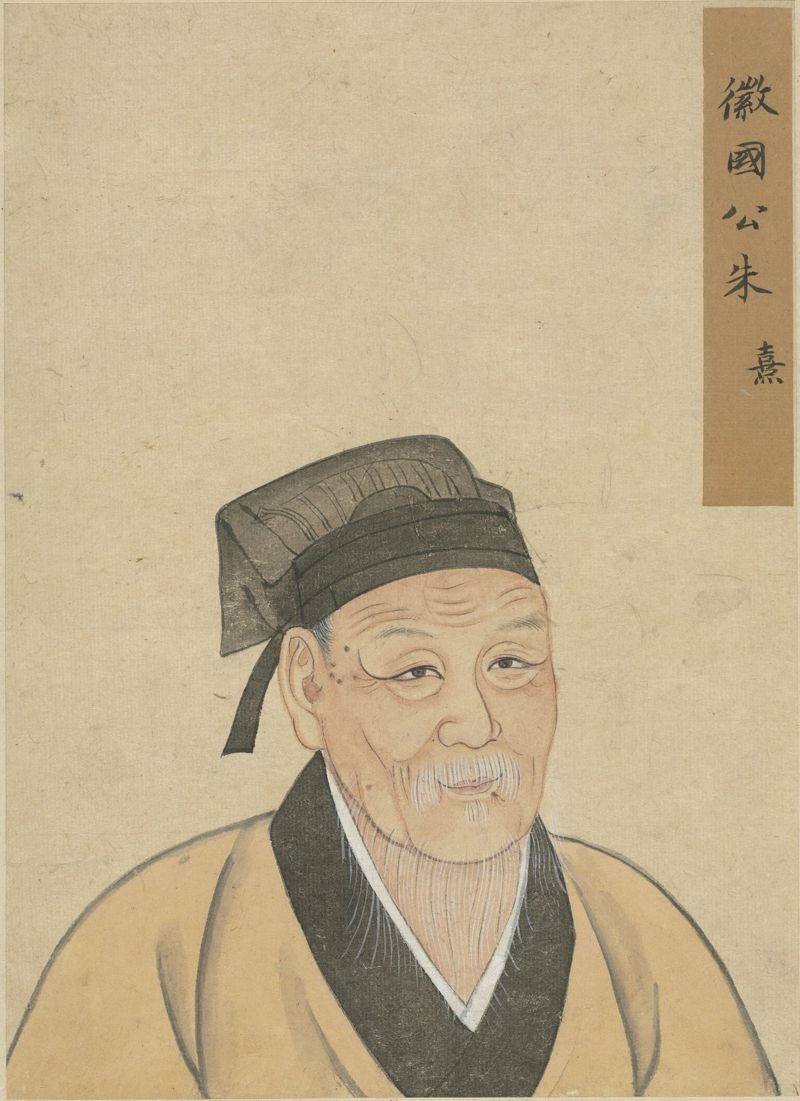
Anonymous (Yuan dynasty), Half Portraits of the Great Sage and Virtuous Men of Old, leaf for Zhu Xi. The National Palace Museum, Taipei, open data (CC0 low-resolution tier; cropped and downscaled) · Leaf for Zhu Xi from the album 'Half Portraits of the Great Sage and Virtuous Men of Old', anonymous, Yuan dynasty (probably after 1330), ink and colours on paper, main sheet 33.3 x 24.3 cm, National Palace Museum, Taipei (object number 中畫000329N000000059, work number 中畫00032900117). The leaf's inscription reads 徽國公朱熹 (Duke of Hui, Zhu Xi) and the museum's catalogue entry names the sitter; the title Duke of Hui was granted to him after his death, so the leaf is a conventional posthumous portrait made well after 1227 and more than a century after his death, not a likeness from life. The file is a crop of the leaf (the museum's colour card, number tag and mount edge removed) from the museum's own image service, downscaled from about 1530 x 2105 source pixels to 800 x 1101 (about 0.88 million pixels) with no upscaling. · CC0 (the museum's open-data declaration for images up to about 1 million pixels; the painting is also public domain by age)
philosopher · Medieval
1130–1200
Not yet included in personality matching — the documented evidence doesn't yet cover enough of the personality model. Everything else on this page is fully available.
Neo-Confucian philosopher of the Southern Song, ranked by the Stanford Encyclopedia as second only to Confucius in influence, who compiled and commented on the Great Learning, Analects, Mencius and Doctrine of the Mean as the Four Books, the basis of the Chinese imperial examinations from the Yuan dynasty until 1908.
A teacher of hundreds if not thousands of students, whose discourses survive in the Classified Dialogues, he rebuilt the White Deer Grotto Academy in 1179-80 and set down its rules, and he co-compiled the anthology Reflections on Things at Hand.
His method of 'investigating things' and his priority of pattern over material force shaped later Confucian debate, and drew criticism from Lu Jiuyuan and Chen Liang in his lifetime and later from Wang Yangming, Wang Fuzhi and Dai Zhen.
To test a monk's claim, he measured the growth of bean sprouts by day and by night and found no difference.
This is consistent with a scholar who sometimes tested a claim by observation and not only by textual authority. Analytical Rigour
While his teaching was banned as 'false learning' and some followers dispersed, he went on lecturing to his students every day, and smiled without answering those who urged him to send them away.
This is consistent with a teacher who kept to his work in the face of pressure to stop. Persistence
After years of interest in Chan Buddhism and Daoism, he became a student of Li Tong in 1160 at the age of thirty, was convinced of the Confucian Way, and devoted the next forty years to it.
This is consistent with a thinker who changed his intellectual direction after reflection and then committed to it for decades. Belief Updating
People whose overall profiles resemble theirs.