Leonardo da Vinci
92% Profile Match
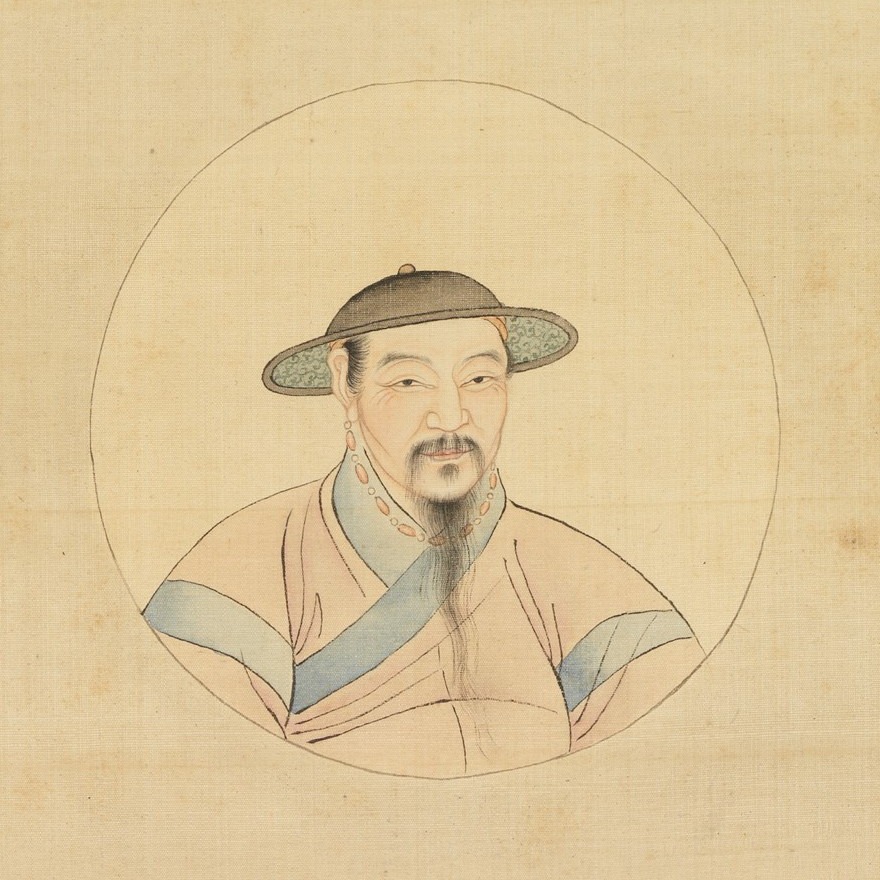
Unidentified artist, 19th century. Copy of a Portrait of Zhao Mengfu, 1986.267.3. The Metropolitan Museum of Art, Gift of Robert Hatfield Ellsworth, in memory of La Ferne Hatfield Ellsworth, 1986 (Open Access, cropped) · Roundel portrait from the hanging scroll 'Copy of a Portrait of Zhao Mengfu', ink and colour on silk, 63.8 x 30.8 cm, unidentified artist, 19th century, The Metropolitan Museum of Art, New York (accession 1986.267.3; Gift of Robert Hatfield Ellsworth, in memory of La Ferne Hatfield Ellsworth, 1986). The museum's title names the sitter. It is a later copy of an earlier portrait, made more than five centuries after Zhao Mengfu's death, not a likeness from life. The file is a crop of the portrait roundel from the museum's Open Access image (2111 x 4000 pixels), taken at original resolution with no scaling or upscaling; the inscription and seals are cropped away. · Public domain (Metropolitan Museum Open Access, CC0; nineteenth-century painting by an unknown artist)
painter · Medieval
1254–1322
Not yet included in personality matching — the documented evidence doesn't yet cover enough of the personality model. Everything else on this page is fully available.
Chinese painter and calligrapher honoured as an early master of the literati tradition of painting (wenrenhua), in which artists sought personal expression rather than the representation of nature, and regarded as the leading calligrapher of his time.
He turned painting back to the 'spirit of antiquity': Britannica says his paintings were among the first after the Song academy to take an interest from ancient masters, and his 1295 handscroll Autumn Colors on the Qiao and Hua Mountains, made for his friend Zhou Mi, reinterprets Dong Yuan-like motifs in a new way.
His calligraphy in seal, clerical, running and cursive scripts revived the style of Wang Xizhi, and the History of Yuan says an Indian monk travelled tens of thousands of li to obtain his writing; the generation after him, the Four Masters of Yuan painting, carried his literati revolution to fruition.
On journeys in North China he saw and collected landscape paintings by the tenth- and eleventh-century masters Li Cheng, Dong Yuan and Fan Kuan, which were little known in the south, and wrote that the most important thing in painting is the 'spirit of antiquity'.
This is consistent with an artist who looked to old masters directly and made them the basis of a new approach rather than following the prevailing style. Creative Originality
The History of Yuan lists his commentary on the Book of Documents, his treatises on the origins of the zither and of music, his poetry and prose, calligraphy in every script, and painting of landscapes, flowers, bamboo, figures and horses, and quotes the historian Yang Zai that his talent was so masked by calligraphy and painting that those who knew one side of him did not know the others.
This is consistent with a scholar-artist whose work spanned several arts that were seldom known together. Cross-Domain Range
After the Song dynasty fell in 1279 he lived at home, and the History of Yuan says he applied himself still more to study; on his later travels in the north he saw and collected old masters' paintings, and in 1295 he produced the handscroll Autumn Colors on the Qiao and Hua Mountains, which the Encyclopedia of World Biography calls his most famous surviving handscroll.
This is consistent with a period of deepened study that led, over the following years, to his characteristic mature painting. Mastery Orientation
People whose overall profiles resemble theirs.


Not a rival — a different profile shape worth a look.