Leonardo da Vinci
93% Profile Match
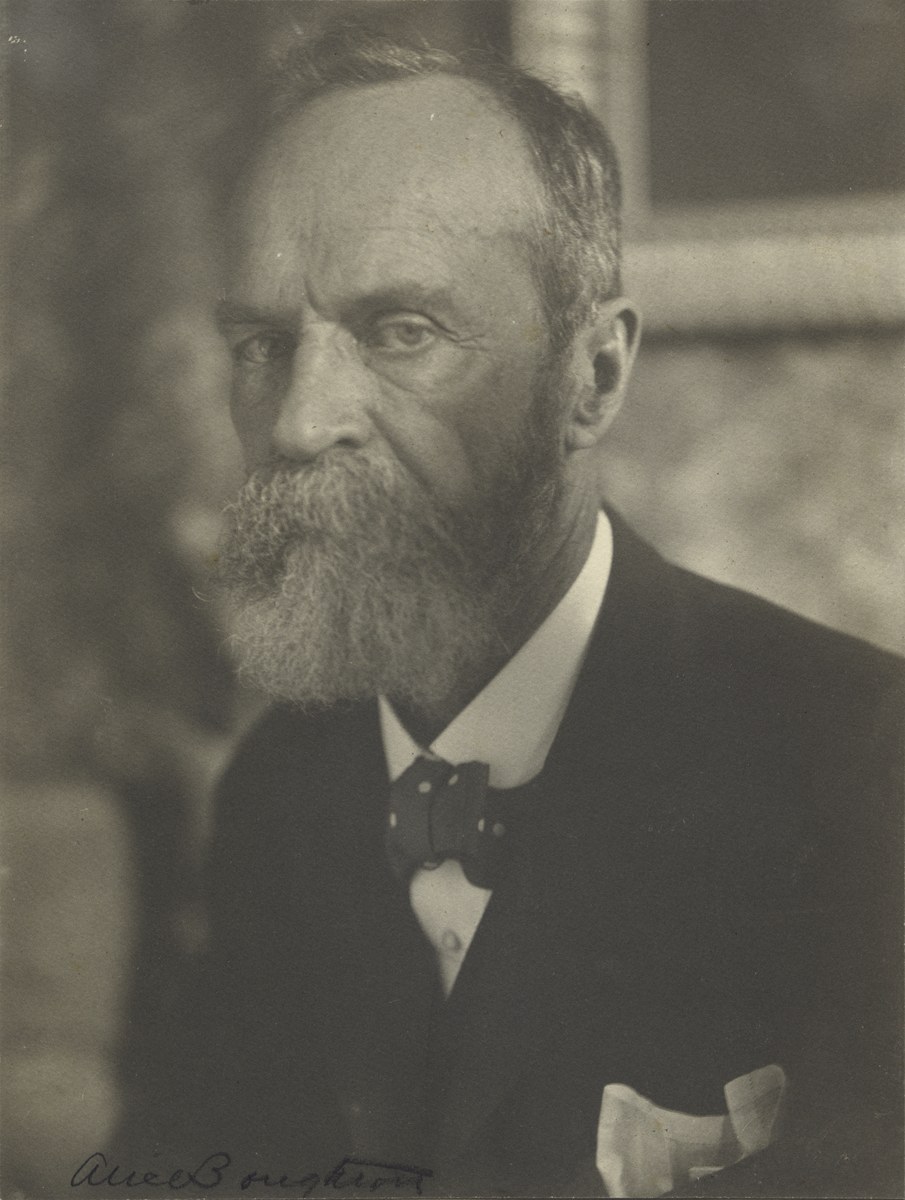
Alice M. Boughton, William James, c. 1907, platinum print, National Portrait Gallery, Smithsonian Institution (NPG.87.37), CC0 · Portrait photograph (platinum print) of William James by Alice M. Boughton, about 1907, National Portrait Gallery, Smithsonian Institution (object NPG.87.37). The Smithsonian Open Access record for the object states 'Restrictions & Rights: CC0', and its image media carry the usage access value CC0; the photographer (1866-1943) is long dead. The file is the Wikimedia Commons crop of the Smithsonian's own scan (the Commons page cites the NPG, the CC0 release and the creator's death year), downscaled only, from 4711 x 6245 to 905 x 1200 pixels; no upscaling. The NPG object web page itself blocks scripted requests, so the rights statement was read from the Smithsonian Open Access API record. · CC0 (Smithsonian Open Access); photographer died 1943
philosopher · 19th Century
1842–1910
Not yet included in personality matching — the documented evidence doesn't yet cover enough of the personality model. Everything else on this page is fully available.
He wrote The Principles of Psychology (1890), twelve years in the making and a founding text of the field, and from 1875-76 taught what Harvard's Houghton Library calls the first graduate course in psychology taught in America; in 1890 he raised funds to equip a Harvard psychology laboratory at Dane Hall.
He popularised pragmatism through public lectures in 1898 and his 1907 book Pragmatism, which judged ideas by their practical consequences; the Stanford Encyclopedia credits him, with Charles Peirce, with founding the pragmatist tradition.
He gave the 1901-02 Gifford Lectures in Edinburgh, published as The Varieties of Religious Experience (1902), and in 1884 helped found the American Society for Psychical Research.
Heading the American Society for Psychical Research's committee on mediums, he attended seances and, though many mediums seemed obviously fraudulent, kept studying Leonora Piper, whom he called his 'white crow' proving that not all crows are black.
Consistent with sustained curiosity about unfashionable questions, though Santayana records that conventional colleagues were wary of a professor who frequented mediums. Curiosity
He later wished he had titled his essay 'The Will to Believe' 'the right to believe', clarifying that he meant to justify certain beliefs in certain circumstances rather than claim that belief can be willed; Peirce had called the essay a very exaggerated utterance.
Consistent with a willingness to restate his position under criticism, though the change was mostly a clarification of an unchanged claim. Belief Updating
After starting at Harvard in 1872 teaching comparative anatomy and physiology, he asked President Eliot to let him move into the new field of 'mental science', and in 1875-76 offered the first graduate course in psychology taught in America before shifting toward philosophy from 1878.
Consistent with a willingness to cross from established fields into emerging ones as his interests shifted. Cross-Domain Range
People whose overall profiles resemble theirs.




Not a rival — a different profile shape worth a look.