Martha Graham
94% Profile Match
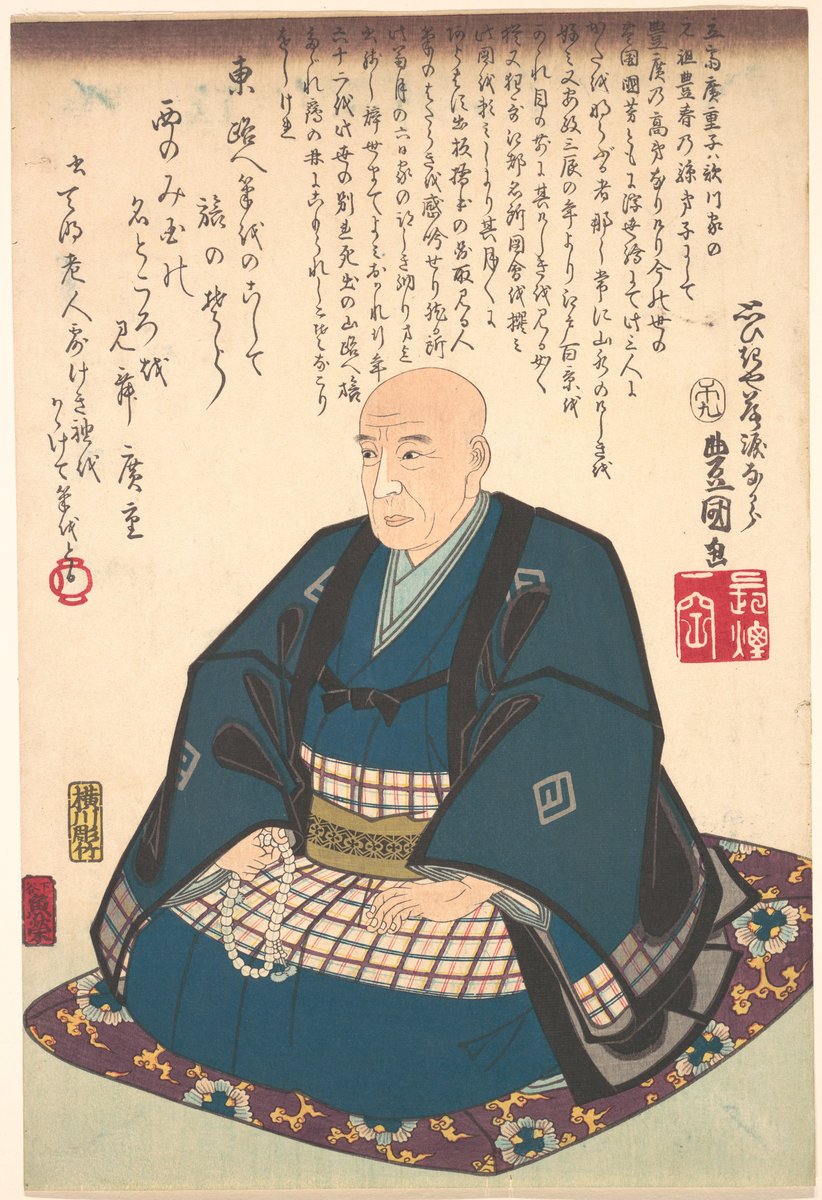
Utagawa Kunisada, memorial portrait of Hiroshige, 1858, The Metropolitan Museum of Art, JP2832, Open Access (CC0) · Memorial portrait of Hiroshige, polychrome woodblock print by Utagawa Kunisada, The Metropolitan Museum of Art, New York, accession JP2832 (Henry L. Phillips Collection, Bequest of Henry L. Phillips, 1939). The Met's Open Access API flags the object as public domain and the Commons copy carries a CC0 declaration. A posthumous memorial print made after his death in October 1858, so shown as a later depiction and not as a likeness taken in his lifetime (the Met record's date field gives only the artists' life dates; the 1858 date is Commons's). Original image 2631 x 3841 pixels from the Met, downscaled to 822 x 1200 with no cropping and no upscaling. · CC0 1.0 Universal (Met Open Access)
artist · 19th Century
1797–1858
Not yet included in personality matching — the documented evidence doesn't yet cover enough of the personality model. Everything else on this page is fully available.
His Fifty-three Stations of the Tokaido (1833-34), prints of the road between Edo and Kyoto, established his fame as a landscape printmaker and was an immediate commercial success.
He helped make landscape a major ukiyo-e subject, replacing the declining actor and beauty prints with poetic views of weather, seasons and everyday travellers, and followed the Tokaido with series such as the Kiso Road prints.
His last series, One Hundred Famous Views of Edo (1856-58), was left unfinished at his death and completed by his successor Hiroshige II; auction-house writers credit his prints with influencing European painters such as Van Gogh.
In the Edo series, begun in 1856 after the 1855 earthquake, he often chose minor local sites and used bird's-eye views and sharp near-far contrasts to make them worthy of the name 'famous places'.
This is consistent with an original approach to familiar subjects. Creative Originality
Scholars report that he continued working on the Edo series until the last moments of his life.
This is consistent with sustained, steady working habits. Discipline
In the early 1830s, after his teacher Toyohiro's death, he turned seriously to landscape prints; scholars say the exact motives are unclear but the older actor and beauty traditions had stagnated.
This is consistent with a willingness to move toward a market opening, though his motives are not documented. Opportunity Sensing
People whose overall profiles resemble theirs.


Not a rival — a different profile shape worth a look.