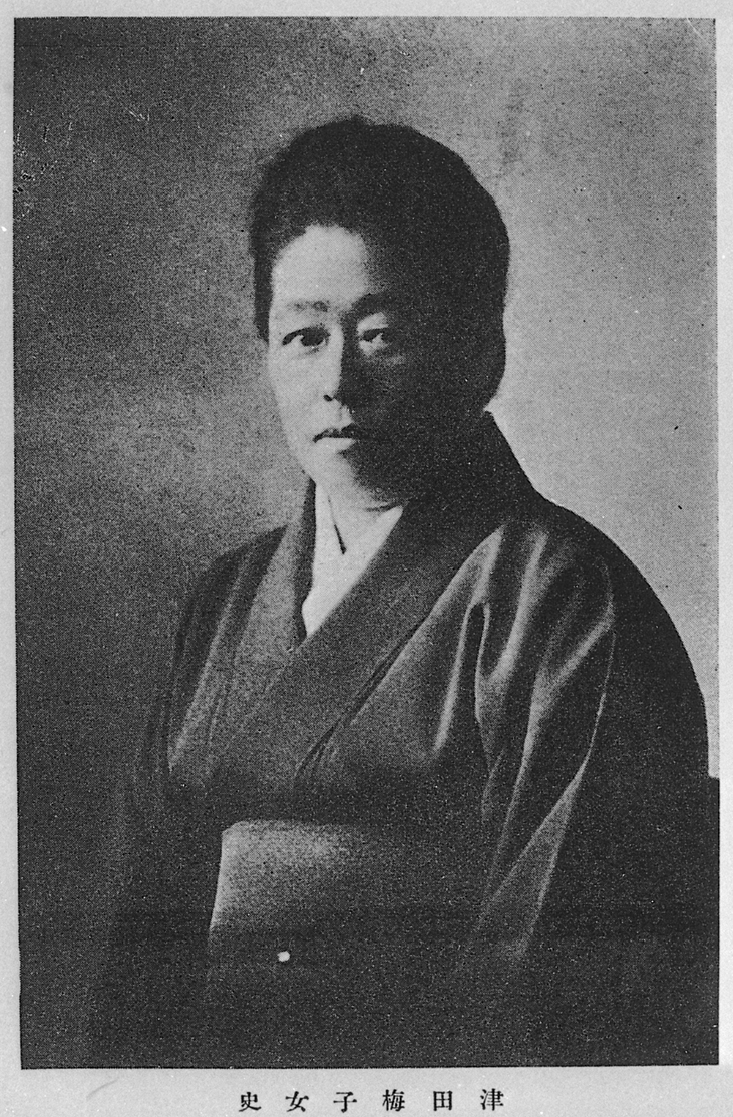
Tsuda Umeko, photograph reproduced in Yoshikawa Toshikazu, Tsuda Umeko (Fujo Shimbunsha, 1930); image from the National Diet Library, Japan, Portraits of Modern Japanese Historical Figures · Photograph of Tsuda Umeko captioned in print 'Tsuda Umeko joshi' (Ms Tsuda Umeko), the first portrait on the National Diet Library's Portraits of Modern Japanese Historical Figures page for her, taken from Yoshikawa Toshikazu, 'Tsuda Umeko' (Tokyo: Fujo Shimbunsha, 1930; NDL Digital Collections item 1191056). The photographer and the date of the sitting are not given in the book. The file is the NDL's unmodified image (733 x 1117 px), including the printed caption strip; no upscaling or cropping. · Public domain (published in Japan in 1930, before 1931; the NDL item record gives permission rule 'ooc', out of copyright, and the NDL Portraits site states that all its images are public domain and may be reused, including commercially, without application)
teacher · 19th Century
Tsuda Umeko
1864–1929
Known For
Not yet included in personality matching — the documented evidence doesn't yet cover enough of the personality model. Everything else on this page is fully available.
Trait Constellation
Key Achievements
In 1900 she resigned from her teaching posts and opened Joshi Eigaku Juku, the Women's Institute for English Studies, in Tokyo with ten students; the school, funded largely by American women, became Tsuda University and is described as one of the first institutions of higher education for women in Japan.
While studying at Bryn Mawr she started the American Scholarship for Japanese Women, backed by a Philadelphia committee; the programme ran until 1976 and supported 25 women students, several of whom became leaders in women's education.
Sent to the United States in 1871 at the age of six as one of the first Japanese women to study abroad, she later returned for higher study and majored in biology at Bryn Mawr, co-authoring with her adviser Thomas Hunt Morgan a paper published in 1894.
Moments That Reveal Them
In July 1900 she resigned from both the Peeresses' School and the Higher Normal School for Women, the highest-ranking and best-paid posts then open to a woman, and opened her own school in September with ten students.
This is consistent with giving up a secure position to start the school she had been planning for years. Proactive Agency
When Bryn Mawr suggested she stay on as a researcher, she declined and went home to teach, which some faculty and the college president resented.
This is consistent with putting a goal for other women ahead of an academic career, as her biographer tells it. Impact Motivation
Turning Points
In 1889 she took a paid two-year leave from the Peeresses' School and enrolled at Bryn Mawr on a scholarship, studying biology and meeting the Philadelphia supporters who later funded her school.
This is consistent with seeking further training of her own before building a school. Mastery Orientation
Similar People
People whose overall profiles resemble theirs.


Warren Buffett

Jane Goodall

Mahatma Gandhi

Elizabeth Cady Stanton

Marie Curie
Opposite Profile
Not a rival — a different profile shape worth a look.
Hildegard of Bingen
Sources
- Tsuda Umeko (Q514524), verified live via the Wikidata API (2026-11-06): English label 'Tsuda Umeko', Korean label, description 'Japanese educator (1864-1929)', born 31 December 1864, died 16 August 1929, citizenship Japan, image 'Tsuda Umeko Portrait c1900.png'. Orientation only; not used as support for any row.
- National Diet Library, Japan, 'TSUDA Umeko', Portraits of Modern Japanese Historical Figures (biographical note written by NDL staff, read in full). CANONICAL SIGNIFICANCE SOURCE: educator, one of the first Japanese women to study abroad (sent with the Iwakura Mission in 1871 at the age of 8 by Japanese reckoning), returned 1882, taught at the Kazoku Jogakko (Peeresses' School), studied biology at Bryn Mawr College from 1889 as a special student, returned in 1892 and taught again at the Peeresses' School and the Higher Normal School for Women, resigned in 1900 and founded the Joshi Eigaku Juku (later Tsuda College) to promote English learning and education that respected individuality, and 'was a pioneer of higher education for women'. Short reference note; it states outcomes rather than behaviour.
- Mari Kunieda (Tsuda University), 'Umeko Tsuda: a Pioneer in Higher Education for Women in Japan', Espacio, Tiempo y Educacion 7(2), 2020, pp. 29-45 (open-access PDF, read in full). A scholarly life history drawing on the standard biographies (Yoshikawa 1930, Furuki 1991 and Umeko's letters): her years with the Lanman family, the Peeresses' School, Bryn Mawr (biology, adviser T. H. Morgan, 1894 co-authored paper, Bryn Mawr's offer that she stay as a researcher which she declined, the American Scholarship for Japanese Women and its US$8,000 and committee), the 1898-99 England trip, her July 1900 resignation from both teaching posts, the opening of Joshi Eigaku Juku on 14 September 1900 with ten students and her opening address (three points), the Philadelphia Committee's funding, the 1903-05 recognition and the 1905 exemption of graduates from the English teaching certificate examination, and the post-1923 reconstruction led by Anna Hartshorne. Author is on the staff of the university Umeko founded, so the tone is admiring and some of it rests on Umeko's own letters; the quoted opening address is her own words reported by the author.
- Amy D. Yamashiro and Ethel Ogane, 'Tsuda Ume: Pioneering Education for Women and ELT', The Language Teacher 22(5), May 1998 (JALT; read in full). A teaching-profession article that quotes former students and scholars: student Yamakawa Kikue's memoir praising her independence and rejection of the 'good wife, wise mother' policy but also criticising her 'political naivete' and censorship of socialist and feminist texts, student Mishima Sumie on classroom argument, Furuki on her 6 August 1900 letter and the 1905 exemption, and a 'Feminist Criticism' section that reports Rose's (1992) criticism of her opposition to women's suffrage and reluctance to be a social agitator. COUNTER-VOICE for the sources above; the criticisms reach this entry only through the authors' summaries of Rose and Hane, which were not opened.
- Tachibanaki Toshiaki (economist and writer), 'Tsuda Umeko: A Life Dedicated to Women's Higher Education', Nippon.com, 4 October 2022 (Shapers of Japanese History series; read in full). An independent popular account: her struggle to find work commensurate with her ability after 1882, going to Bryn Mawr on diverted salary and a partial scholarship, majoring in education and English while studying biology and co-writing papers with T. H. Morgan, her wish for a private women's university, the three hurdles she faced (funding, finding students, finding teachers), her use of American connections to hire Alice Bacon and Anna Hartshorne, the 1900 opening in a refurbished house in Kojimachi, the 1903 recognition as a professional school, and the school's reputation. Contrasts her with Naruse Jinzo's better-funded Japan Women's University. The author is an economist, not a historian, and interprets some private choices speculatively (those are not used).
- Masako Iino (President Emerita of Tsuda University), 'From Japan to Bryn Mawr and Back', Bryn Mawr College Bulletin, Winter 2019 (excerpts of a campus talk, read in full). The college's own alumnae magazine: Umeko of the Class of 1890 returned to Japan 'like a foreigner', went back to the United States for higher training unavailable to Japanese women, and during her Bryn Mawr stay called for an American Scholarship for Japanese Women supported by the Japanese Scholarship Committee of her Philadelphia friends, a programme that supported 25 women students before it ended in 1976 (one of them Michi Kawai, who later taught at Umeko's school). Retrospective alumnae-magazine material by a successor president; the listing is an excerpt of a talk.
- Tsuda University, 'Profile' (official university page, read in full). States that the university was founded as one of the first institutions of higher education for women in Japan in 1900 by Umeko Tsuda, a pioneering woman educator. Institutional self-description; used only for the founding statement.
- Tsuda College Library, Digital Archive, 'Anna C. Hartshorne' special feature (read in full). The college archive's account of the Quaker teacher Anna Hartshorne, who met Umeko at Bryn Mawr, heard her decision to found the school in February 1897, taught without salary from 1902 to 1940 and raised funds in the United States after the 1923 earthquake. Institutional history page; its praise is of Hartshorne and it is used only for the collaboration with Hartshorne.
- National Diet Library Digital Collections item record for Yoshikawa Toshikazu, 'Tsuda Umeko' (Tokyo: Fujo Shimbunsha, 1930), the source book of the portrait photograph used here. Portrait source only: the item API gives publication year 1930, rights permission rule 'ooc' (out of copyright) and no rights code; no row depends on the book's text.