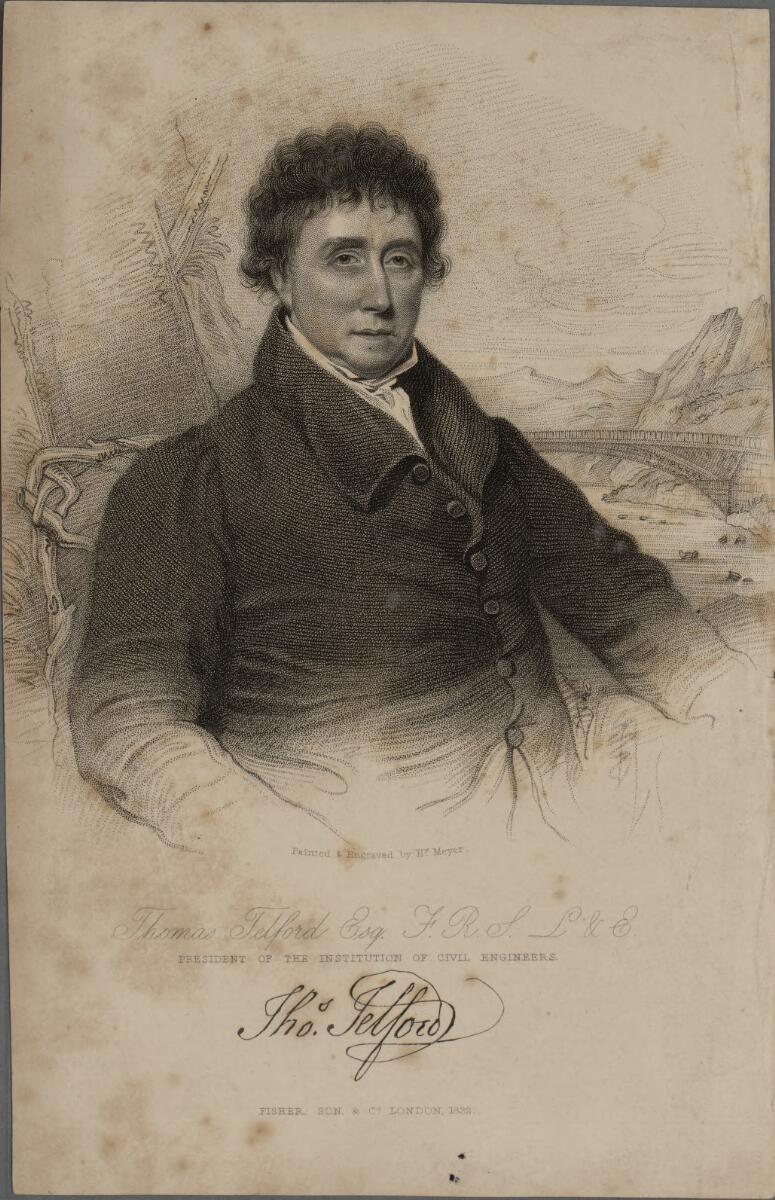

Henry Hoppner Meyer, portrait print (1832), National Library of Wales, Public Domain Mark 1.0 · Engraved portrait of Thomas Telford, 'Painted & Engraved by Hy. Meyer', published by Fisher, Son and Co., London, 1832 (lifetime print, titled 'Thomas Telford Esq. F.R.S. L & E, President of the Institution of Civil Engineers'), held and digitised by the National Library of Wales (item 4672045; 1 print, line and stipple engraving, 201 x 131 mm). Rights basis: (1) the library's own IIIF manifest for the item, which I read live, marks it with the Public Domain Mark 1.0 licence and credits the National Library of Wales; (2) independent of that, the print was published in London in 1832 and the artist Henry Hoppner Meyer (1782-1847, the library's catalogue dates) died long ago, so it is in the public domain in the United Kingdom, the United States and elsewhere by age; the NLW catalogue record page itself was behind a bot-check and could not be opened, so the item-level terms were read from the manifest and I found no conflicting copyright notice. Lead check: the lead's preflight named this same print as its initial lead. Caveats: the print is a later reproduction of Meyer's painting rather than a documented sitting, so it is recorded as a historical depiction; the file is a crop of the print area (colour-checker strip and scanner border removed) downloaded from the library's image server at 775 x 1200 pixels from a 2144 x 3564 pixel original, downscaled only, never upscaled; the print retains the plate caption and facsimile signature. · Public domain (published 1832; Public Domain Mark 1.0 on the National Library of Wales item)
engineer · 19th Century
Thomas Telford
1757–1834
Known For
Not yet included in personality matching — the documented evidence doesn't yet cover enough of the personality model. Everything else on this page is fully available.
Trait Constellation
Key Achievements
A stonemason's son who became one of Britain's most eminent civil engineers, Telford planned or advised on hundreds of roads, canals, bridges and harbours and is called the 'Father of Civil Engineering' by the Institution of Civil Engineers.
His Pontcysyllte aqueduct (World Heritage site, 2009), the Caledonian Canal (1804-22) and the Menai suspension bridge (1819-26, a span of nearly 580 feet) are his best-known works; the canal took twelve years and cost 910,000 pounds against a plan of seven years and 474,000.
As first president of the Institution of Civil Engineers from 1820 he was the driving force behind its 1828 Royal Charter and left it his largest donation, his books, drawings and papers.
Moments That Reveal Them
Before the Menai Bridge's chains went up he had every part carefully tested by repeated experiment, because the structure was the largest of its kind ever attempted and its failure had been predicted.
This is consistent with a habit of testing a new design before committing to it, though the account comes from an admiring Victorian biography. Experimentation
For his twenty-one years as principal engineer of the Caledonian Canal, parliamentary returns show a fixed fee of 237 pounds a year, and he served the British Fisheries Society's harbour works without payment.
This is consistent with weighing public works above personal earnings, though the pay figures and the unpaid work are known mainly through one admiring biography. Impact Motivation
Turning Points
Appointed engineer of the Ellesmere Canal in 1793 with no canal-making experience, he took William Jessop's advice on earthwork and then designed the cast-iron-trough aqueducts at Chirk and Pontcysyllte that brought him national fame.
This is consistent with learning a new branch of engineering quickly by asking for help, though Smiles' own footnote notes a dispute over who proposed the iron trough. Mastery Orientation
Similar People
People whose overall profiles resemble theirs.

Marie Curie

Yi Sun-sin

Ruth Bader Ginsburg

Warren Buffett

Confucius
Sources
- Thomas Telford (Q380875), verified live via the Wikidata API (2026-11-02): label 'Thomas Telford', description 'Scottish civil engineer, architect and stonemason (1757-1834)', born 1757-08-09, died 1834-09-02, citizen of the United Kingdom of Great Britain and Ireland, Korean label 토머스 텔퍼드. Orientation only; not used as support for any row.
- 'Thomas Telford: The Father of Civil Engineering', Institution of Civil Engineers (ICE), Meet the Engineers (read in full, about 1,100 words). CANONICAL SIGNIFICANCE SOURCE: the professional body he led as first president states his significance (canals, roads, bridges and harbours; the Caledonian Canal, the Ellesmere Canal, the London to Holyhead road, the Menai suspension bridge, consultancy for Sweden, Russia and North America), that he was approached by Henry Palmer to give the young institution leadership and prestige, that he was the driving force behind its 1828 Royal Charter, and that he left it his largest donation (over 3,000 pounds), books, drawings and papers. An institution's commemorative profile of its own first president, so admiring in tone.
- 'Thomas Telford', Encyclopaedia Britannica (read in full, about 500 words). Reference biography: mason who educated himself to become an architect, surveyor of public works for Shropshire from 1786, engineer to the Ellesmere Canal from 1793 (the Chirk and Pontcysyllte aqueducts brought him national fame), the Caledonian Canal, Highland harbours and more than 900 miles of roads from 1803, the Conwy and Menai suspension bridges as his crowning achievement, first president of the Institution of Civil Engineers, and the 2009 World Heritage designation of Pontcysyllte.
- W. Ll. Davies, 'Telford, Thomas (1757-1834), civil engineer', Dictionary of Welsh Biography (National Library of Wales, 1959; read in full, about 800 words). Concise scholarly entry focused on his Welsh and Border work: the Ellesmere Canal aqueducts at Chirk (1796-1801) and Pontcysyllte (1795-1805), the Holyhead road, and the Menai suspension bridge (Parliament's select committee recommended his design after other engineers including John Rennie had commented; work 1819 to about 1825) and the Conwy bridge.
- 'Thomas Telford', Westminster Abbey, Famous people (read in full, about 450 words). The Abbey's commemorative entry: buried in the nave in 1834, with a gravestone naming him president of the Institution of Civil Engineers and a statue (E. H. Baily, 1839) whose inscription calls him an orphan shepherd's son, self-educated, who rose by talents and integrity from an operative mason to one of the most eminent civil engineers of the age; he died unmarried.
- Samuel Smiles, 'The Life of Thomas Telford, Civil Engineer' (London, 1867; Project Gutenberg text read in the chapters on the Ellesmere Canal, the Menai bridge and Telford's later years and character, plus targeted searches; the book is long and was not read cover to cover). A Victorian, admiring biography built on Telford's own letters, his autobiographical notes and parliamentary returns, so it reaches us partly as self-report; it also records a dispute with the Jessop memoirist over who proposed the iron trough.
- 'Caledonian Canal history and heritage', Scottish Canals (read in full, about 350 words). The canal's present-day owner states that the work was expected to take seven years at 474,000 pounds but took twelve years at 910,000 pounds (opened 1822), and that defects in construction material caused a partial collapse of the Corpach locks and the Cullochy bank in the 1840s, repaired by James Walker. COUNTER-VOICE source on cost, time and durability.
- 'Pontcysyllte Aqueduct and Canal', UNESCO World Heritage Centre, list entry 1303 (read in the synthesis, criteria and integrity sections). Describes the aqueduct as a pioneering masterpiece of engineering by Telford built with metal arches on tall slender masonry piers, his first great masterpiece that formed the basis of his international reputation, and notes that the historic rubble embankments later gave stability and waterproofing problems.
- 'Thomas Telford Esq. F.R.S. L & E, President of the Institution of Civil Engineers', portrait print painted and engraved by Henry Hoppner Meyer, published by Fisher, Son and Co., London, 1832, National Library of Wales item 4672045 (IIIF manifest, licence marked Public Domain Mark 1.0). Used for the portrait only, not for any trait row.