Sigmund Freud
92% Profile Match
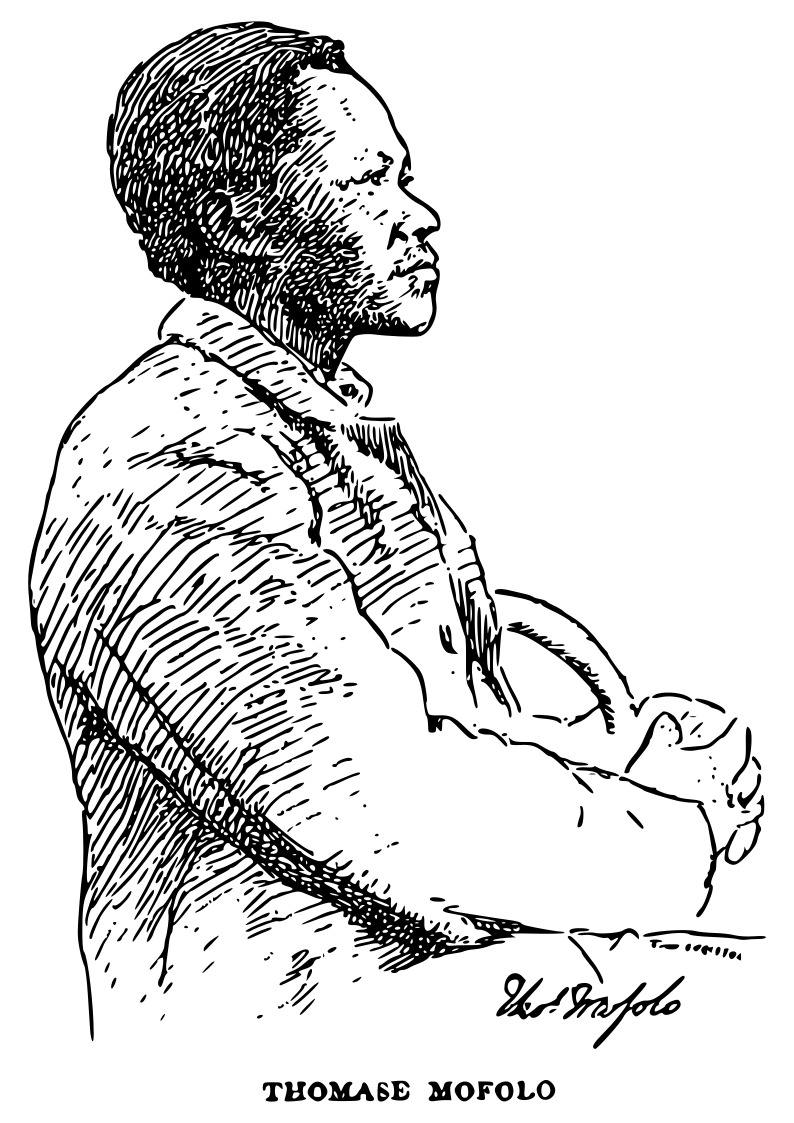
Frederic Christol (1850-1933), 1911, in L'art dans l'Afrique australe, Berger-Levrault, Paris. Scan: Smithsonian Libraries (https://doi.org/10.5479/sil.244705.39088000226712) · Line-drawn portrait sketch of Thomas Mofolo, captioned 'Thomase Mofolo' and showing his signature, by Frederic Christol, published on page 42 of L'art dans l'Afrique australe: impressions et souvenirs de mission (Berger-Levrault, Paris, 1911), as scanned by the Smithsonian Libraries (DOI 10.5479/sil.244705.39088000226712) and shared on Wikimedia Commons. The book's text names the sitter as the teacher and author of Moeti oa bochabela. The file is the scan's 794 x 1123 pixel image converted from PNG to JPEG with no resizing, cropping or upscaling. It is a contemporary drawing, not documented as made from life. · Public domain (published 1911; the Smithsonian Libraries record states CC0 1.0 and 'No Copyright - United States')
writer · 20th Century
1876–1948
Not yet included in personality matching — the documented evidence doesn't yet cover enough of the personality model. Everything else on this page is fully available.
Sesotho writer of Lesotho whose novels Moeti oa Bochabela (1907), Pitseng (1910) and Chaka (1925) Britannica credits as the first Western-style novels in Southern Sotho.
Chaka, a historical novel on the Zulu king Shaka written after careful study of traditional accounts, is the classic on which his reputation rests; it appeared in 1925 after missionaries at the depot where he worked delayed it, and was translated into English in 1931.
The success of his first novel is credited with prompting other young teachers to try fiction, launching one of the earliest literary movements in sub-Saharan Africa.
Chaka, written while he worked at the Morija book depot, was held back for years by the missionaries there, who were disturbed that it did not condemn pagan customs, and appeared in 1925.
This is consistent with a writer whose book did not follow the moral framing his mission employers expected. Independent Thinking
A missionary colleague later wrote that Mofolo wrote Chaka after careful study of the traditional accounts of the Zulu king, but that it is no mere chronicle.
This is consistent with a craft-minded writer who prepared his historical material before shaping it into fiction. Mastery Orientation
After Chaka, his third and last book, he stopped writing; from 1910 he taught and learned carpentry, then turned to mining and labour recruiting, a mill (by 1916) and a trading store (1928), ventures that ended in financial loss and ill health.
This is consistent with a writer whose later career moved into self-started business ventures with mixed results. Proactive Agency
People whose overall profiles resemble theirs.