Rosalind Franklin
95% Profile Match
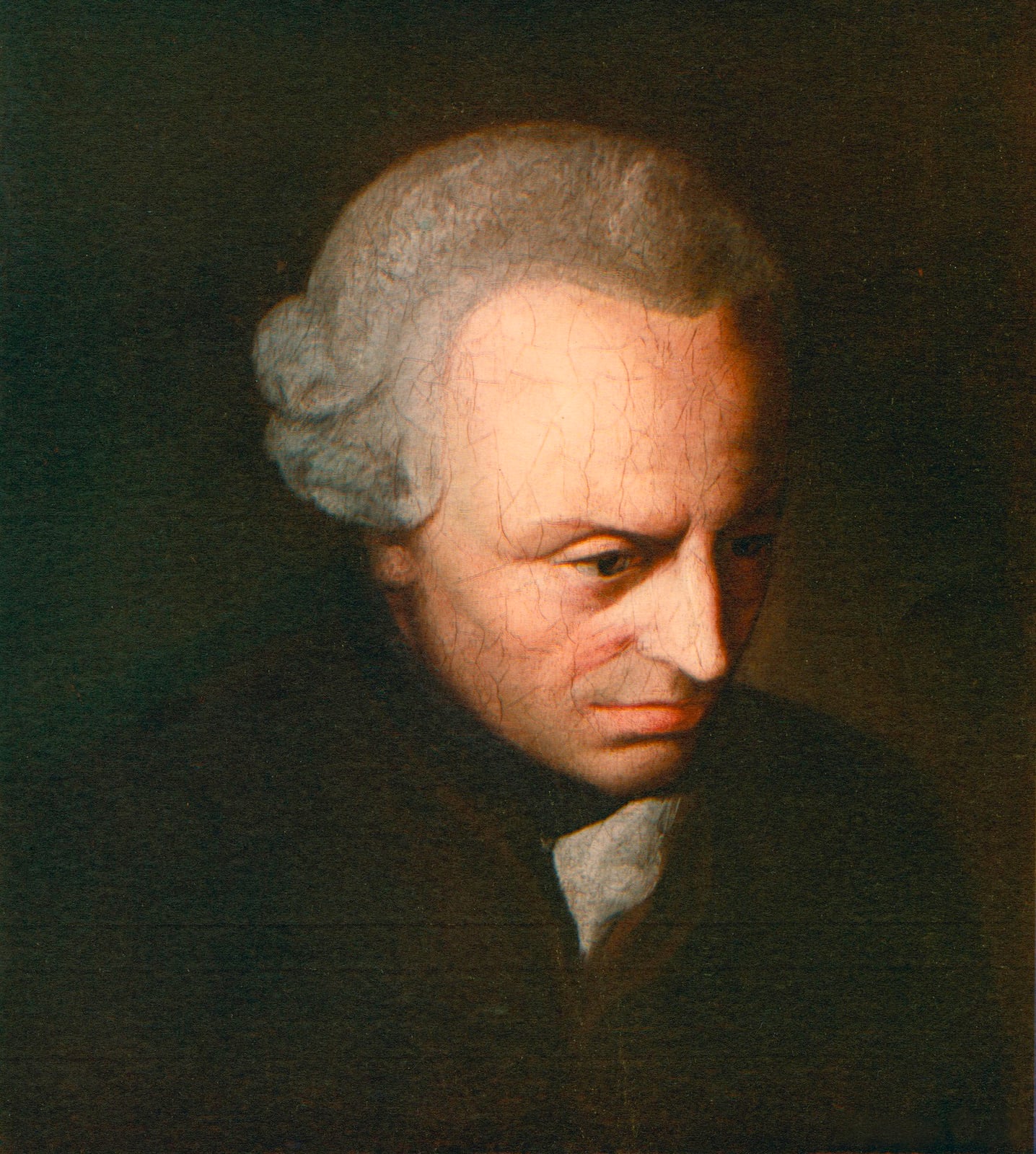
Unknown painter, possibly Elisabeth von Stägemann (Anton Graff school), circa 1790, Public Domain · Wikimedia Commons (hosted locally by this app as a resized/compressed derivative; see licenseUrl for the full-resolution original) · Public Domain
1724 — Born in Königsberg.
1770 — Appointed full professor of Logic and Metaphysics at the University of Königsberg.
1781 — Published the Critique of Pure Reason at 57, after a long period of quiet private development.
Following years — Completed his critical system with the Critique of Practical Reason and the Critique of Judgment, framing the categorical imperative as a universal standard of duty.
Later years — Drew formal censure from Prussian royal censors for his writing on religion; ordered not to write further on the subject.
1804 — Died in Königsberg.
Across the Critique of Pure Reason (1781), the Critique of Practical Reason, and the Critique of Judgment, Kant built a unified philosophical system spanning epistemology, ethics, and aesthetics under one coherent framework — work the Stanford Encyclopedia of Philosophy regards as among the most rigorous in the Western philosophical canon.
His moral philosophy, centered on the categorical imperative, was explicitly framed in the Groundwork of the Metaphysics of Morals as a standard of universal ethical duty applicable to all rational beings, not a code specific to any one place, tradition, or circumstance.
Kant maintained such a precise, unvarying daily routine — including his afternoon walk — that residents of Königsberg reportedly set their clocks by it, a pattern corroborated across multiple contemporary and biographical accounts (Kuehn), not a single repeated anecdote.
After early academic promise, Kant published comparatively little through his forties and early fifties while privately developing his mature philosophical system, releasing the Critique of Pure Reason only at 57 — a deliberate, extended period of private revision, according to Kuehn's biography, rather than a lack of activity.
The length of this private revision period, not merely its existence, is what grounds the profile's dual-edged perfectionism score — the same standard that produced a famously rigorous system also delayed it for over a decade. Perfectionism
Kant's later work on religion, Religion within the Bounds of Bare Reason, drew formal censure from Prussian royal censors, who directed him not to write further on religious subjects — a real institutional consequence of a published position, in a career that Kuehn's biography otherwise describes as marked by institutional caution and an unusually careful, routine-bound public life.
This stands out precisely because it departs from the otherwise cautious pattern the rest of the profile describes — a considered risk taken within a careful life, not evidence of a broader pattern of confrontation. Risk Tolerance
People whose overall profiles resemble theirs.



Not a rival — a different profile shape worth a look.