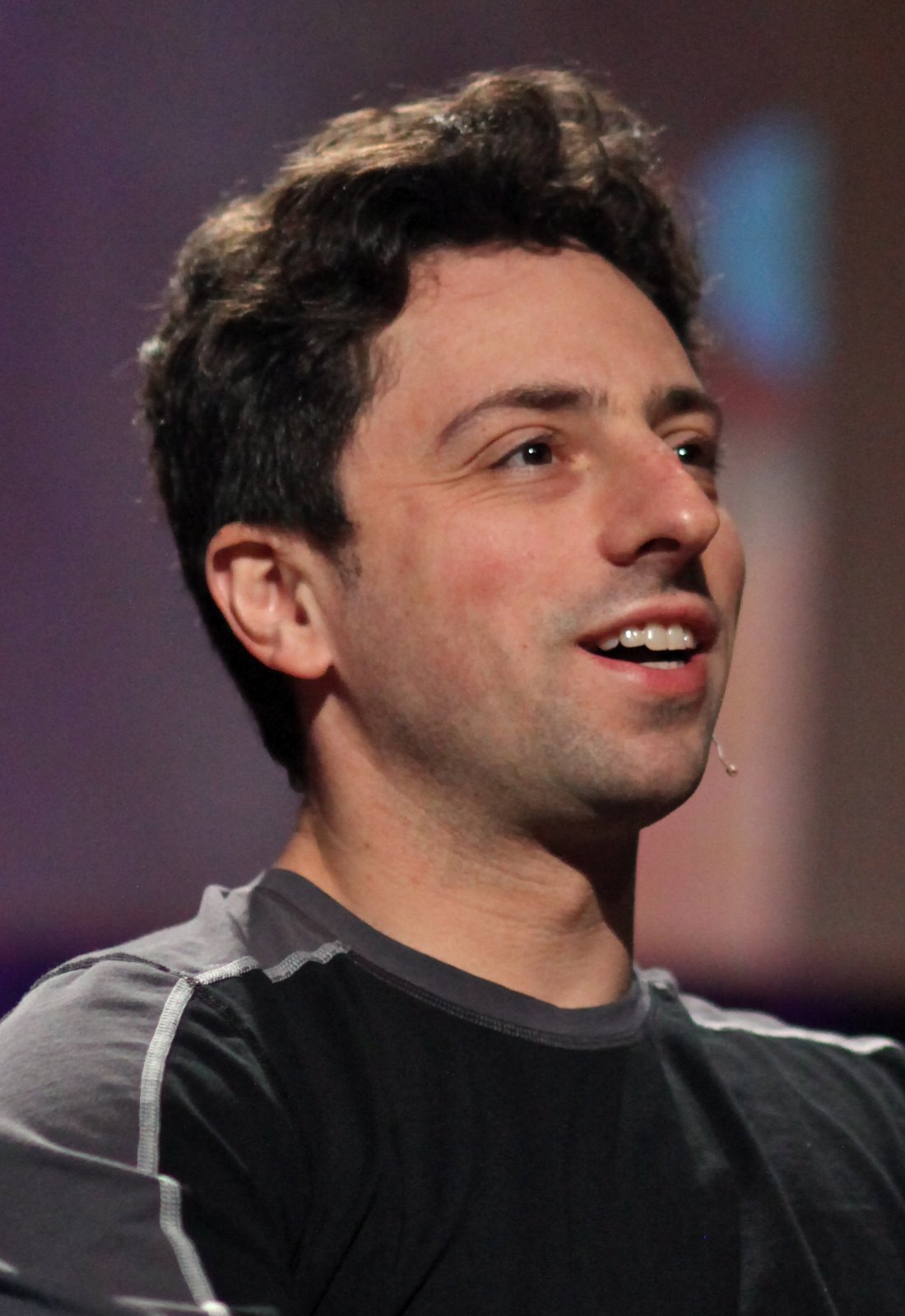

Photo: Steve Jurvetson, CC BY 2.0, via Wikimedia Commons. Cropped and resized for display. · Photograph of Sergey Brin at the TED conference, 12 February 2010, by Steve Jurvetson, via Wikimedia Commons (cropped version of a Flickr photograph titled 'Idealism') · Creative Commons Attribution 2.0 Generic (CC BY 2.0)
computer scientist · Contemporary
Sergey Brin
b. 1973
Known For
Not yet included in personality matching — the documented evidence doesn't yet cover enough of the personality model. Everything else on this page is fully available.
Trait Constellation
Key Achievements
While PhD students at Stanford in 1995-1998, Brin and Larry Page built the BackRub web-crawling prototype and developed PageRank, a method that ranks a web page highly when many highly ranked pages link to it. The National Science Foundation describes Brin as a graduate student on Stanford's NSF-supported digital-library project who joined Page's work; the pair described the resulting Google prototype in the 1998 paper 'The Anatomy of a Large-Scale Hypertextual Web Search Engine'.
Brin and Page founded Google in September 1998. By Alphabet's own account in 2019, the company had grown to more than 100,000 employees, with products including Search, Maps, Ads, Gmail, Android, Chrome, Google Cloud and YouTube.
In the 2004 founders' letter in Google's registration statement, Page and Brin set out an auction-based public offering and a dual-class share structure in which Class B shares carry ten votes each, and the letter describes Brin as focusing on engineering and business deals alongside Page and the CEO Eric Schmidt. Google became part of the Alphabet holding company in 2015; Brin was Alphabet's President until 3 December 2019, when he and Page left their executive roles while remaining co-founders, shareholders and board members.
Moments That Reveal Them
At Google I/O in June 2012 Brin presented Project Glass by staging a live demonstration in which a skydiver wearing the glasses streamed a jump toward the Moscone Center, followed by stunt cyclists wearing them. He announced that only conference attendees could order the Explorer edition, which was not a consumer product.
Fronting a high-profile live demonstration of an unfinished product is consistent with risk tolerance; Brin and analysts later judged the publicity premature, so the same stance carried a cost. Risk Tolerance
At Google I/O in May 2025, asked what he had learned from Glass, Brin said he felt he had 'made a lot of mistakes with Google Glass', citing his lack of knowledge of consumer-electronics supply chains and the difficulty of a reasonable price. He added that the next launch should polish the product before a demo.
Publicly naming his own errors and the change he would make is consistent with belief updating; this is a single reported on-stage statement. Belief Updating
Turning Points
By 1998 Brin and Page were unsure they wanted to run a company, and Brin was reluctant to leave the Stanford programme. Battelle reports that Brin's adviser told him he could return to graduate school and finish his thesis if Google did not work out; Brin recalls answering, 'Yeah, OK, why not? I'll just give it a try.' Google was incorporated in September 1998.
Stepping out of a doctoral programme with a safety net, after weighing the choice, is consistent with proactive agency; the account rests on a journalist's interviews and Brin's own recollection. Proactive Agency
Similar People
People whose overall profiles resemble theirs.


Benjamin Banneker

T. E. Lawrence

Akio Morita

Catherine the Great

Sor Juana Inés de la Cruz
Sources
- Sergey Brin (Q92764) -- verified live via wbgetentities (2026-10-10): en label 'Sergey Brin', ko label '세르게이 브린', born 21 Aug 1973, instance of human, citizenship United States. Orientation only; not used as support for any row.
- John Battelle (journalist, Wired co-founder), 'The Birth of Google', Wired 13.08 (August 2005), an excerpt from his book The Search, based on interviews with both founders -- INDEPENDENT journalistic narrative of how Brin joined Page's BackRub project, how the two built early Google from borrowed hardware, and how they weighed leaving Stanford. Read in full. It relies partly on the founders' own recollections (quoted), and it credits Page with the weighted-ranking concept and Brin with the mathematics.
- U.S. National Science Foundation, 'Google' impact page on the Digital Library Initiative project at Stanford -- institutional (funder) history, non-self. Read in full; it describes Brin as a Stanford graduate student supported by an NSF Graduate Student Fellowship who joined Page's work on web ranking, the BackRub prototype and the PageRank method.
- Engineering and Technology History Wiki (IEEE), 'Milestones: PageRank and the Birth of Google, 1996-1998' -- independent institutional account of the PageRank algorithm and the three commemorative plaques. Read in full; its reference list also records the January 1998 Stanford technical report by Page, Brin, Motwani and Winograd and the patent filed in Page's name.
- Sergey Brin and Lawrence Page, 'The Anatomy of a Large-Scale Hypertextual Web Search Engine', Seventh International World Wide Web Conference (Brisbane, 1998), Stanford-hosted copy -- SELF/primary technical paper by Brin and Page. Read the abstract, the design-goals and scalability sections and Appendix A (advertising and mixed motives). Used for what the two authors built and wrote, never as the only perspective for a scored row.
- Larry Page and Sergey Brin, 'An Owner's Manual for Google's Shareholders' (founders' letter in Google's 2004 S-1 registration statement), Alphabet investor-relations archive -- SELF/primary corporate document, written in Page's voice and signed by both. Read in full. Describes the planned auction IPO, the dual-class voting structure, the long-term and high-risk-project policy, the 20% time policy and the three-person executive arrangement in which Brin 'focuses on engineering and business deals'.
- Alphabet Inc. press release and founders' letter, 'Alphabet management change' (3 December 2019), abc.xyz -- SELF/corporate document announcing that Page and Brin leave their CEO and President roles at Alphabet while remaining co-founders, shareholders and board members, with a statement by chairman John Hennessy. Read in full.
- The Register, report on Sergey Brin's interview at the TED conference (February 2010) about Google's China operations -- trade-press report, non-self, short. Read in full. Records his stated wish to find a way to keep serving China, and his call for other companies hit by the December 2009 attacks to come forward.
- Wall Street Journal report (March 2010) on Brin's role in Google's decision to stop self-censoring in China, as excerpted by the Business and Human Rights Resource Centre -- EXCERPT ONLY: the full WSJ article is paywalled and was not opened; the excerpt says Brin pushed the company to abandon its censored China search engine and had reluctantly agreed to launch it four years earlier. Used only as a corroborating pointer, never as the sole support for a scored row.
- TechRadar, 'Google Glasses showcased with skydiving extravaganza' (June 2012) -- trade-press report on Brin's keynote presentation of Project Glass at Google I/O 2012, the skydiving and bike stunt demonstration, and the Explorer edition offered to attendees. Read in full.
- Computerworld, 'Google X exec: Where Google went wrong with Glass' (18 March 2015) -- trade-press report on Astro Teller's South by Southwest remarks about Glass, with critical commentary from independent analysts (Enderle, Kerravala, Kagan) on how Google publicised the prototype. Read in full. Teller is a Google colleague, so the analysts are the non-self voices; the article concerns Glass as a company programme, with Brin named only as the project's public face by other sources.
- Lance Ulanoff, TechRadar, "'I made a lot of mistakes with Google Glass': Google's Sergey Brin admits missteps" (May 2025) -- journalist's report on Brin's on-stage conversation at Google I/O 2025 with Alex Kantrowitz and Demis Hassabis, quoting his own assessment of Glass (timing, supply chains, price) and his statement that Google should polish a product before a demo. Read in full; the quotations are Brin's own words reported by an independent writer.
- The Next Web, 'Sergey Brin has no executive title at Google but is shaping Gemini' (September 2026), summarising a Business Insider report -- secondary, explicitly unverified by TNW; Google declined to comment. Read in full for context on Brin's recent technical involvement in Gemini; NOT used as support for any scored row, and its unrelated personal-finance items were ignored.