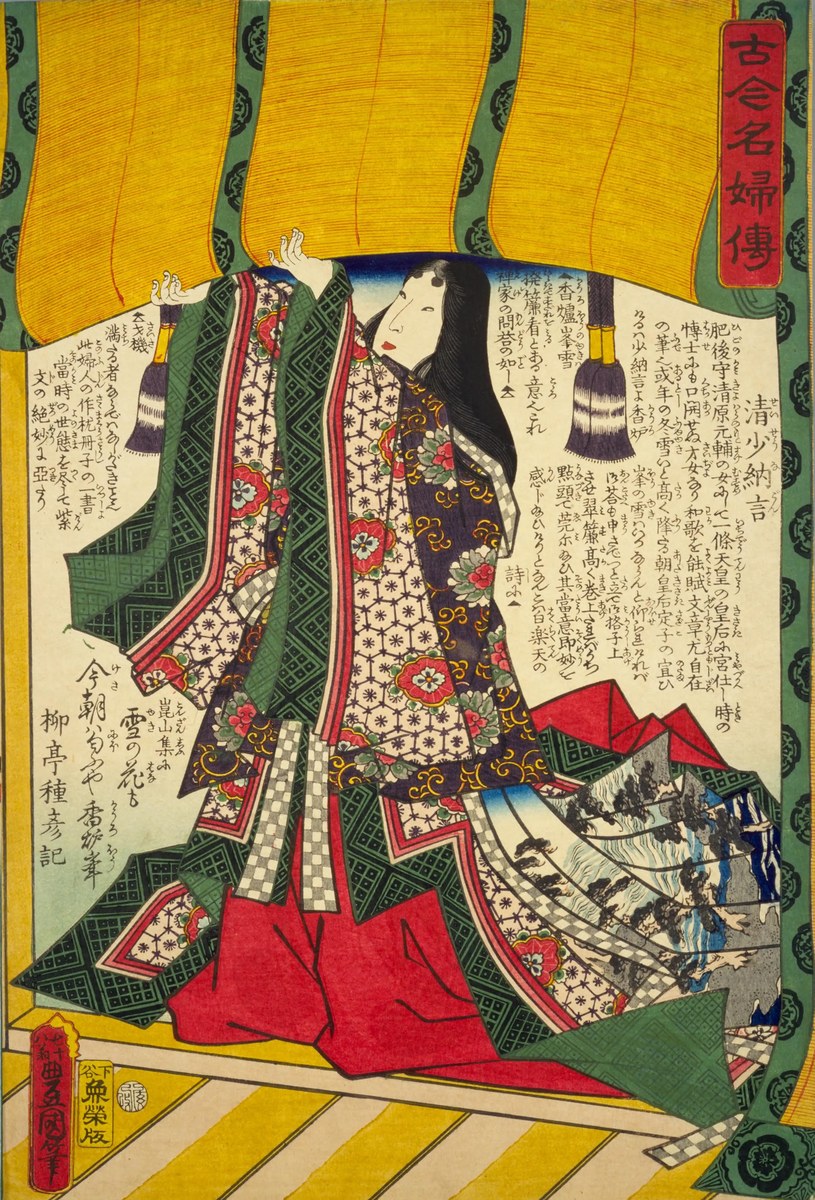
Utagawa Kunisada (Toyokuni III), Kokin meifu den: Sei Shonagon, 1863. National Diet Library, Japan, digital collections, public domain · Kokin meifu den: Sei Shonagon ('Biographies of Famous Women, Ancient and Modern'), colour woodblock print by Utagawa Kunisada (Toyokuni III), published 1863 by Uoei with text by Ryutei Tanehiko, in the National Diet Library, Tokyo (call number Yose-betsu 2-7-1-4, persistent ID 1304224). The print's cartouche and text name her and show her lifting the blind in the snow episode of the Pillow Book; it is an idealised image made about 850 years after her life, not a likeness. The file is a crop of the library's 4096 x 6144 scan (colour chart and ruler removed), downscaled to 815 x 1200 with no upscaling. · Public domain (the library's item record carries the Public Domain Mark; the artist died in 1865)
writer · Medieval
Sei Shōnagon
966–1025
Heian-era Japan
Known For
Not yet included in personality matching — the documented evidence doesn't yet cover enough of the personality model. Everything else on this page is fully available.
Key Achievements
Served Empress Teishi at the Heian court from about 993 to 1000 and wrote the Pillow Book, which Britannica calls a masterpiece of classical Japanese literature in a brilliant and original prose style.
The Pillow Book mixes vivid memoirs with lists such as 'Annoying Things', and is described as the best source of information on Japanese court life in the Heian period.
A poet from a family of poets, she is counted among the thirty-six poetic immortals of the middle Heian period, and one of her poems is no. 62 in the Ogura Hyakunin Isshu.
Moments That Reveal Them
When the Empress pressed her to compose poems after the cuckoo excursion, she told her she would write poems only when she felt inclined and would leave her service if she were repeatedly called on to compose on demand; the Empress laughed and said she could do as she pleased.
This is consistent with insisting on choosing when and how she produced her own work. Need for Autonomy
When the Empress teased her that a sneeze proved she did not truly like her, she answered the next morning with a poem of puns saying she was thought shallow-hearted because of another person's nose.
This is consistent with a readiness to answer back at once in court company. Social Assertiveness
Turning Points
In 996 she spent several months away from the Empress's service at home; the Heibonsha encyclopedia judges that she probably began writing the first form of the Pillow Book then, and she later returned to the Empress's side.
This is consistent with turning a period of enforced distance into the start of a distinctive written work. Creative Originality
Similar People
People whose overall profiles resemble theirs.

Coco Chanel

Sequoyah

Wolfgang Amadeus Mozart

Duke Ellington

Mark Twain
Sources
- Sei Shonagon (Q231603), verified live via the Wikidata API (2026-11-04): English label 'Sei Shonagon' (with macron), description 'Japanese author and court lady', Korean label 세이 쇼나곤, birth 966 and death 1025 (year precision), image a Tosa Mitsuoki portrait. Orientation only; not used as support for any row.
- Encyclopaedia Britannica, 'Sei Shonagon' (article body of about 300 words read in full from the public page). CANONICAL SIGNIFICANCE SOURCE: a diarist, poet and courtier born about 966 and died about 1025 whose Pillow Book (Makura no soshi) 'exhibits a brilliant and original Japanese prose style and is a masterpiece of classical Japanese literature' and 'is also the best source of information on Japanese court life in the Heian period'; daughter of the poet Kiyohara Motosuke; in the service of the empress Teishi (Sadako) at Heian-kyo from about 993 to 1000; little is known of her life outside court; the book mixes memoirs with categories such as 'Annoying Things'; its 'sensitive descriptions of nature and everyday life' and 'detached, sometimes caustic, value judgments'; her wit won her place and also enemies, according to Murasaki Shikibu's diary, which called her conceited; the legend of a miserable old age 'is likely an invention'. Scholarly reference; its praise is retrospective.
- Arthur Waley, introduction ('Japan in the Tenth Century') and closing essay in 'The Pillow-Book of Sei Shonagon' (Boston: Houghton Mifflin, 1929; Internet Archive scan of the text, the lines on her family, service at court, the months away in 996, the Empress's death, Murasaki's remark, the later legends, and the closing character assessment all read). The translator-scholar's independent assessment: the book is 'a plain record of fact' and 'the most important document of the period that we possess'; she entered the Empress's service about 991 and the book deals with 991 to 1000; he calls her 'incomparably the best poet of her time' in her prose, with 'delicate precision of her perceptions' and 'extraordinary power of conveying character'; says her learning is known only from her own book and has been exaggerated, that it was 'her extreme readiness of wit rather than her erudition' that is remarkable; describes a character of contradictions, 'extreme fastidiousness and irritability', behaviour 'calculated to inspire fear rather than affection', and a 'detachment about herself'. Note: Waley's 1929 judgements and some dates differ from later scholarship (the Heibonsha entry dates her service from 993).
- The Pillow-Book of Sei Shonagon (Makura no soshi, written in the years around 1000), in Arthur Waley's 1929 selection of about a quarter of the work (episodes read: her first night in the Empress's service and the sneeze episode, the cuckoo excursion and her refusal to be pressed to compose poems, the evening Korechika and the Empress asked her to take a theme, the months away from the Empress in 996 and the azalea-petal letter). SELF-REPORT: she is the author of every episode; the sources below are used to check or balance it. The Waley volume is a selection, not the whole book.
- The Diary of Lady Murasaki (Murasaki Shikibu nikki, about 1008-1010), translated by Annie Shepley Omori and Kochi Doi in 'Diaries of Court Ladies of Old Japan' (1920; Project Gutenberg text read, the character-sketches passage on court women including Sei Shonagon and the translator's notes). A contemporary and rival-court voice: Murasaki calls her 'a very proud person' who 'values herself highly, and scatters her Chinese writings all about', says 'should we study her closely, we should find that she is still imperfect', that she 'tries to be exceptional' and gives offence, and predicts a bad end. Hostile and personal; used only as the counter-voice, not for private-life inference. The translator's editorial notes in the volume are not used.
- Kotobank (Japanese reference aggregator) entry for Sei Shonagon, reproducing four Japanese reference works: Shogakukan's Digital Daijisen, the Nihon Kokugo Daijiten, Heibonsha's World Encyclopedia (entry by Hagiya Haku) and Shogakukan's Nipponica (entry by Ueno Osamu), read in the original Japanese. They record service with Empress Teishi from about 993, membership among the thirty-six poetic immortals of the middle Heian period, the reputation she won for the snow-of-Koro-ho exchange in the winter of 994, a long stay at home in 996 during which the first form of the Pillow Book was probably begun (Hagiya), the later completion of the surviving text, that she asked the Empress to excuse her from composing poems, left only about 55 poems of her own, and withdrew after the Empress's death; the Nipponica entry notes the Murasaki diary's criticism of her learning and her taste for being different, and that later stories of destitution are probably untrue. Japanese scholarly reference, independent of Waley's selection.