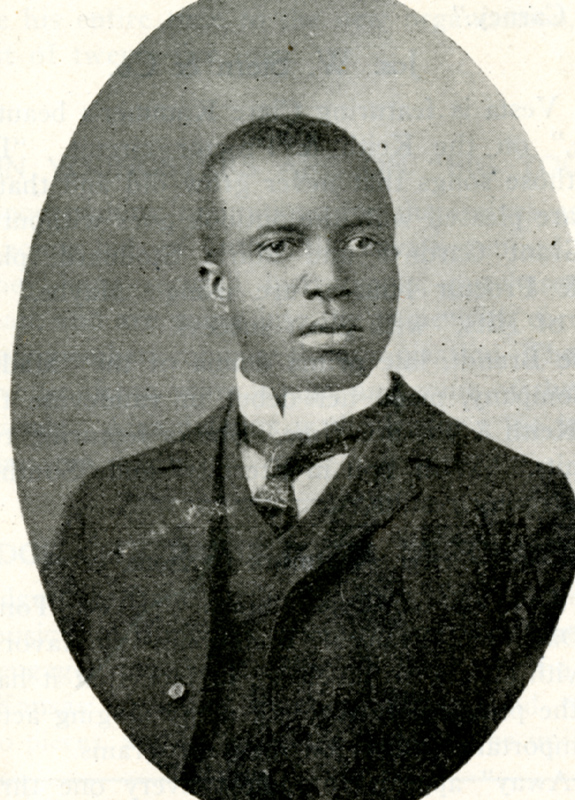

Unknown photographer, published in The American Musician and Art Journal, 17 June 1907. Library of Congress, Music Division (image from the Library's blog) · Portrait photograph of Scott Joplin published in The American Musician and Art Journal, 17 June 1907 (photographer not credited), held by the Library of Congress Music Division and shown as the lead image of the Library's blog post 'Scott Joplin & the Magical Maple Leaf Rag' (2024). The oval halftone was printed on a magazine page and the file shows faint show-through of print around it; it is shown uncropped at its original 575 x 800 pixels with no upscaling. · Public domain (photograph first published in the United States in 1907)
composer · 20th Century
Scott Joplin
1868–1917
Known For
Not yet included in personality matching — the documented evidence doesn't yet cover enough of the personality model. Everything else on this page is fully available.
Trait Constellation
Key Achievements
Composer and pianist known as the 'King of Ragtime Writers', whose Maple Leaf Rag (1899) took him from local fame in Sedalia, Missouri, to national attention and set the standard for the ragtime compositions that followed; Britannica says his reputation rests on the classic rags published from 1899 to 1909, including Maple Leaf Rag and The Entertainer.
He carried ragtime into larger forms: a ragtime ballet (1902), the lost opera A Guest of Honor (1903), the instruction book The School of Ragtime (1908), and the three-act opera Treemonisha, which he published at his own expense in 1911 but never saw fully staged.
After years of obscurity his music was revived: the New York Public Library issued his collected works in 1971, Treemonisha was fully produced in 1972 and reached Broadway in 1975, the 1973 film The Sting made The Entertainer a hit, and in 1976 the Pulitzer Prize board gave him a special posthumous award for his contributions to American music.
Moments That Reveal Them
After his first published pieces in 1895-96 showed little compositional sophistication, he took the advice of Otis Saunders and Tony Williams and enrolled in music courses at Sedalia's George R. Smith College, and by 1897 he could write down the complicated rhythms he and his friends had long improvised.
This is consistent with a musician who acted on a candid assessment of his own gaps and trained to close them. Mastery Orientation
After a Harlem theatre backed out of a planned 1913 staging, Joplin put on Treemonisha himself in 1915 at the Lincoln Theater with no costumes, props or orchestra, having already invested most of his money in the opera; it drew no critical comment.
This is consistent with a creator who kept pursuing a large work through repeated failures to find backing, at heavy personal cost. Persistence
Turning Points
In 1899 the publisher John Stark issued Maple Leaf Rag in Sedalia, and its success moved Joplin from local entertainer to national fame; Stark moved to St. Louis in 1900 and Joplin followed within a year, hoping to reach a larger market with compositions and performances.
This is consistent with a composer who used a breakthrough to move toward a bigger stage for his work. Achievement Drive
Similar People
People whose overall profiles resemble theirs.

Frida Kahlo

Wolfgang Amadeus Mozart

Yayoi Kusama

Maya Angelou

Marie Curie
Opposite Profile
Not a rival — a different profile shape worth a look.
Otto von Bismarck
Sources
- Scott Joplin (Q191499), verified live via the Wikidata API (2026-11-02): label 'Scott Joplin', description 'American composer, musician, pianist (1867/68-1917)', Korean label 스콧 조플린, several candidate birth dates recorded and death April 1917. Orientation only; not used as support for any row.
- Encyclopaedia Britannica, 'Scott Joplin' (Britannica Editors, revised by Rene Ostberg), read in full. CANONICAL SIGNIFICANCE SOURCE: American composer and pianist who became known as the 'king of ragtime'; he settled in Sedalia, Missouri, in 1895, studied music at the George R. Smith College for Negroes and hoped for a career as a concert pianist and classical composer; his first published songs brought him fame and in 1900 he moved to St. Louis to work with the publisher John Stark; 'Maple Leaf Rag' ignited the ragtime craze; he published a ragtime ballet suite in 1902, an opera A Guest of Honor (1903, no longer extant), and in New York The School of Ragtime, an instruction book that was widely imitated; most of his later effort went into the three-act opera Treemonisha, published at his own expense in 1911 and given only one semipublic performance in his lifetime; his reputation rests on the classic rags published 1899-1909, and he was awarded a special Pulitzer Prize posthumously in 1976. Its remarks on his later health are not used.
- Handbook of Texas Online (Texas State Historical Association), 'Joplin, Scott' by Theodore Albrecht, read in full: childhood in Texarkana and piano lessons from Julius Weiss, years as an itinerant pianist, the Sedalia period and the George R. Smith College, the 1899 publication of Maple Leaf Rag (this entry names Carl Hoffman of Kansas City as publisher, which conflicts with the Missouri Encyclopedia, the SHSMO and the Library of Congress, who name John Stark of Sedalia; the Stark account is followed here) and the sheet music's reported sale of over a million copies, the on-and-off arrangement with John Stark, the ballet and two operas (orchestration scores of both operas lost), conductor Alfred Ernst's remark that he was 'an unusually intelligent young man and fairly well educated', the statement that he held a strong conviction that education was the key to success for African Americans, the unsuccessful 1915 staging of Treemonisha, and the posthumous recognition (Songwriters Hall of Fame 1970, New York Public Library collected works 1971, The Sting 1973, Pulitzer 1976). State historical association reference; admiring in tone; the sales figure is disputed by Berlin (see the Gracyk review).
- Missouri Encyclopedia, 'Scott Joplin (1868-1917)' by Susan Curtis (from the Dictionary of Missouri Biography, University of Missouri Press), read in full: foremost contributor to a 'Missouri style' of ragtime; his early publications lacked compositional sophistication, so on the advice of Otis Saunders and Tony Williams he enrolled in courses at the George R. Smith College; he collaborated with Arthur Marshall and Scott Hayden; Maple Leaf Rag (1899) 'set the standard' though he was 'not the first' to capture the rhythm on the page; Stark coined 'King of Ragtime Writers'; conductor Alfred Ernst (1909) and critic Monroe Rosenfield (1903) praised him; his 1903 opera A Guest of Honor drew no financial backing and was staged little more than once as a dress rehearsal; in New York he joined the Colored Vaudevillian Benevolent Association (executive committee 1912); Treemonisha, which he insisted was grand opera and 'strictly Negro' music, found no backer, a Harlem theatre deal collapsed in 1913, and the 1915 staging had no costumes, props or orchestra and drew no critical comment; he had invested most of his money in it. University-press scholarly reference by a historian; the passages on illness and family are not used.
- State Historical Society of Missouri, 'Scott Joplin' (Historic Missourians), read in full: wrote 44 original piano rags, two operas and one ragtime ballet and co-wrote seven rags; led a band at the 1893 Chicago fair; trained at the George R. Smith College to turn his music into notation; Alfred Ernst and Monroe Rosenfield praised his work; 'trouble raising money to produce the works that he cared most deeply about'; 1911-1915 unstaged run-throughs and partial performances of Treemonisha without backing for a full production; Treemonisha first fully produced in January 1972 (Morehouse College and the Atlanta Symphony), which 'drew criticism from some reviewers' as well as praise; his work revived in the 1940s and more in the 1970s; The Entertainer a hit after The Sting (1973); special Bicentennial Pulitzer 1976. State historical society educational biography.
- Library of Congress blog 'Timeless', 'Scott Joplin & the Magical Maple Leaf Rag' by Neely Tucker (21 November 2024), read in full: the two 1899 copyright-deposit copies of Maple Leaf Rag in the Music Division, with Joplin credited as composer on the cover; Joplin got a penny from every 50-cent sale and it made him moderately well off for several years; no original manuscript survives; the piece is so difficult that Joplin rehearsed before playing it in public; no recordings of his playing survive apart from edited piano rolls (preserved in the National Recording Registry, 2002); the 1973 film The Sting score topped the Billboard Hot 100 for five weeks in 1974; the St. Louis house he rented after 1900 is a National Historic Landmark; Eubie Blake's recollection of a poor late performance is NOT used. The page also captions the portrait photograph used here as published in The American Musician and Art Journal, 17 June 1907.
- Tim Gracyk, book review of Edward A. Berlin's 'King of Ragtime: Scott Joplin and His Era' (Oxford University Press), Phonographs, Singers and Old Records (gracyk.com), read in full. Independent critical voice by an old-records collector: Berlin never exaggerates Joplin's popularity, Stark's claimed million copies of Maple Leaf Rag is judged inflated by Stark's own ledgers, and 'it did not sell as much as the most popular vocal music' (quoting Berlin); the reviewer argues ragtime never dominated the period, finds Treemonisha musically weak ('not a good opera') and says Stark's refusal to publish it 'is testimony to sound business instincts', and detects 'some arrogance' in Joplin's belief that he could succeed in opera and in his sheet-music instruction that it is never right to play ragtime fast; notes Joplin was not regarded as a strong player late in life, that few contemporary black musical leaders took notice of him, and that a pupil called him 'a little hot headed' (the same review treats that pupil as an unreliable source). Opinionated secondary review; used as the counter-voice and for what it reports from Berlin.
- The Pulitzer Prizes, 'Scott Joplin', 1976 Special Citations and Awards, read: 'A special award is bestowed posthumously on Scott Joplin, in this Bicentennial Year, for his contributions to American music.' Award-body record used only for the recognition fact.