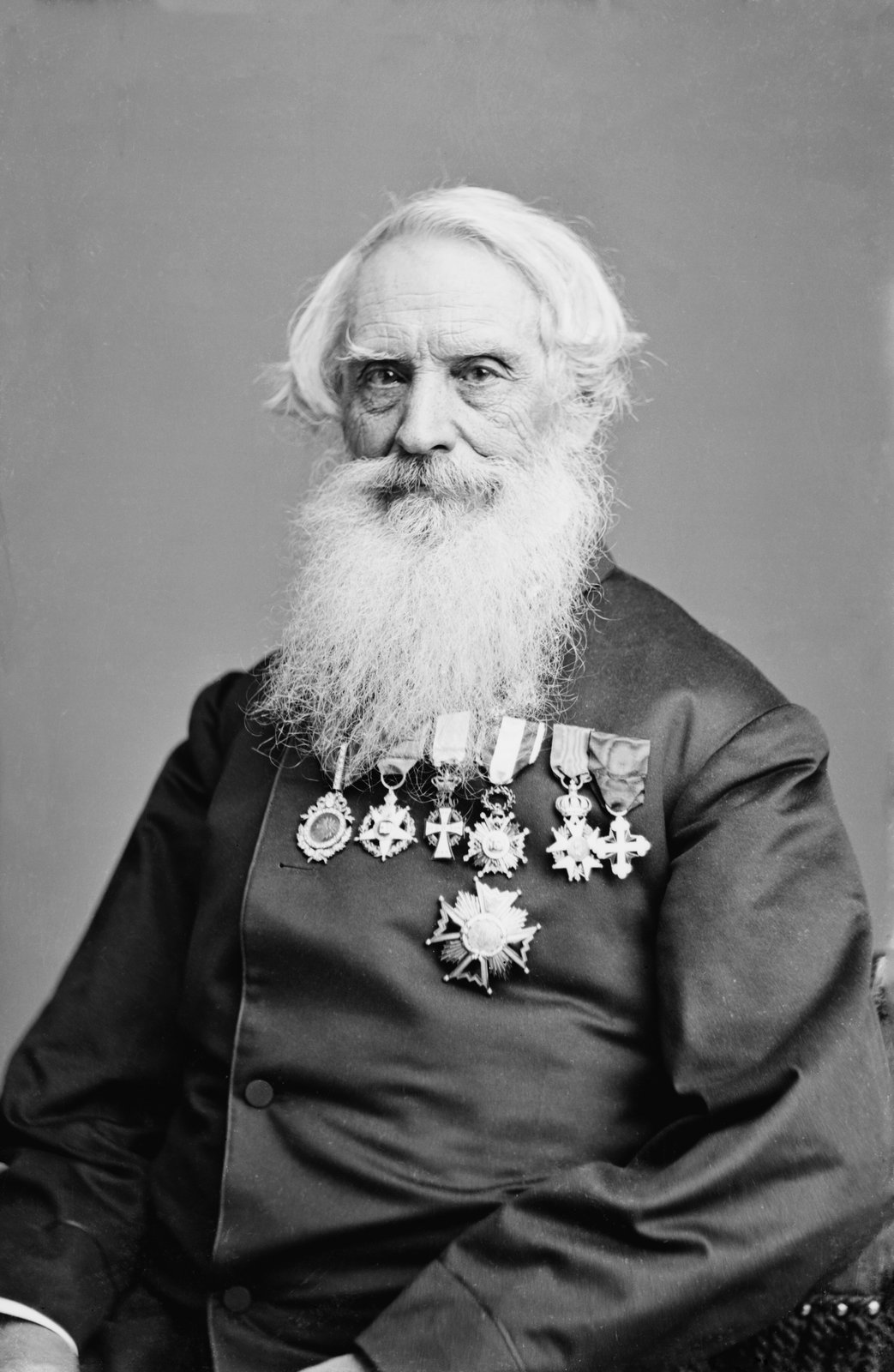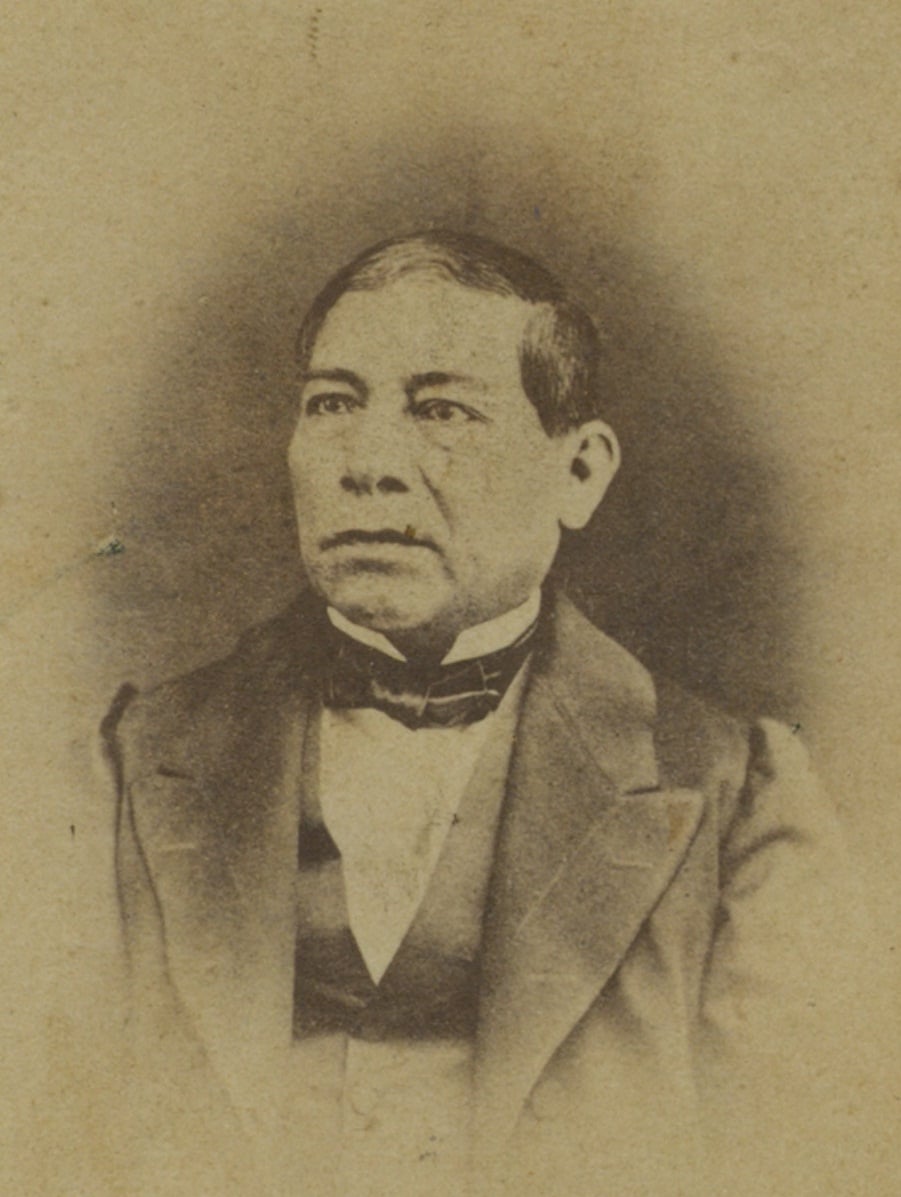

Mathew Brady studio, Samuel F. B. Morse, between 1855 and 1865, wet-collodion glass negative, Brady-Handy photograph collection, Library of Congress (LC-DIG-cwpbh-00853); public domain, no known restrictions on publication; downscaled · Library of Congress, Prints and Photographs Division, Brady-Handy photograph collection (LC-DIG-cwpbh-00853, digital file from original glass negative), via Wikimedia Commons · Public domain
Trait Constellation
Key Achievements
From 1836 Morse developed an electromagnetic recording telegraph with Leonard Gale and, from 1837, Alfred Vail. After Congress voted $30,000 in March 1843 for an experimental line, the Washington-Baltimore wire carried the message "What hath God wrought?" on 24 May 1844. The Library of Congress's account names Joseph Henry's published research, Gale's help and Vail's mechanical work as keys to the system, and in O'Reilly v. Morse (1854) the Supreme Court upheld his patent for the apparatus and process he had described while striking down his broadest claim, to any use of electromagnetism for marking characters at a distance.
Trained in London under Benjamin West and Washington Allston, Morse worked as a portrait and history painter for more than two decades. His large canvases include The House of Representatives (1821-22), with some eighty portraits of members, and Gallery of the Louvre (1831-33), in which he regrouped Old Master paintings from the Louvre in a single room. In 1826 he was a founder and the first president of the National Academy of Design in New York.
After meeting Louis Daguerre in Paris in 1839, Morse published one of the earliest American descriptions of the daguerreotype. With John William Draper he opened a portrait studio in New York and taught the process to several pupils, among them Mathew Brady.
Moments That Reveal Them
On 18 October 1842 Morse laid about two miles of wire, insulated by hand with pitch, tar and rubber, across New York Harbor from the Battery to Governor's Island. According to his son's account, the next day's public demonstration stopped after a few signals when a ship's anchor snagged the cable and the crew cut it. That December he tried sending signals across the canal in Washington, and reported to Alfred Vail that the test succeeded.
Repeating the trial in a different form within two months, rather than dropping the question of crossing water, is consistent with the profile's high experimentation score. Experimentation
Leonard Gale, a chemistry professor at the University of the City of New York, first examined Morse's apparatus in the winter of 1836 and suggested replacing its single-cell battery with one of many cells and winding the magnet with hundreds of turns of wire. In a letter written in 1856, Gale recalled that the change was tried the same day and carried the current through hundreds of feet of wire instead of a few dozen. Gale wrote this for Joseph Henry during Henry's dispute with Morse, twenty years after the event.
Taking up an outsider's correction immediately offers one example behind the profile's moderate belief-updating score; the episode also shows how much the working system drew on other people's science. Belief Updating
Turning Points
In 1834 Morse wrote to members of Congress asking to be chosen to paint one of the four remaining panels in the Capitol Rotunda. When the artists were named in 1837 he was not among them; he finished his last paintings that December and turned to the telegraph. In an 1849 letter he wrote that he had taken scarcely any interest in painting for many years.
Moving his working life from painting to invention after this setback sits alongside the profile's adaptability, though his need for income and the telegraph work already under way were also part of the change. Adaptability
Similar People
People whose overall profiles resemble theirs.

Louis Pasteur

Thomas Edison

Benjamin Franklin

Malala Yousafzai

Abraham Lincoln
Opposite Profile
Not a rival — a different profile shape worth a look.

Benjamin Banneker
Sources
- Samuel Morse (English Wikipedia) -- orientation only (identity, dates, occupations); not used as support for any scored row. The Korean Wikipedia page 'ko:새뮤얼 모스' was confirmed to exist via the Wikidata sitelink (title only).
- Samuel Finley Breese Morse (Q75698) -- identity verified live through the Wikidata API (wbgetentities: labels, descriptions, claims, sitelinks): en label 'Samuel Finley Breese Morse', description 'American inventor and painter (1791-1872)', ko label '새뮤얼 모스', born 1791-04-27, died 1872-04-02, citizenship United States (Q30), P18 'Samuel Morse portrait.jpg', kowiki title '새뮤얼 모스'. Orientation only.
- Library of Congress, 'Samuel F. B. Morse Papers at the Library of Congress, 1793 to 1919' -- curatorial essays read in full via the loc.gov JSON API: 'Invention of the Telegraph', the essay on Morse as artist, politician and photographer ('An Artist First', 'Towards Telegraphy', 'Art and Politics', 'Pioneering Photographer'), and the two collection timelines '1791-1839' and '1840-1872'. Independent institutional/curatorial perspective (secondary, built on the Morse Papers); explicitly credits Henry's published work, Gale's help, Vail and Cornell. Used for dated facts and for the essay's characterisation only where corroborated.
- Annual Report of the Board of Regents of the Smithsonian Institution for 1857 (Washington, 1858), Proceedings of the Regents, pp. 85-96 read (archive.org OCR full text): Joseph Henry's 'Communication ... relative to a publication by Prof. Morse' and the Regents' special committee report on it, which reproduces Leonard D. Gale's letters to Henry of 7 April 1856 and 5 August 1857, an extract of Sears C. Walker's deposition, S. P. Chase's 1856 letter, and passages from Morse's own letters of 1839 and notes of 1846-48. ADVERSARIAL/INTERESTED perspective (Henry and the institution he headed, answering Morse's 1855 'Defense'); Gale's letters are firsthand collaborator testimony written ~20 years after the events. Used for the 1836 Gale episode and the 1846-55 Henry dispute, never for motive claims.
- O'Reilly v. Morse, 56 U.S. (15 How.) 62 (1854), U.S. Supreme Court, full text read via Cornell LII: the reporter's statement of the case (pleadings and the patentee's own account of 1832-37) and the opinion of the court by Chief Justice Taney (December Term 1853) on priority, the 1832-38 chronology and the eighth claim, held void as too broad. JUDICIAL perspective resting on the trial depositions (Captain Pell, W. C. Rives, the Morse brothers, Gale, Henry); the reporter's summary of Morse's own sworn statement is treated as self. Priority holdings are NOT used as trait evidence.
- Samuel F. B. Morse: His Letters and Journals, ed. Edward Lind Morse (Boston, 1914), 2 vols, Project Gutenberg #11017/#11018 full text downloaded -- MORSE'S OWN LETTERS as printed there (SELF, one perspective): vol. I ch. VII (letter of 2 May 1814), vol. II ch. XXII (circular of 7 March 1834; 1849 letter to Cooper; his account of the first instrument), ch. XXVIII (letters to Vail, Dec. 1841), ch. XXIX (letter to Vail of 18 Dec. 1842), ch. XXX (letters to Sidney Morse and the Treasury, Dec. 1843 - Jan. 1844), ch. XXXIV (letters of 1852-54 on the 'Defense'). Never the sole support for a row.
- Edward Lind Morse's editorial narrative in Samuel F. B. Morse: His Letters and Journals (1914), vol. I ch. XX and vol. II ch. XXII-XXX, XXXIV (same Gutenberg texts) -- INSIDER perspective (the subject's son; admiring and openly partisan on priority questions, e.g. duplex/wireless and alphabet claims, which are NOT used). Includes letters by third parties reproduced there: Washington Allston to Morse's parents (1814) and to Morse (1837), Thomas Cole to Morse (14 March 1837), George Vail (31 Dec. 1842), and Samuel Isham's 1910 critical assessment.
- Daniel Huntington's recollection of Morse as teacher and painter (pupil from spring 1835), prepared for S. I. Prime and reproduced in Letters and Journals vol. I ch. XX -- FIRSTHAND, non-family (a pupil and friend; admiring, written decades later). Read in full as reproduced.
- David Hunter Strother ('Porte Crayon'), recollection of studying painting under Morse at the University of the City of New York c.1841, reproduced in Letters and Journals vol. II ch. XXVIII -- FIRSTHAND, non-family pupil's anecdote told long afterwards (one anecdote; used only for Morse's circumstances and teaching, not for extreme scores).
- Ezra Cornell's account of the 1844 switch from underground pipe to poles and the choice of insulator, as quoted in S. I. Prime's Life (1875) and reproduced in Letters and Journals vol. II ch. XXX -- FIRSTHAND, non-family (Morse's hired mechanical assistant; recalled years later and partly self-serving about his own role).
- Samuel Irenaeus Prime, The Life of Samuel F. B. Morse, LL.D. (New York, 1875), archive.org OCR full text (cu31924022818185) -- FRIEND/ADMIRING biographer working from family-supplied papers (insider-leaning, weakly independent). Read: the marble-carving machine and House of Representatives passages (pp. 89-128), the National Academy of Design chapter pp. 149-153 (which quotes William Dunlap's contemporary History of the Arts of Design and Morse's address of 14 Jan. 1826), the Louvre-picture passage (pp. 227-228) and the 1873 Daily Graphic description quoted pp. 248-249.
- Terra Foundation for American Art, 'Terra Collection Initiative: Samuel F. B. Morse's Gallery of the Louvre and the Art of Invention' and 'Conservation Notes: A New Look ...' (web pages, read in full) -- independent museum perspective (owner of the painting); reports the 1831-33 creation in Paris and New York, the selection and 'reinstallation' of Louvre masterpieces, and that the 2010 conservation 'confirmed that Morse was as fearless an experimenter with painting media' as in his later work. Short pages; used only as corroboration.