Bertrand Russell
89% Profile Match
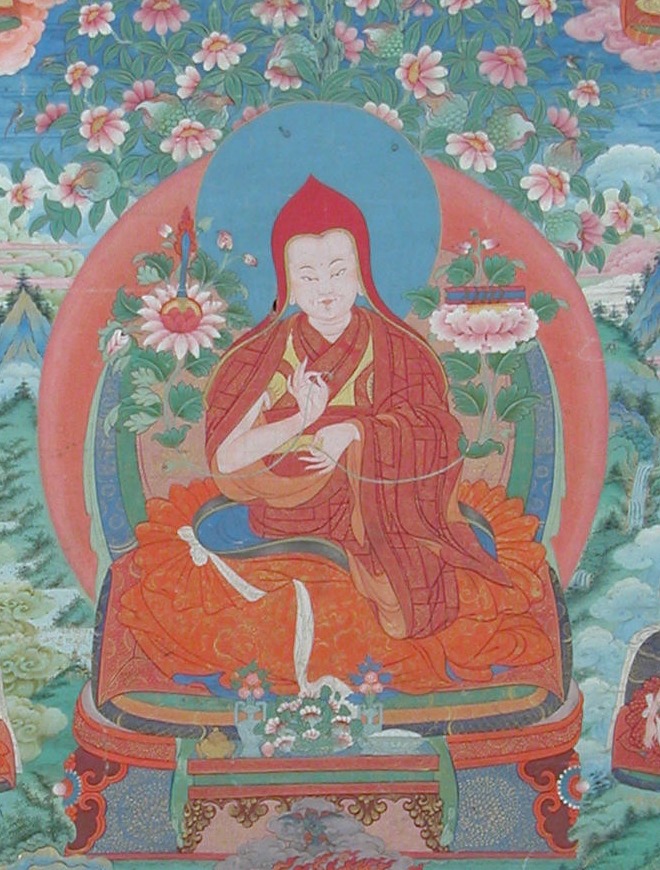
Sakya Pandita, thangka, Eastern Tibet, 18th century. The Metropolitan Museum of Art, Rogers Fund, by exchange, 2006 (2006.285), Open Access · Sakya Pandita, thangka (distemper on cloth), Eastern Tibet, 18th century, accession 2006.285, The Metropolitan Museum of Art, New York (Rogers Fund, by exchange, 2006). A later devotional painting by an unknown artist, made about 500 years after his life, not a likeness. The file is a crop of the central seated lama from the museum's 1168 x 1676 image (the surrounding figures removed), 660 x 870, no upscaling. The painting carries no visible lettering; the museum's title identifies the sitter. · Public domain (Met Open Access: the museum's record marks the work as public domain; anonymous 18th-century painting)
scholar · Medieval
1182–1251
Not yet included in personality matching — the documented evidence doesn't yet cover enough of the personality model. Everything else on this page is fully available.
The fourth of the five great throneholders of Sakya (1182-1251), he re-established Sakya as a leader in the study of epistemology; the Encyclopedia of Buddhism calls him the greatest early scholar of the Sakya school and counts more than one hundred compositions.
His five major works include the Treasury of Aphoristic Jewels, still memorized by Tibetans, the Treasury of Epistemological Reasoning, the Clear Differentiation of the Three Codes, Clarifying the Sage's Intent and the Gateway to Learning.
With the Kashmiri scholar Shakyashribhadra he retranslated Dharmakirti's Pramanavarttika into Tibetan, and in the Gateway to Learning he set out a program of study in composition, exposition and debate that SEP calls a rare medieval treatise on the goals and means of education.
In the Clear Differentiation of the Three Codes he listed ten doctrines held by his Tibetan contemporaries as fallacious and defended the use of scripture and reasoning against the charge that his critiques came from hostility or jealousy.
This is consistent with a readiness to dispute openly with his own side, at the price of lasting controversy. Conflict Tolerance
A verse attributed to him uses the word 'I' eight times to claim to be a grammarian, logician, poet and master of the outer and inner sciences, and calls other so-called scholars mere imitations.
This is consistent with an openly self-assured way of presenting his own learning, though the verse is attributed and self-reported. Social Assertiveness
When the Kashmiri scholar Shakyashribhadra arrived in Tibet with a group of pandits, he met him, hired Sugatashri as a tutor for three years and then studied with Shakyashri for five more; SEP calls this a major turning point, after which he retranslated Dharmakirti's work and made Sakya a center of epistemology, where it had been known for the Lamdre tradition.
This is consistent with a deliberate, multi-year commitment to mastering a new body of learning. Mastery Orientation
People whose overall profiles resemble theirs.

Not a rival — a different profile shape worth a look.